
Two or Three Signs in Weeks? Early Dementia Checklist for Caregivers

Early signs of dementia go well beyond forgetfulness. Trouble finding words, getting disoriented in familiar places, poor judgment about money, and personality changes can all show up before memory loss becomes obvious. If you notice a pattern rather than an isolated slip, the right move is to schedule an evaluation with a primary care clinician. Some causes are reversible, and early answers give you time to plan.
TL;DR:
- Memory loss that disrupts daily routines is a key early sign, especially when questions are repeated or recent events are forgotten.
- Challenges with planning or solving familiar problems often become obvious, such as difficulty managing bills or following multi-step recipes.
- Behavioral changes like social withdrawal, irritability, or mood shifts can appear months or years before memory issues in some dementia types.
- Reversible causes such as vitamin B12 deficiency, thyroid issues, or depression can mimic early dementia symptoms and require prompt evaluation.
- Early safety concerns include poor medication management, risky driving, financial vulnerability, and home hazards that need immediate attention.
Table of Contents
- What Are the Early Signs of Dementia to Watch For?
- When Should You Call a Doctor About Memory Changes?
- Could Something Other Than Dementia Explain These Symptoms?
- How Do Doctors Test for Early Dementia?
- What Should You Do After Noticing Warning Signs?
- How Garden State Medical Group Supports Early Evaluation
- Could It Be Apathy or Irritability Instead of Forgetfulness?
- How Do Early Signs Affect Daily Safety?
- Does Family History Raise Your Dementia Risk?
- What Screening Tests Detect Early Dementia?
- What the Checklist Gets Right, and Where It Falls Short
- Sources
- FAQ
What Are the Early Signs of Dementia to Watch For?
The Alzheimer’s Association’s list of 10 early signs remains the most widely cited checklist, and for good reason: it captures how dementia touches memory, language, judgment, and mood all at once rather than one skill in isolation. Here’s how each one tends to show up in daily life, and how it differs from the normal slowdowns that come with aging.
-
Memory loss that disrupts daily life. Forgetting a name and recalling it later is normal. Asking the same question repeatedly, or forgetting a recent conversation, is not.
-
Challenges with planning or solving problems. Balancing a checkbook, following a recipe with multiple steps, or paying bills on time becomes noticeably harder, and mistakes multiply.
-
Difficulty completing familiar tasks. This is called apraxia. Someone who has made coffee every morning for 40 years suddenly can’t remember the steps, or forgets how to drive to a store they’ve visited hundreds of times.
-
Confusion about time or place. Losing track of dates, seasons, or the passage of time is common. So is genuinely not knowing how you got somewhere.
-
Trouble with visual or spatial relationships. Judging distance, reading, or navigating stairs becomes harder. Some people stop driving because depth perception and distance judgment quietly decline.
-
New problems with words. Struggling to follow a conversation, repeating the same story, or calling a “watch” a “hand clock” all point to language changes.
-
Misplacing items and losing the ability to retrace steps. Everyone misplaces keys. It’s different when someone puts the remote in the freezer and cannot walk back through what they did.
-
Decreased or poor judgment. Falling for phone scams, dressing inappropriately for the weather, or neglecting hygiene are common early markers.
-
Withdrawal from work or social activities. Hobbies, favorite shows, or standing social plans get dropped, often quietly, because keeping up feels harder than it used to.
-
Changes in mood and personality. Increased confusion, suspicion, anxiety, or irritability, especially outside a person’s comfort zone, is a signal worth noting.
Mayo Clinic’s overview of dementia notes that symptom patterns vary by cause. Frontotemporal dementia, for instance, often begins with personality shifts or language trouble rather than memory loss at all. That’s why “he just doesn’t remember things” is the wrong lens for every case. If the person’s family history includes an atypical dementia, watch for behavioral change first, not memory slips.
When Should You Call a Doctor About Memory Changes?
Some symptoms need attention today. Others are worth tracking and bringing to a scheduled visit. Knowing the difference keeps you from either panicking unnecessarily or waiting too long.
Seek urgent care for:
- A sudden, severe change in alertness or confusion, especially over hours or days
- Hallucinations, delusions, or new inability to recognize familiar people
- A new fall, loss of mobility, or sudden difficulty speaking
- Any signs that could indicate a stroke or acute infection
Schedule a routine but timely visit for:
- Gradual memory or functional decline that’s been noticeable for weeks to months
- A pattern from the checklist above that’s affecting work, finances, or safety
- Family members independently raising the same concern
Pro Tip: Keep a simple running note on your phone with dates and specific examples (“March 3: forgot how to start the dishwasher”). Vague impressions fade; dated examples give a clinician something concrete to work with.
Before the appointment, gather a medication list, any recent labs or imaging, and the names of family members or friends who’ve noticed changes. Clinicians rely heavily on outside observations, since people experiencing cognitive decline often underestimate it themselves.
Could Something Other Than Dementia Explain These Symptoms?
Many conditions produce symptoms that look exactly like early dementia, and several are treatable. This is precisely why self-diagnosing from a checklist is risky, and why an evaluation matters more than the checklist itself.
- Vitamin B12 deficiency. Low B12 can cause memory problems, confusion, and even nerve symptoms. It’s one of the most common reversible causes clinicians check for, and correcting it (often with methylcobalamin or cyanocobalamin, depending on the case) can meaningfully improve cognition.
- Thyroid dysfunction. An underactive thyroid slows thinking and can mimic dementia closely.
- Medication side effects. Older adults on multiple prescriptions (polypharmacy) are especially prone to drug interactions that cloud thinking.
- Depression, often called pseudodementia in older adults. It frequently comes with memory complaints and slowed thought, and it tends to improve substantially once treated.
- Sleep disorders, alcohol use, and infections. Poor sleep and untreated urinary tract infections are notorious for causing sudden confusion in older adults.
The National Institute on Aging lists these reversible causes explicitly, which is why a full evaluation, not a guess, comes first.
How Do Doctors Test for Early Dementia?
Diagnosis is a process of ruling things in and ruling things out, and it usually starts simpler than people expect.
- Brief cognitive screens. Tools like the Mini-Cog and the Montreal Cognitive Assessment (MoCA) take 5 to 15 minutes and check memory, attention, and executive function. The Mini-Cog is faster and more limited; the MoCA and the Mini-Mental State Examination (MMSE) go deeper and catch subtler deficits, which matters for distinguishing mild cognitive impairment from early dementia.
- Baseline labs. B12, thyroid-stimulating hormone (TSH), a complete blood count, and a metabolic panel are standard first steps, according to CDC guidance on dementia signs and symptoms.
- Imaging or neuropsychological testing. These come next if screening and labs don’t explain the picture, or if the presentation is unusual.
- Specialist referral. Neurology, geriatrics, or psychiatry gets involved for complex or ambiguous cases.
Mild cognitive impairment (MCI) sits between normal aging and dementia. Reviewed conversion rates to dementia range from under 5% to roughly 20% a year depending on the population studied, which is why serial testing over time matters more than a single snapshot.
What Should You Do After Noticing Warning Signs?
Once you’ve noticed a real pattern, safety comes first, and paperwork comes second.
- Check safety basics now. Review driving ability, medication management (missed or doubled doses are a red flag), and home hazards like loose rugs or poor lighting that raise fall risk.
- Book the evaluation. Don’t wait for a “worse” moment. Earlier evaluation means more treatable causes are still on the table.
- Document specific examples. Bring dated notes, not general impressions.
- Involve a trusted contact. A second observer strengthens the clinical picture and supports the person through appointments.
- Review medications with a pharmacist or physician. Polypharmacy is a common, fixable contributor to confusion.
- Start the planning conversation. Advance directives, power of attorney, and financial planning are far easier to arrange while someone can still participate in the decisions. The CDC notes that early diagnosis gives families time to plan for legal and care needs before a crisis forces the issue.
How Garden State Medical Group Supports Early Evaluation
A memory concern rarely has one cause, which is why Garden State Medical Group built its evaluation process around coordination rather than a single office visit. Primary care starts the workup, on-site radiology handles imaging without a separate referral trip, and the practice’s Memory and Cognition Care Program follows up on findings over time instead of leaving families with a one-time screening result.
- Cognitive screening and a full medication review at the first visit
- Lab work (B12, thyroid, metabolic panel) ordered the same day when indicated
- Direct coordination with specialists when a case needs neurology or geriatrics
| What to bring | Why it matters |
|---|---|
| Insurance card and ID | Needed for check-in and billing |
| Current medication list | Screens for polypharmacy and interactions |
| Dated examples of changes | Gives the clinician a concrete timeline |
| Names of family observers | Supports accurate history-taking |
Could It Be Apathy or Irritability Instead of Forgetfulness?
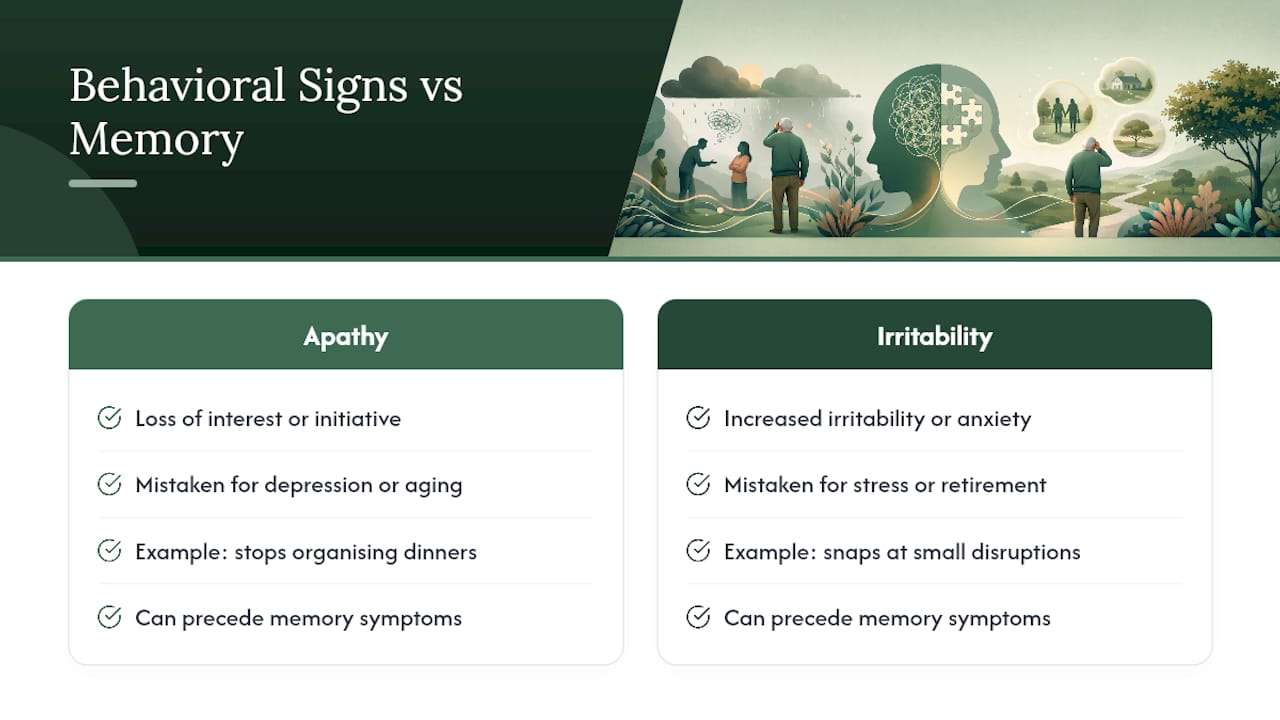
Not every early sign looks like a memory problem. Apathy, a loss of interest or initiative, is one of the most underreported early symptoms of dementia because it’s easy to mistake for depression, retirement adjustment, or simple aging. Someone who used to organize the family dinner every Sunday just stops, without sadness or complaint, and without any obvious trigger.
Irritability and increased anxiety over minor changes in routine are also common and often show up before any measurable memory loss does. A person who was easygoing might snap at small disruptions, become suspicious of a spouse’s whereabouts, or grow anxious about tasks that used to be routine.
These behavioral shifts matter clinically because they sometimes precede memory symptoms by months or years, particularly in frontotemporal dementia. They’re also the signs families dismiss most often, chalking them up to stress, retirement, or “just getting older.” If a normally social, engaged person becomes flat, indifferent, or uncharacteristically irritable, that shift deserves the same attention as a memory lapse, not less.
How Do Early Signs Affect Daily Safety?
The practical risk of early dementia isn’t abstract. It shows up in specific, preventable situations: a missed medication dose that becomes a doubled dose, a stove left on, a wrong turn on a familiar drive that turns into a police welfare check.
Financial safety is just as real a concern. Poor judgment about money, one of the checklist signs above, makes older adults more vulnerable to scams, unpaid bills, and impulsive purchases. Families often discover the problem only after a financial loss forces the conversation.
Driving deserves particular attention because it combines several early deficits, visuospatial judgment, reaction time, and attention, into one high-stakes activity. A single close call is worth treating as a serious signal, not a fluke. None of this means early signs equal immediate incapacity. Many people function well and safely for years after their first symptoms, especially with support systems in place. But the earlier a family identifies the specific safety gaps, driving, cooking, finances, medication, the more options remain for addressing them gradually instead of in a crisis.
Does Family History Raise Your Dementia Risk?
A parent or sibling with dementia raises your own risk somewhat, though it’s far from destiny. Most dementia cases result from a mix of genetics, vascular health, lifestyle, and age, not a single inherited gene. Early-onset Alzheimer’s, which appears before age 65, has a stronger genetic component than the more common late-onset form.
Knowing your family history is still useful information for a clinician, not a reason for fatalism. It shapes how closely a doctor watches for early signs and how they weigh subtle symptoms you might otherwise dismiss. If you have a parent who developed dementia in their 60s, a doctor evaluating your own memory complaints in your 50s will likely take them more seriously and sooner than they would otherwise.
Mentioning family history at your first evaluation, including the type of dementia if known and the age it began, gives your clinician real context instead of a guess. It’s a five-minute conversation that can meaningfully shape how quickly and thoroughly you get worked up.
What Screening Tests Detect Early Dementia?
Cognitive screening tools are quick, low-stakes ways to flag whether more testing is needed. None of them diagnose dementia on their own, but they’re the standard starting point in primary care.
- Mini-Cog. A three-item recall test paired with a clock-drawing task, done in about three minutes. It’s fast and useful for a first pass but less sensitive to mild impairment.
- Montreal Cognitive Assessment (MoCA). Takes about 10 to 15 minutes and covers memory, attention, language, and visuospatial skills. It catches milder deficits that the Mini-Cog can miss, which makes it useful for distinguishing MCI from normal aging.
- Mini-Mental State Examination (MMSE). A longer-standing tool covering similar domains, still widely used, though many clinicians now favor the MoCA for its sharper sensitivity to early impairment.
- The five-word memory test. A quick recall check where a patient is asked to remember five unrelated words and recall them a few minutes later, sometimes with a category hint. Struggling with delayed recall, even with hints, is a meaningful clinical signal.
None of these replace a full evaluation. A low score prompts labs, a medication review, and possibly imaging or neuropsychological testing, not an immediate diagnosis.
What the Checklist Gets Right, and Where It Falls Short
The standard 10-sign checklist is useful precisely because it’s memorable, but it has a real blind spot: it’s written around memory-first dementias, and it underweights the behavioral and personality changes that come first in other types. Families searching for memory loss will miss a case that starts with apathy or a personality shift, sometimes for a year or more.
The other place conventional advice falls short is urgency framing. A lot of guidance treats early evaluation as something to get to eventually. Given that several common causes of these symptoms, B12 deficiency, thyroid dysfunction, depression, are fully reversible, the actual priority should be booking the evaluation as soon as a real pattern emerges, not after months of watching and waiting.
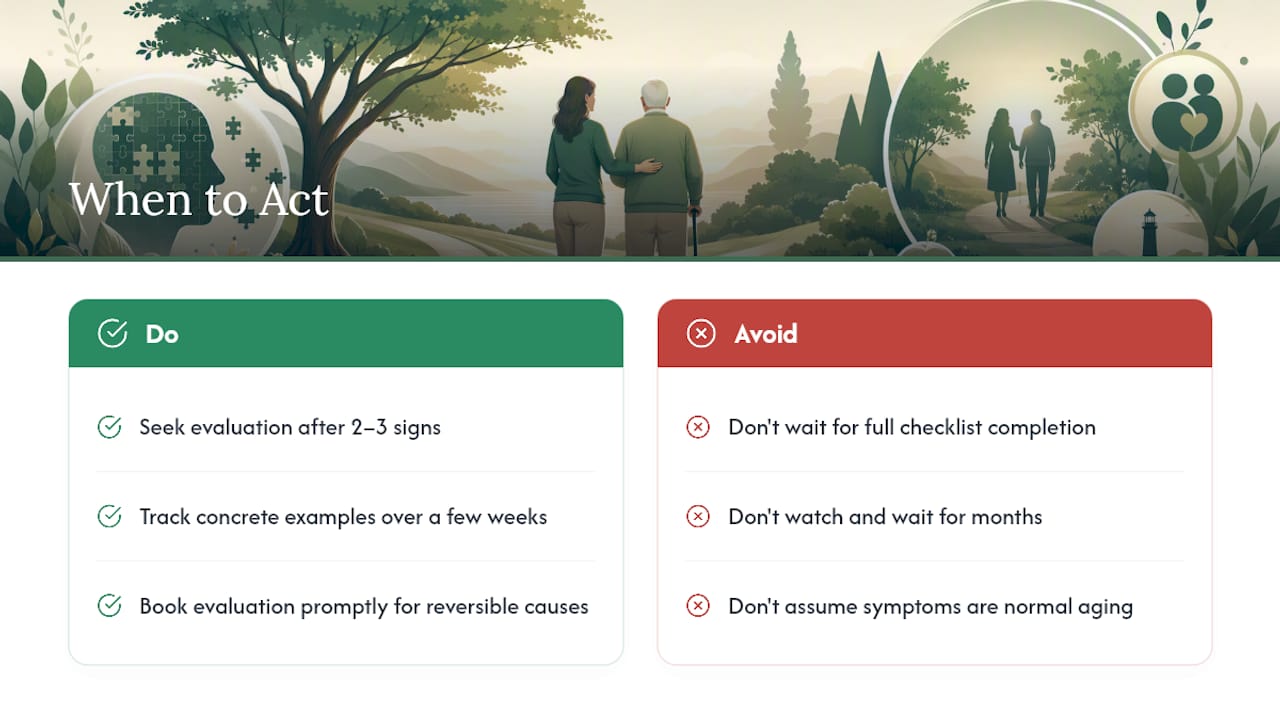
If you take one thing from this article, make it this: don’t wait for the checklist to feel complete before acting. Two or three items, tracked with real examples over a few weeks, are enough reason to see a clinician. The cost of an unnecessary visit is far lower than the cost of a missed reversible cause.
Concerned about symptoms in yourself or a family member? Garden State Medical Group’s primary care team can start the evaluation with a cognitive screen, lab work, and a coordinated referral path if further testing is needed.
— Garden State Medical Group
This article is general information, not a substitute for advice from a qualified doctor. Consult a qualified healthcare professional about your own circumstances before acting on anything here.
Sources
- Dementia - Symptoms and causes - Mayo Clinic
- Memory Problems, Forgetfulness, and Aging | National Institute on Aging
- Early diagnosis importance — CDC
- 10 Early Signs and Symptoms of Alzheimer’s and Dementia | Alzheimer’s Association
FAQ
How Early Can Dementia Start?
Most dementia appears after age 65, but early-onset forms can begin in a person’s 40s or 50s. Symptoms often develop gradually over months or years before they become obvious enough to prompt an evaluation.
What Does Stage 1 Dementia Look Like?
In the earliest stage, changes are often subtle enough that only close family notices them, things like mild word-finding trouble, occasional disorientation, or small lapses in judgment about finances. Daily functioning is largely intact at this point.
What Are the 10 Early Warning Signs of Dementia?
The Alzheimer’s Association’s checklist includes memory loss disrupting daily life, planning and problem-solving challenges, difficulty with familiar tasks, time or place confusion, visual and spatial trouble, language problems, misplacing items, poor judgment, social withdrawal, and mood or personality changes.
What Is the Five-Word Test for Memory?
It’s a brief screening tool where a patient recalls five unrelated words after a short delay, sometimes with category hints. Difficulty with delayed recall, even with cues, is a signal clinicians use alongside other screens like the Mini-Cog or MoCA.