
Explain Medical Credentials: What Patients Need to Know

TL;DR:
- Medical credentials such as degrees, licenses, and certifications reflect a provider’s training, legal authority, and ongoing expertise. While MD and DO degrees offer equivalent qualifications, board certification demonstrates advanced proficiency beyond licensing standards. Patients can verify credentials easily online to ensure trustworthiness and make informed healthcare choices.
When you look at a doctor’s nameplate and see “MD, FACP, ABIM” after their name, do you actually know what any of that means? You are not alone. Most people cannot explain medical credentials beyond “they went to medical school,” yet those letters tell a rich story about a provider’s training, legal authority, and commitment to ongoing excellence. Understanding what those credentials mean gives you real power when choosing who to trust with your health. This guide breaks it all down clearly.
Table of Contents
- Key takeaways
- Explaining medical credentials: degrees, licenses, and certifications
- Advanced credentials and professional designations
- The medical credentialing process
- How to verify your doctor’s credentials yourself
- My perspective on credential awareness for patients
- Finding credentialed care at Gardenstatemedicalgroup
- FAQ
Key takeaways
| Point | Details |
|---|---|
| MD and DO are equal degrees | Both degrees grant the same scope of practice, prescribing rights, and licensing in the U.S. |
| Licenses are the legal floor | A state medical license is the minimum required to practice; board certification goes further. |
| Fellowships signal peer recognition | Designations like FACS or FACP reflect advanced training and peer-evaluated professional standards. |
| Credentialing takes time | The full medical credentialing process typically runs 90 to 180 days for providers. |
| Patients can verify credentials | Free public tools like FSMB’s DocInfo.org let you check a doctor’s license and history yourself. |
Explaining medical credentials: degrees, licenses, and certifications
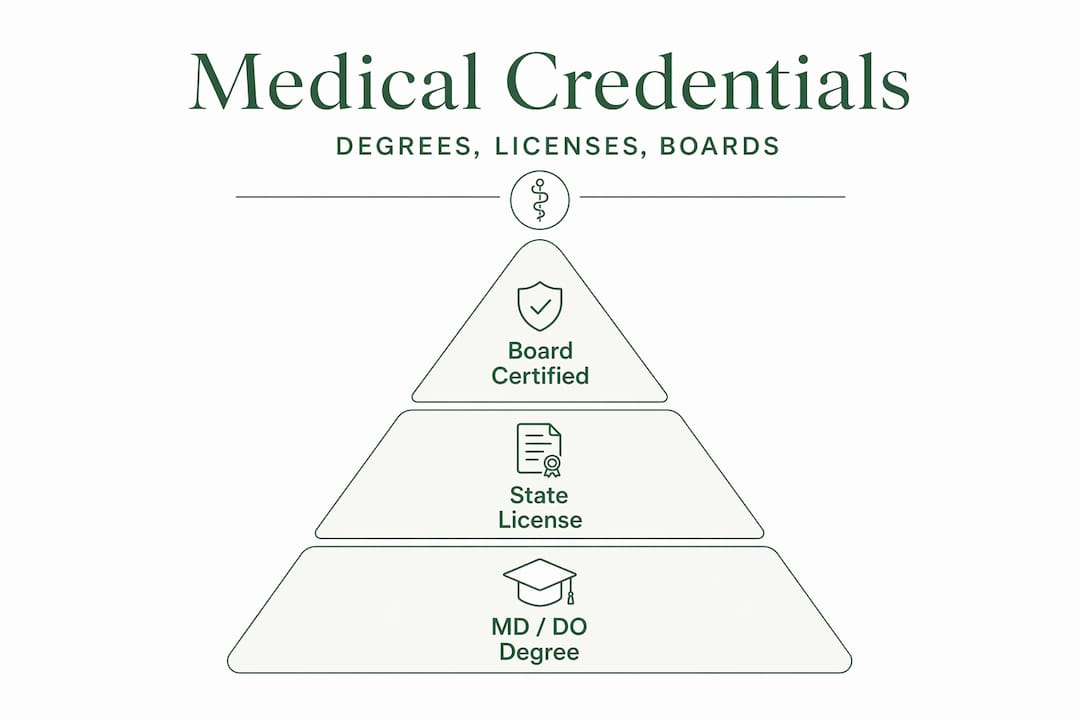
Medical credentials fall into three layers, and each layer serves a different purpose. Knowing the difference between them keeps you from confusing a legal requirement with an achievement.
Medical degrees: MD vs. DO
The two most common doctoral degrees in medicine are the MD (Doctor of Medicine) and the DO (Doctor of Osteopathic Medicine). Patients often wonder whether one is better than the other. The short answer: no. MD and DO degrees offer equivalent qualifications, including the same scope of practice, licensing requirements, and prescribing privileges. DO physicians complete additional training in osteopathic manipulative therapy and tend to emphasize a whole-body approach to care, but there is no meaningful difference in patient outcomes between the two.
State medical licenses
A state medical license is not an achievement. It is a legal requirement. Every physician who sees patients must hold an active license in the state where they practice. That license confirms the state medical board has verified the provider’s education, residency training, and fitness to practice. Without it, a doctor cannot legally treat you. The license alone, however, does not tell you much about how skilled or specialized a provider is. It simply clears the minimum bar.
Board certification
This is where credentials start to tell a more meaningful story. Board certification is voluntary and represents advanced expertise in a medical specialty beyond what a license requires. A doctor becomes board certified by passing rigorous exams administered by a specialty board recognized by the American Board of Medical Specialties (ABMS). For example, a physician might hold board certification in internal medicine, family medicine, or cardiology. Board-certified status signals a physician’s dedication to up-to-date medical knowledge and patient safety, making it a meaningful green flag when you evaluate a provider.
Pro Tip: You can verify any physician’s board certification status for free at the ABMS website. It takes less than two minutes and confirms whether certification is current.
| Credential type | What it means | Required? |
|---|---|---|
| MD or DO degree | Completed accredited medical school and residency | Yes, to practice |
| State medical license | Legal authorization to practice in a specific state | Yes, to practice |
| Board certification | Passed specialty exams; demonstrated advanced expertise | No, voluntary |
| Fellowship designation | Peer-recognized advanced training in a subspecialty | No, voluntary |
Advanced credentials and professional designations
Once a physician is licensed and board certified, they may pursue fellowship designations. These are not the same as fellowship training programs completed after residency (though the names overlap). A fellowship designation is a credential granted by a professional medical society, and it signals that peers in that specialty have recognized the physician’s qualifications, ethics, and contributions.
Here are some common fellowship credentials you will see:
- FACS (Fellow of the American College of Surgeons): The FACS designation requires rigorous training, board certification, and peer evaluation. It shows a surgeon meets high ethical and professional standards recognized by their own field.
- FACP (Fellow of the American College of Physicians): This applies to internists and signals recognition by one of the oldest and largest medical specialty societies in the world.
- FAAP (Fellow of the American Academy of Pediatrics): Pediatricians who earn this credential have demonstrated commitment to child health beyond the standard requirements.
- FACOG (Fellow of the American College of Obstetricians and Gynecologists): Relevant for OB-GYN providers, this reflects active involvement in ongoing professional development in the specialty.
What do these designations mean for you as a patient? They tell you that a provider has not simply met the minimum standards. They have gone further, earned recognition from their professional community, and committed to ongoing education in their field. That kind of commitment tends to translate into more thoughtful, up-to-date care.
The medical credentialing process
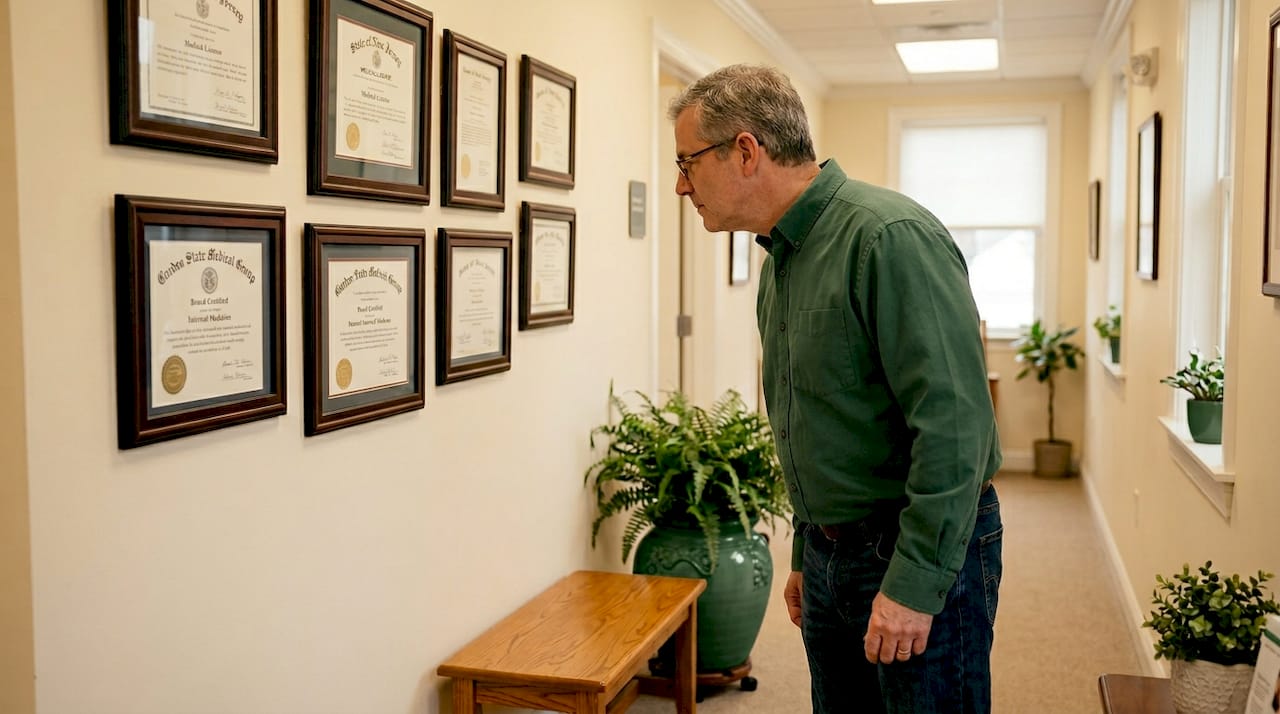
Understanding the medical credentialing process matters not just for providers but for patients, because it directly affects who you can see and whether their services are covered by your insurance.
Here is how the process generally works:
- Application submission. The provider submits education records, training history, malpractice insurance, and license information to a hospital, healthcare organization, or insurance payer.
- Primary Source Verification (PSV). The credentialing body contacts the original issuing organizations to confirm every credential directly. Automated PSV now completes verifications in 2 to 5 days with 95 to 98 percent accuracy, compared to 15 to 30 days with manual methods.
- Committee review. A credentialing committee evaluates the verified information and approves or denies the provider’s privileges.
- Enrollment. For insurance billing, providers also enroll with individual payers, including Medicare. Medicare enrollment through PECOS often takes 30 to 60 days on average and is one of the most common bottlenecks in the process.
- Ongoing maintenance. Credentials are not a one-time event. Providers must re-attest their information regularly. CAQH profiles require re-attestation every 90 to 120 days. Missing a deadline can cause claim denials and payment delays.
The full credentialing and enrollment timeline typically runs 90 to 180 days. Delays often happen because of incomplete data or mismatches between documents. A name spelled differently across two forms, or an address that does not match, can stop the process cold.
Pro Tip: If you are a patient waiting on a new specialist, the delay you experience before they are in-network with your insurer is usually a credentialing issue, not a scheduling one. Asking the office about their enrollment timeline can help you plan accordingly.
If you are exploring Medicare enrollment in New Jersey, understanding these timelines helps set realistic expectations and avoid gaps in coverage.
How to verify your doctor’s credentials yourself
Patients have more tools available to them than most realize. Checking a doctor’s credentials is free, takes less than ten minutes, and can give you significant peace of mind.
Here is what to look for and where to find it:
- License status and disciplinary history. Visit your state medical board’s website or use FSMB’s DocInfo.org, which aggregates physician license data and disciplinary actions across multiple states. This is your starting point.
- Board certification status. Go to the ABMS website at certificationmatters.org. Enter the doctor’s name and specialty to confirm their certification is current and in good standing.
- Hospital affiliations. A physician who holds privileges at a reputable hospital has already passed that hospital’s own credentialing review. This is an additional layer of independent verification.
- Malpractice history. Some state medical board websites include malpractice settlement information. This requires context: one settled case in 30 years of practice tells a different story than multiple cases in a short period.
- Online reviews and patient feedback. Reviews are not credentials, but patterns in patient feedback can surface communication issues or billing concerns that credentials alone would not reveal.
| Verification resource | What it shows | Cost |
|---|---|---|
| State medical board website | License status, disciplinary history | Free |
| FSMB DocInfo.org | Multi-state license and action data | Free |
| ABMS CertificationMatters.org | Board certification status | Free |
| Hospital website | Physician privileges and affiliations | Free |
Proactively checking a doctor’s credentials increases transparency and reduces the guesswork that comes with choosing a new provider. When you find a reputable doctor, verifying credentials is one of the clearest first steps.
Credentials should be the foundation of your evaluation, but not the only factor. Think about how clearly a doctor explains your condition, whether they listen, and whether you feel heard. Those qualities matter just as much once you have cleared the credential bar. For more on those softer but equally important factors, the qualities of a great doctor go well beyond letters after a name.
My perspective on credential awareness for patients
I have seen patients who chose providers based entirely on a flashy website bio and patients who spent weeks researching every letter after a doctor’s name before their first appointment. Neither extreme serves you well.
Here is what I have learned: credentials are the floor, not the ceiling. They tell you a provider is qualified and has committed to a standard. What they cannot tell you is whether that provider will take the time to understand your specific situation, communicate clearly, or recognize when your case needs a different set of eyes. I have met highly credentialed physicians who were poor communicators and board-certified specialists who were exceptional at both the science and the relationship side of care.
The common misconception I see most often is patients assuming that more letters mean more trust. A long list of credentials is genuinely meaningful, but a board-certified DO with no fellowship designations can be an outstanding choice for primary care. Do not let the absence of a fellowship designation steer you away from a provider who fits your needs well.
My practical advice: start with credentials to confirm a provider is qualified, then use a first appointment as your real test. Ask about their approach to your specific condition. Watch whether they listen before they speak. Credentials open the door. The relationship keeps it open. When patients take the time to understand what to look for in a primary care physician, they are already making a better decision than most.
— Krunal
Finding credentialed care at Gardenstatemedicalgroup
At Gardenstatemedicalgroup, understanding why credentials matter is built into how we operate. Every provider at our North Bergen and Secaucus locations has passed a rigorous credentialing process, holds active licensure, and brings verified specialty training to your care. Whether you need primary care services from a trusted internist, specialized cardiopulmonary care from a credentialed pulmonologist, or advanced radiology and diagnostic testing, you can count on the same standard of verified, expert care throughout. We also offer health programs in diabetes management, bone health, weight management, and more. Explore what our team can do for you.
FAQ
What does it mean to explain medical credentials?
Explaining medical credentials means clarifying what each degree, license, certification, or designation on a provider’s title actually represents and how it reflects their training and qualifications.
What is the difference between a medical license and board certification?
A medical license is the legal minimum required to practice medicine in a state, while board certification is a voluntary achievement that demonstrates advanced expertise in a specific specialty.
Are MD and DO doctors equally qualified?
Yes. MD and DO degrees carry the same scope of practice, licensing requirements, and prescribing privileges in the United States. DO doctors receive additional osteopathic training but provide equivalent care.
How can I verify a doctor’s credentials as a patient?
You can check a doctor’s license and disciplinary history at FSMB’s DocInfo.org or your state medical board’s website, and confirm board certification status for free at ABMS CertificationMatters.org.
Why does the medical credentialing process take so long?
The credentialing process takes 90 to 180 days because it involves verifying every credential directly with issuing organizations, committee review, and insurance enrollment, each of which has its own timeline and potential for delays.
Recommended
- Understanding medical groups: what patients need to know
- 5 Signs You Need the Expertise of a Primary Care Doctor | Garden State Medical Group | Garden State Medical Group
- 4 Facts You Need to Know About Internal Medicine Doctors | Garden State Medical Group | Garden State Medical Group
- The Qualities of a Great Doctor | Garden State Medical Group | Garden State Medical Group