
Weight Loss Plateau: How to Restart Progress Safely

A weight loss plateau means your weight has stayed essentially flat for three weeks or longer despite keeping up your diet and exercise routine, and it happens to about 85% of people on a structured weight loss plan at some point. The single most effective first move is to reassess what you’re actually eating and add resistance training. Most plateaus are not a sign that your metabolism has broken. They’re a sign that your body has adjusted to a new normal, and your plan needs to adjust too.
Before you overhaul anything, try these steps for two weeks:
- Track every bite and sip with a food scale or measuring cups, not just estimates.
- Add two to three resistance training sessions per week if you aren’t already lifting.
- Increase your daily step count or overall movement, even by 1,500 to 2,000 steps.
- Get a full week of consistent sleep (7 or more hours) before you change your calorie target again.
- Weigh yourself under the same conditions daily and look at the weekly average, not single readings.
Key Takeaways
Breaking a weight loss plateau usually requires honest calorie tracking, added resistance training, and patience through the three to six week window it takes for real changes to show.
| Point | Details |
|---|---|
| Confirm before you change course | Wait three to six weeks of flat weekly averages before treating a stall as a genuine plateau. |
| Calorie creep is the top hidden cause | Two weeks of honest food logging often reveals 200 to 400 unlogged daily calories. |
| Muscle protects your metabolism | Resistance training two to three times weekly plus 1.2 to 1.5 g/kg of protein preserves lean mass during a deficit. |
| Hit the activity guideline | Aim for at least 200 minutes per week of moderate activity, combining strength and aerobic exercise. |
| Know when to get evaluated | Persistent stalls despite verified adherence, or symptoms like fatigue and cold intolerance, warrant a clinical review. |
| Garden State Medical Group offers tailored evaluation | Our weight loss programs pair primary care oversight with labs and medication review to identify what’s really driving a stall. |
Table of Contents
- What Is a Weight Loss Plateau, Really?
- What Causes a Plateau in Your Weight Loss Journey?
- How Do You Confirm You’re Really at a Plateau?
- Evidence-Based Strategies to Break a Weight Loss Plateau
- When Should You See a Clinician About a Stalled Weight Loss?
- How to Maintain Progress After You Break the Plateau
- What the Research Actually Says About Metabolic Adaptation
- Our Clinical Perspective on Weight Loss Plateaus
- Get Personalized Support for a Stalled Weight Loss Plan
- Sources
- FAQ
What Is a Weight Loss Plateau, Really?
A true weight loss plateau is a stretch of three to six weeks with no meaningful downward trend on the scale, even though you’re sticking to your calorie deficit and activity plan. That’s different from the day-to-day bounce most people mistake for stalling out. Your weight can swing two to four pounds in a single day from sodium, hydration, hormonal shifts, or the timing of your last meal, and none of that reflects fat loss or fat gain.
The confusion usually starts in the first weeks of a new plan. Weeks one through three often bring a rapid drop as your body burns through stored glycogen, and every gram of glycogen holds roughly 3 to 4 grams of water alongside it. That combination can produce a fast five to eight pound loss that has little to do with fat tissue. Once glycogen stores stabilize, usually by week four to six, the rate of loss naturally slows, and this is where many people panic and assume something has gone wrong.
Picture a typical 12 week stretch: weeks one through three show a steep drop, weeks four through eight show steady but slower loss, and somewhere between weeks nine and twelve, the scale holds flat for two, three, sometimes four weeks straight. That flat stretch is often not a plateau at all. It’s your body catching up to the deficit you created, and for many people, movement resumes on its own if they stay consistent a bit longer.
What Causes a Plateau in Your Weight Loss Journey?
Three overlapping forces usually explain a genuine stall: your body adapting to weight loss, your daily habits quietly shifting, and errors in how you’re measuring progress.
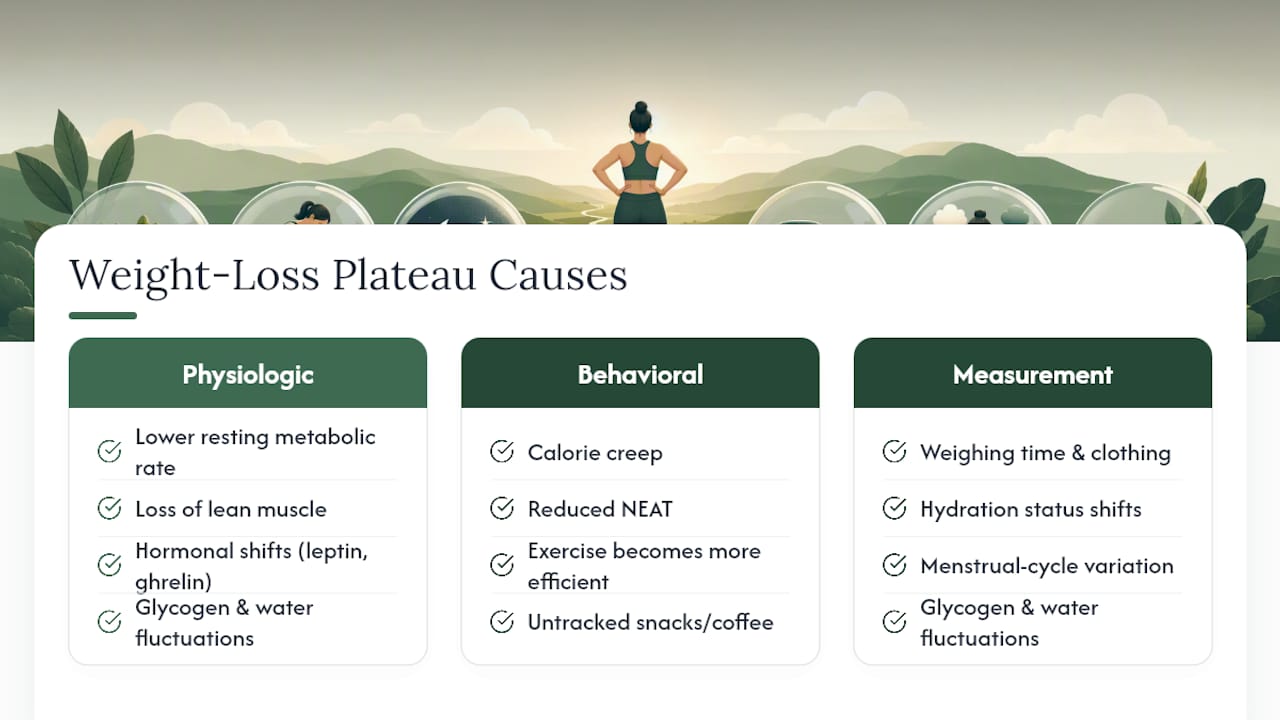
Physiologic causes are the ones people worry about most, and for good reason, since your body is not a static machine. As you lose weight, your resting metabolic rate drops because a smaller body simply burns fewer calories at rest. Losing lean muscle mass along with fat compounds this, since muscle is metabolically active tissue. Hormonal shifts in leptin and ghrelin also change how hungry you feel and how efficiently your body uses energy. Add in the glycogen and water fluctuations mentioned earlier, and you get a scale that can stall even when fat loss is technically still happening underneath.

Behavioral causes creep in slower and are easier to overlook. Calorie creep is the most common offender: a slightly bigger portion here, a coffee with cream you forgot to log, a weekend where “eating normally” turns into 400 extra calories a day without you noticing. Reduced non-exercise activity thermogenesis, or NEAT, also plays a role. As you lose weight, you often move less unconsciously, fidgeting less, taking the elevator instead of stairs, without any deliberate decision to slow down. Your body also becomes more efficient at the exercise you’ve been doing, burning fewer calories for the same workout over time.
Measurement problems mask real progress more often than people realize. Weighing yourself at a different time of day, in different clothing, or during a different phase of your menstrual cycle can create the illusion of a stall when fat loss is continuing. Hydration status alone can shift the scale by several pounds.
Timing matters here too. Lifestyle-based plateaus, the kind driven by diet and exercise alone, tend to show up around the six month mark. Adults using FDA-approved weight loss medications often see their plateau arrive later, closer to the one year mark, since these drugs work through a different appetite and satiety mechanism that takes longer to fully play out.
How Do You Confirm You’re Really at a Plateau?
Before you change your entire approach, spend three to six weeks confirming the stall is real. A single flat week almost never counts.
- Weigh yourself at the same time each day, ideally right after waking and before eating or drinking, and track the weekly average instead of daily numbers.
- Take a tape measure to your waist, hips, and thighs every two weeks; body composition can shift even when total weight doesn’t.
- Snap progress photos in consistent lighting and clothing every two to four weeks to catch changes the scale misses.
- Note performance markers like how your clothes fit or how much weight you’re lifting, since strength gains often continue through a scale plateau.
- Log your food intake honestly for seven to fourteen days to check for calorie creep you might have missed.
Short-term food logging is one of the highest-yield diagnostic steps available, because it often reveals that intake has quietly climbed by 200 to 400 calories a day without any conscious decision to eat more. If your tracking confirms a genuine calorie deficit and the scale still hasn’t budged in several weeks, you’re looking at a real weight loss plateau, not just noise.
Evidence-Based Strategies to Break a Weight Loss Plateau
Once you’ve confirmed the stall, work through these changes in order rather than overhauling everything at once. That way you can tell what actually worked.
- Recalculate your calorie target. Your needs at a lower body weight are not the same as they were 20 pounds ago. Recompute your target based on current weight, not your starting weight.
- Prioritize protein. Aim for roughly 1.2 to 1.5 grams per kilogram of body weight per day to protect lean muscle mass while you’re in a deficit.
- Add resistance training two to three times a week. Preserving and building muscle supports your resting metabolic rate in a way cardio alone doesn’t.
- Increase total weekly activity. AHA/ACC guidance recommends at least 200 minutes per week of moderate activity, combining aerobic work with strength training for the best metabolic effect.
- Boost your NEAT. Small changes, like parking farther away or taking calls standing up, add up to real daily calorie burn over weeks.
- Protect your sleep. Poor sleep disrupts hunger hormones and makes calorie control harder, regardless of how disciplined you are during the day.
- Manage stress deliberately. Chronic stress raises cortisol, which can affect appetite and where your body stores fat.
Try this two-week test: log every meal for the full period, add two resistance sessions per week if you don’t already lift, and increase daily steps by 1,500 to 2,000. Weigh in daily but judge results by the weekly average, and track your waist measurement at the start and end. If nothing has moved after two weeks of genuinely consistent effort, adjust your calorie target by 100 to 150 calories rather than making a drastic cut.
Pro Tip: The calories that sabotage a plateau are rarely the ones you notice. Cooking oil, salad dressing, coffee creamer, and “just a taste” while cooking can add 300 to 500 unlogged calories a day. Weigh your cooking oil with a kitchen scale for a week and you’ll likely be surprised.

Cleveland Clinic’s guidance reinforces that plateaus often respond better to reassessment and modest adjustments than to sudden, aggressive calorie cuts. Mayo Clinic’s advice echoes this, cautioning against dropping below roughly 1,200 calories a day for most adults, since intake that low can backfire by increasing hunger and reducing your ability to sustain exercise.
When Should You See a Clinician About a Stalled Weight Loss?
Some plateaus need more than a diet and exercise tune-up. Certain warning signs point toward an underlying issue that deserves medical attention rather than another round of self-adjustment.
Watch for rapid unexplained weight changes in either direction, persistent fatigue, cold intolerance, hair thinning, or irregular periods, all of which can signal a thyroid or other endocrine issue. Some medications, including certain antidepressants, steroids, and blood pressure drugs, cause weight changes as a side effect, so a recent prescription change is worth mentioning to your provider. If you’ve verified adherence through honest tracking, added resistance training, and hit activity guidelines for six weeks or more with zero movement, that’s a reasonable point to ask for a professional evaluation rather than continuing to guess.
For adults with a BMI of 30 or higher, or 27 or higher with a related condition like type 2 diabetes or high blood pressure, a referral for specialist or bariatric evaluation is a legitimate next step, not a last resort.
GLP-1 receptor agonists have become a common part of plateau management for appropriate candidates. These medications work by slowing gastric emptying and enhancing satiety signals, which reduces overall intake without requiring the same level of constant willpower. Because the mechanism is different from diet and exercise alone, plateaus on these medications tend to arrive later, often around the one year mark, and clinicians typically pair them with the same behavioral strategies, like resistance training and protein intake, covered above. A resource like Legacy Meds offers additional background on how GLP-1 programs are structured for people considering that route.
If you’re preparing for an appointment, bring two weeks of food logs, your weight trend over the past three months, a full list of current medications and supplements, and specific questions about whether pharmacotherapy or specialist referral makes sense for your situation.
How to Maintain Progress After You Break the Plateau
Breaking a stall is only half the job. Keeping the momentum requires a few habits that hold up over months, not just the two weeks it took to get the scale moving again.
- Keep two to three resistance training sessions weekly as a permanent fixture, not something you drop once you hit a goal.
- Maintain your protein target even as your calorie needs shift with a lower body weight.
- Weigh yourself weekly during maintenance rather than daily, which reduces obsessive focus on normal fluctuation.
- Set a daily step goal in the 7,000 to 9,000 range and treat it as non-negotiable, similar to brushing your teeth.
- Build in a planned refeed or recovery week every 8 to 12 weeks if you’ve been in a deficit for a long stretch, giving your body and mind a break before resuming.
Behavioral changes matter as much as the physical ones. Habit stacking, like always doing your resistance workout right after your morning coffee, removes the daily decision of whether to exercise. Modifying your environment, such as keeping trigger foods out of the house, reduces reliance on willpower alone. Planning ahead for social events and travel, rather than treating them as automatic setbacks, keeps one bad week from spiraling into a full regression. A goal as simple as “three strength sessions per week plus 7,000 to 9,000 daily steps” gives you something concrete to measure instead of a vague intention to “stay healthy.”
What the Research Actually Says About Metabolic Adaptation
Metabolic adaptation is real, but its size and permanence are frequently overstated in popular weight loss advice. Research measuring resting metabolic rate found that adaptation is largest immediately after weight loss, in the range of 90 to 110 fewer calories burned per day compared to what you’d predict from body size alone. That number drops substantially, roughly by half, after just a few weeks of weight stability, and in some study samples, the effect was no longer detectable at the one year mark and did not predict who regained weight and who didn’t.
That distinction matters for how you interpret your own stall. A plateau in the first month or two after rapid loss is more likely to reflect this temporary, larger metabolic adjustment layered on top of glycogen and water shifts. A plateau that persists six months or a year in is far more likely to reflect calorie creep, reduced NEAT, or measurement noise than a permanently damaged metabolism.
Individual variability is significant here. Some people show larger or more persistent adaptation than others, and factors like genetics, sleep quality, and stress levels all influence the picture. The research supports a measured take: metabolic adaptation is a real physiological response, not an excuse, and not a life sentence. It calls for reassessment and patience, not resignation.
Our Clinical Perspective on Weight Loss Plateaus
The biggest misconception we see is that a plateau means something has gone wrong. In most cases, it means your body did exactly what bodies do when they lose weight, and your plan simply hasn’t caught up yet. The stepwise approach that tends to work best in practice starts with reassessing intake honestly, since calorie creep explains more stalls than people want to admit. From there, we look at strength and activity levels before touching calorie targets again, because adding muscle and movement often restarts progress without requiring a person to eat any less.
Medication and specialist referral have a place, but they’re a tool for the right situation, not a default response to a few flat weeks on the scale. What frustrates us most is watching people abandon a solid plan after three weeks of no movement, when the data shows plateaus of that length are often just the body settling into a new equilibrium. Patience paired with a genuine reassessment beats a dramatic overhaul almost every time.
If you’ve done the reassessment and the stall persists, that’s exactly when a tailored evaluation, including labs and a medication review, earns its place. A plateau isn’t a failure. It’s information, and how you respond to it determines whether it becomes a temporary pause or the reason you give up.
Get Personalized Support for a Stalled Weight Loss Plan
Garden State Medical Group gives you something a generic diet app can’t: a clinician who can actually check whether your plateau is behavioral, hormonal, or medication-related, and adjust your plan accordingly instead of leaving you to guess. Our weight loss programs combine primary care oversight with lab work, nutrition guidance, and medication management when it’s appropriate, all under one roof in North Bergen and Secaucus.
A visit typically starts with a review of your recent food and activity logs, your weight trend over the past few months, and any medications you’re currently taking, so bring what you have even if it’s incomplete. From there, we can order relevant labs, discuss whether a program like our weight loss programs fits your situation, or refer you for specialized care if your plateau points to something beyond diet and exercise. If you’re not sure where to start, our primary care team can run the initial evaluation and go from there. Schedule an appointment to get a clear read on what’s actually driving your stall.
Sources
- Management of Weight Loss Plateau - StatPearls - NCBI Bookshelf
- Metabolic adaptation is an illusion, only present when participants are in negative energy balance - PMC
- Getting past a weight-loss plateau - Mayo Clinic
- Ways To Break a Weight-Loss Plateau - Cleveland Clinic Health Essentials
- Why Weight Loss Plateaus Happen – And What To Do About It - Diabetes Victoria
This article is general information, not a substitute for advice from a qualified doctor. Consult a qualified healthcare professional about your own circumstances before acting on anything here.
FAQ
How do you break a plateau in weight loss?
Reassess your calorie intake through honest tracking for one to two weeks, add resistance training two to three times weekly, and increase daily activity toward 200 minutes of moderate exercise per week.
How do you shock your body out of a weight loss plateau?
There’s no single trick that “shocks” your body into losing weight again; the most reliable approach is recalculating your calorie needs at your current weight and adding strength training rather than making a drastic, sudden cut.
How long does a weight loss plateau last?
Lifestyle-based plateaus commonly resolve within a few weeks of adjusting intake and activity, though they tend to appear around the six month mark of a diet and exercise plan; plateaus on weight loss medication often arrive later, closer to one year.
How do you break a plateau while on GLP-1 medication?
GLP-1 plateaus, which often show up around the one year mark, typically respond to the same behavioral strategies as lifestyle plateaus, including resistance training and protein intake, alongside a medication review with your prescribing clinician.
Is a weight loss plateau normal?
Yes, roughly 85% of people following a structured weight loss plan experience a plateau at some point, making it a normal part of the process rather than a sign of failure.
Recommended
- Proven Weight Management Strategies for Lasting Results
- Obesity Prevention: How to Maintain a Healthy Weight | Garden State Medical Group | Garden State Medical Group
- Things to Consider Before Trying a Weight loss Program | Garden State Medical Group | Garden State Medical Group
- Your Diabetes Prevention Checklist for 2026