
What Is a Health Assessment? Your Guide to Better Care

TL;DR:
- A health assessment is a comprehensive process that evaluates your physical, mental, and social health to establish a personalized baseline. It differs from diagnostics and screenings by focusing on holistic data collection to inform ongoing care and lifestyle adjustments. Regular, honest assessments enable early risk detection, improve communication with providers, and support proactive health management.
Most people assume a health assessment is just another term for a yearly physical. It is actually something broader and more useful than that. A health assessment is a systematic process that gathers information about your physical health, mental well-being, and lifestyle habits to build a complete picture of where your health stands right now. Understanding what is health assessment and why it matters can help you show up to your next appointment more prepared, more honest, and more engaged in your own care.
Table of Contents
- Key takeaways
- What is health assessment: definition and components
- How health assessments differ from diagnostics and screenings
- Types of health assessments
- Benefits of health assessments for adults and caregivers
- My take on what health assessments actually do for you
- Start your health assessment at Gardenstatemedicalgroup
- FAQ
Key takeaways
| Point | Details |
|---|---|
| More than a checkup | A health assessment covers physical, mental, and social health to set a personalized baseline. |
| Different from diagnostics | Assessments gather holistic data; they do not diagnose illness the way a targeted medical test does. |
| Multiple types exist | From initial to geriatric assessments, the type used depends on your age, setting, and health goals. |
| Honesty improves outcomes | The more accurate your answers, the more useful your results and care recommendations will be. |
| Financial benefits are real | Employer and insurance-based assessments can lower your premiums when you participate actively. |
What is health assessment: definition and components
The health assessment definition most healthcare providers use centers on one idea: collecting information about you as a whole person, not just your symptoms. According to health educators, assessments gather data on physical, mental, and social health to establish baselines and guide personalized care, which makes them distinct from diagnostic exams.
In practice, a health assessment pulls together several categories of information.
- Health history: Your past illnesses, surgeries, hospitalizations, family medical history, and current medications all give context that no single test can provide.
- Vital signs: Blood pressure, heart rate, temperature, respiratory rate, and weight are measured to establish your current physical baseline.
- Lifestyle behaviors: Diet, physical activity, sleep patterns, alcohol use, and smoking status are documented because they directly influence long-term health risk.
- Mental and emotional health: Questions about stress, mood, anxiety, and cognitive function are part of a thorough assessment, not a separate concern.
- Social factors: Housing stability, support systems, and access to care all affect health outcomes and belong in the picture.
The methods used to collect this data vary. Some assessments use structured questionnaires, either on paper or online. Others involve a physical examination where your provider checks your body for signs that numbers alone might miss. Clinical assessment tools balance digital data with direct observation, because technology can miss subtle cues that a trained clinician picks up during a face-to-face visit.
Pro Tip: Before your health assessment, write down your current medications, recent symptoms, and any family history details you know. Providers use this information immediately, and having it ready saves time and improves accuracy.
Understanding what does health assessment include helps you prepare rather than feel caught off guard. Think of it as building a file that tells your care team who you are medically, not just what is wrong today.

How health assessments differ from diagnostics and screenings
One reason people feel anxious about health assessments is that they blur them together with medical tests or disease screenings. The distinction matters. Health assessments serve as baseline-setting tools rather than illness detection, and understanding this mindset shift can reduce unnecessary fear.
The table below shows how the three processes compare.
| Feature | Health assessment | Medical diagnostic test | Health screening |
|---|---|---|---|
| Primary goal | Establish health baseline | Identify or confirm a disease | Detect a specific condition early |
| Scope | Holistic: physical, mental, social | Narrow: focused on one condition | Targeted: one condition or risk factor |
| Triggered by | Routine care or program enrollment | Symptoms or referral | Age, risk factor, or guidelines |
| Outcome | Personalized care plan | Diagnosis and treatment plan | Referral for further testing |
| Patient experience | Conversation and observation | Lab work, imaging, or procedure | Specific test or measurement |
Health risk assessments occupy their own space in this comparison. They combine lifestyle, emotional, and physical health questions, often completed online, and pair that data with biometric readings. The results help identify candidates for care programs and guide population health management, which is why employers and insurers use them frequently.
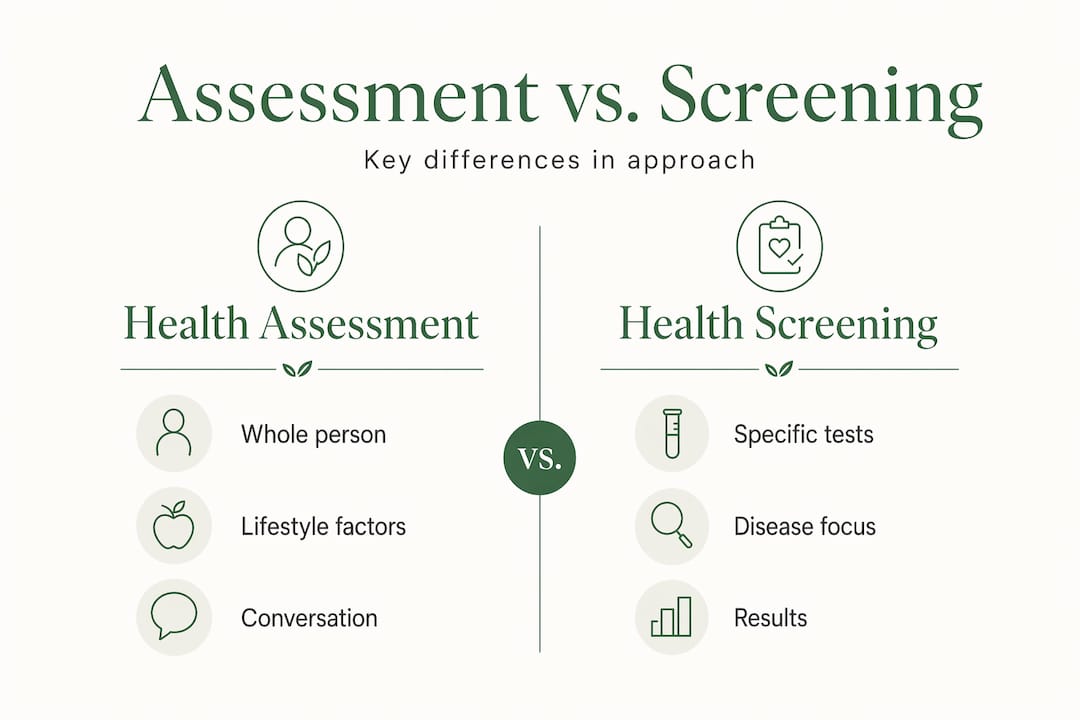
Knowing the difference between these three processes also helps you understand routine health screenings as a separate but related part of managing your health over time.
Pro Tip: If your provider orders a follow-up test after your health assessment, that does not mean the assessment found something alarming. It often means the baseline data pointed to an area worth monitoring more closely.
Types of health assessments
The purpose of health assessment shifts depending on who is being assessed and where the assessment takes place. There is no single format that fits every situation.
- Initial assessment: Conducted when you first establish care with a new provider. It collects a full picture of your health history and current status so your care team can understand you from the start.
- Focused assessment: Used when a specific concern needs attention. If you report knee pain, your provider may assess only the musculoskeletal system related to that complaint rather than running through a full evaluation.
- Time-lapsed assessment: Compares your current health data to a previous baseline. This is how providers track whether a chronic condition is progressing, improving, or staying stable.
- Emergency assessment: A rapid process used when time is critical. Providers prioritize the most life-threatening concerns first and fill in broader data later.
- Geriatric assessment: Specialized for older adults and required for Medicare wellness visits. These evaluations include tools like the Geriatric Depression Scale to evaluate functional independence and cognitive status alongside physical health.
- Workplace and insurance wellness assessments: Common through employer health programs. Health assessments for wellness programs often take about 20 minutes online and may be paired with an in-person physical examination.
- Assessments for people with intellectual disabilities: These use adapted communication methods and focus on detecting health changes that the individual may not be able to report themselves.
Settings also shape how assessments are conducted. A clinical office assessment differs from one conducted at a community health fair, a school, or through a telehealth platform. Each setting has its own level of depth, but all share the same core purpose: understanding your health status in order to support better outcomes.
If you are a caregiver for an older adult or someone with complex needs, understanding specialized health programs designed for those populations can help you advocate more effectively during any assessment process.
Benefits of health assessments for adults and caregivers
The health assessment importance goes beyond satisfying a checkbox on a benefits enrollment form. When done well and taken seriously, health assessments create real, measurable advantages.
- Early identification of chronic disease risk. Many conditions like hypertension, prediabetes, and high cholesterol develop silently. A health assessment can flag risk factors before symptoms appear, giving you time to act rather than react.
- Personalized care planning. Health assessments build a partnership between patient and provider, focusing on your experience of health rather than just clinical facts. This produces care plans that reflect your real life, not just your lab values.
- Honest tracking over time. Regular assessments show trends. If your blood pressure was borderline two years ago and is now elevated, your provider has context. Without that baseline, the current number tells only half the story.
- Financial incentives through employer and insurance programs. Employer health assessments are often voluntary but can affect financial benefits, and missing enrollment can mean losing savings on premiums or wellness rewards.
- Better communication with your care team. The data collected during an assessment gives your provider something concrete to discuss with you. It shifts appointments from reactive to proactive.
One detail that matters more than most people realize: the quality of your results depends directly on how honestly and specifically you answer. Vague answers reduce the usefulness of results and risk evaluation, which means incomplete responses can leave real health risks undetected. The benefits of health assessment are only as strong as the information you bring to it.
Regular health checkups work best when they build on a solid assessment foundation, so treating each one seriously pays off cumulatively over time.
My take on what health assessments actually do for you
I have worked alongside providers long enough to notice a consistent pattern. Patients either dismiss health assessments as administrative paperwork or approach them with the anxiety they reserve for diagnostic workups. Neither response serves them well.
What I have seen work is a third approach. When you treat an assessment as a conversation starter rather than a test you pass or fail, the entire interaction changes. You share more. Your provider learns more. And the care plan that comes out of it actually fits your life.
The piece patients most often overlook is the social and lifestyle data. People rush through those questions because they feel personal or irrelevant. But health assessments reveal your experience of health and illness beyond just factual data, and that context is what makes care plans address real-life impacts rather than textbook recommendations.
I also think people undersell how much preparation matters. Showing up with your medication list, a note about recent changes in sleep or energy, and honest answers to lifestyle questions transforms a 20-minute form into a tool your provider can actually use. The balance of technology and clinical skill in any good assessment depends on your input as much as your provider’s training.
My strongest recommendation is this: stop waiting until something feels wrong. An assessment taken when you feel fine gives your care team the clearest possible picture of your normal. That picture becomes priceless the moment something does change.
— Krunal
Start your health assessment at Gardenstatemedicalgroup
If you are ready to take a clearer look at your health, Gardenstatemedicalgroup offers primary care services in North Bergen and Secaucus, New Jersey that put health assessments at the center of every patient relationship. The team conducts thorough evaluations covering physical health, lifestyle factors, and mental well-being to give you a baseline that actually means something. For patients managing ongoing conditions, the chronic care management program builds directly on assessment data to support consistent, personalized follow-through. Contact Gardenstatemedicalgroup to schedule an appointment and take a concrete step toward proactive, informed healthcare.
FAQ
What is a health assessment in simple terms?
A health assessment is a structured process where a healthcare provider gathers information about your physical, mental, and social health to understand your current status and guide your care. It is not a diagnostic test. It is a tool for building your health baseline.
What does a health assessment include?
A health assessment typically includes your medical and family history, vital signs, current medications, lifestyle behaviors like diet and exercise, and mental health questions. Some assessments also incorporate a physical exam or online questionnaires.
How is a health assessment different from a physical exam?
A physical exam is one component that may be part of a health assessment, but the assessment itself is broader. It also covers mental health, lifestyle, and social factors that a physical exam alone does not address.
How long does a health assessment take?
Online health assessments often take about 20 minutes to complete, while in-person assessments that include a physical examination may take longer depending on your health history and the scope of your care needs.
Why is honest information important during a health assessment?
The quality of your assessment results depends on the accuracy of what you share. Incomplete or vague responses reduce the usefulness of your results, which can leave health risks undetected and care recommendations less targeted to your actual needs.