
What Is Telemedicine: A Simple Guide for Patients

Telemedicine is the delivery of clinical care at a distance using technology — phones, video calls, secure messaging, and remote monitoring devices — so you can connect with a licensed provider without leaving home. According to the NCBI Bookshelf, it encompasses diagnosis, medical advice, and treatment across geographic separation using electronic information and communications technologies.
Here is what that means for you as a patient:
- Access: You can reach a primary care provider, specialist, or mental health clinician regardless of distance, mobility, or schedule.
- Convenience: Routine follow-ups, prescription refills, and chronic disease check-ins often require no travel and minimal wait time.
- Continuity of care: Your provider can monitor your health between in-person visits, keeping your care plan on track.
One honest limit: telemedicine does not replace every in-person exam. Conditions requiring hands-on assessment, imaging, or lab work still need a physical visit. The most effective care model combines both.
Table of Contents
- What does “telemedicine” actually mean — and how is it different from telehealth?
- How telemedicine is delivered: the formats you will actually encounter
- Common telemedicine visits and who benefits most
- What the evidence says about telemedicine outcomes
- When you should skip the virtual visit and go in person
- Technology, privacy, and HIPAA: what you need to know
- Licensing, insurance coverage, and what visits typically cost
- How to prepare for your telemedicine appointment
- Key Takeaways
- Telemedicine works best when it is part of a real care relationship
- Telemedicine visits at Gardenstatemedicalgroup: what to expect
- Useful sources
- FAQ
What does “telemedicine” actually mean — and how is it different from telehealth?
The terms get mixed up constantly, so a clear distinction matters. The American Medical Association and the FCC both recommend keeping them separate.

Telemedicine refers specifically to remote clinical services: diagnosis, treatment decisions, medication management, and specialist consultations delivered by a physician or licensed clinician. Telehealth is the broader category. It includes telemedicine but also covers non-clinical services such as provider training, administrative communication, health education, and patient support from nurses, pharmacists, or social workers.
A few other terms you will likely encounter:
Telecare is a term more common in Europe. It generally refers to consumer-facing technology — fitness apps, medication reminders, fall sensors — that helps people stay safe and independent at home. It is not the same as a clinical telemedicine visit.
Teleconsultation is a provider-to-provider interaction: your primary care doctor consulting a specialist remotely about your case, often without you present.
Synchronous telemedicine means real-time interaction — a live video or phone call between you and your provider. Asynchronous telemedicine means communication that does not happen in real time. You might upload a photo of a skin rash or send a secure message describing symptoms, and your provider reviews and responds later. This is sometimes called store-and-forward communication.
Remote patient monitoring (RPM) involves devices that collect health data — blood pressure cuffs, glucose monitors, pulse oximeters — and transmit readings to your care team automatically. RPM is especially useful for managing chronic conditions between scheduled visits.
How telemedicine is delivered: the formats you will actually encounter
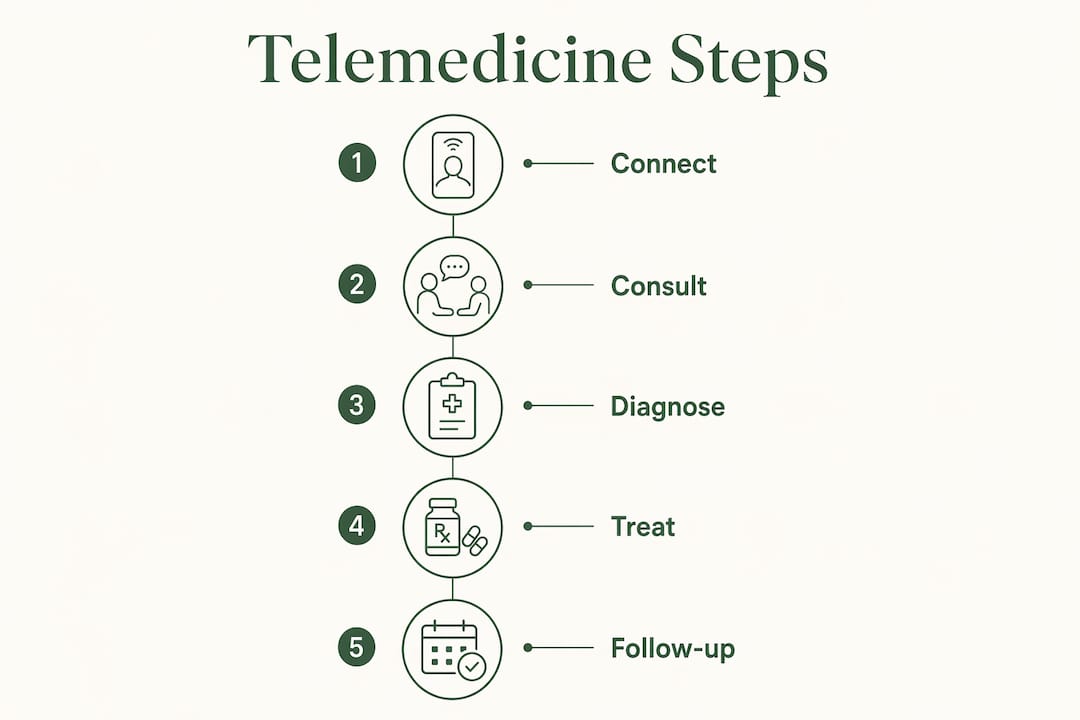
Not every virtual visit looks the same. The delivery format depends on what your provider needs to assess and what your situation calls for.
- Live video (synchronous): The most familiar format. You and your provider connect face-to-face through a secure video platform. Best for acute concerns, mental health sessions, medication reviews, and any visit where real-time conversation adds clinical value.
- Audio-only (phone call): Used when video is not available or not needed. Appropriate for straightforward follow-ups, medication questions, and patients without reliable internet access.
- Store-and-forward (asynchronous): You submit photos, test results, or a written symptom history through a secure portal. Your provider reviews the information and responds — often within 24 hours. Dermatology is a strong example: a clear photo of a rash can give a dermatologist enough information to recommend treatment without a live visit.
- Remote patient monitoring: Wearable or home devices send health data to your care team continuously or at set intervals. Particularly valuable for heart disease, diabetes, and hypertension management.
- Provider-to-provider teleconsultation: Your doctor connects remotely with a specialist to discuss your case. You benefit from specialist input without needing a separate appointment at a different facility.
Each format has a practical role. Knowing which one applies to your visit helps you prepare the right equipment and set realistic expectations.
Common telemedicine visits and who benefits most
Virtual care covers more ground than most people realize. These are the scenarios patients use most often.

Primary care follow-ups are among the most common. If you had a recent lab panel, a blood pressure check, or a medication adjustment, a video visit is often all your provider needs to review results and update your plan.
Mental health visits translate well to video. Therapy sessions, psychiatric medication management, and initial mental health assessments are all routinely conducted through secure video platforms. For patients who find in-person appointments anxiety-provoking, the home setting can actually improve engagement.
Chronic disease check-ins are where telemedicine adds consistent value. Patients managing diabetes, heart disease, or lung conditions can have regular monitoring visits without the disruption of traveling to a clinic. Gardenstatemedicalgroup’s chronic care management programs are designed to support exactly this kind of ongoing, between-visit oversight.
Dermatology photo consults use the store-and-forward model. A clear, well-lit photo of a skin concern — submitted through a secure portal — gives a dermatologist enough information to assess common conditions like eczema, acne, or suspicious moles.
Post-surgical follow-ups often require only a visual check and a conversation. Wound appearance, swelling, and recovery questions can frequently be handled over video, sparing patients a trip to the office during a period when mobility may be limited.
Urgent triage for mild illness — a sore throat, a urinary tract infection, a mild respiratory infection — can be evaluated quickly through a virtual visit. Your provider can determine whether you need a prescription, a test, or an in-person exam, saving you time and unnecessary exposure in a waiting room.
Patients who benefit most include those with mobility limitations, people in rural or underserved areas, busy professionals, caregivers who cannot easily leave home, and anyone managing a condition that requires frequent but routine check-ins. Telemedicine works best as part of a hybrid model: virtual visits for what can be handled remotely, in-person care when the exam or testing requires it.
What the evidence says about telemedicine outcomes
The case for telemedicine is not just convenience. Clinical research supports its effectiveness across several areas of care.
A systematic review covering 2020–2025 found that telemedicine often achieves clinical outcomes comparable to — and in some cases better than — in-person care for chronic disease management, prenatal care, and surgical follow-ups. The same review noted that telemedicine enhanced access and convenience while maintaining those outcomes across multiple specialties.
The scale of adoption tells its own story. Medicare fee-for-service telehealth visits rose from approximately 0.84 million in 2019 to 52.7 million in 2020, a shift driven by the COVID-19 pandemic that has remained elevated since. That volume reflects both patient demand and provider confidence in virtual care.
| Area of care | Evidence finding | Source |
|---|---|---|
| Chronic disease management | Outcomes comparable to in-person care | Systematic review, 2020–2025 |
| Prenatal care | Comparable clinical outcomes with improved access | Systematic review, 2020–2025 |
| Surgical follow-ups | Effective for post-op monitoring and wound checks | Systematic review, 2020–2025 |
| Medicare visit volume | ~0.84M visits (2019) → 52.7M visits (2020) | Systematic review, 2020–2025 |
The main patient benefits are consistent across the literature: reduced travel time and cost, fewer missed appointments, lower exposure to illness in waiting rooms, and better continuity of care for patients managing long-term conditions. For patients in rural areas or those with transportation barriers, virtual care can mean the difference between getting care and going without it.
When you should skip the virtual visit and go in person
Telemedicine is genuinely useful, but it has real diagnostic limits. Knowing when to go in person protects your health.
Go to an in-person visit or emergency care immediately if you experience:
- Chest pain, difficulty breathing, or signs of a stroke (sudden numbness, confusion, slurred speech, vision changes)
- Severe abdominal pain or any acute injury
- High fever with stiff neck, rash, or altered mental status
- Symptoms that are rapidly worsening or that you cannot describe clearly over video
Schedule an in-person visit when your care requires:
- A hands-on physical exam (palpation of the abdomen, lymph nodes, or joints)
- Blood draws, urine tests, or cultures
- Imaging such as X-rays, CT scans, or ultrasounds — Gardenstatemedicalgroup offers on-site radiology and diagnostic testing for exactly these situations
- A new, complex, or undiagnosed condition where a full physical workup is needed
- Procedures, injections, or wound care
A practical triage question: Can my provider make a sound clinical decision about this without touching me or running a test? If the answer is yes, a virtual visit is likely appropriate. If the answer is no, go in person. When in doubt, call your clinic first — most practices can help you decide over the phone.
Technology, privacy, and HIPAA: what you need to know
A telemedicine visit typically uses one of three setups: a smartphone or tablet with a camera and microphone, a laptop or desktop with a webcam, or a dedicated patient portal integrated into your provider’s electronic health record (EHR) system. Some practices use standalone secure video platforms; others build the visit directly into the patient portal you already use for test results and messaging.
HIPAA applies to telemedicine. Covered entities — your doctor’s office, hospital, or health system — are required to use HIPAA-compliant platforms and to obtain your consent for telehealth services where required by state law. Consumer apps like FaceTime or standard Zoom are generally not HIPAA-compliant and should not be used for clinical visits unless your provider has a business associate agreement in place. Before your first virtual visit, it is reasonable to ask your provider which platform they use and how your health information is stored and protected.
A few practical steps to keep your visit secure:
- Use a private, password-protected Wi-Fi network rather than public internet
- Find a quiet, private space where others cannot overhear your conversation
- Ask your provider about their consent process and how visit notes are documented
- Review the telehealth consent form before signing — a resource like RoenRx’s telehealth consent guidance explains what these forms typically cover
Your visit notes, prescriptions, and follow-up orders should flow into your medical record the same way an in-person visit would. If your provider’s telemedicine platform is integrated with their EHR, that documentation happens automatically.
Licensing, insurance coverage, and what visits typically cost
How provider licensing works
In the United States, a provider must generally be licensed in the state where you are located at the time of the visit — not where their office is. This matters if you travel or live near a state border. Many states have adopted interstate licensing compacts (such as the Interstate Medical Licensure Compact for physicians) that make it easier for providers to practice across state lines, but coverage varies. Always confirm that your provider is licensed in your state before scheduling.
What insurance typically covers
Coverage has expanded significantly since 2020. Medicare, Medicaid, and most major private insurers now reimburse telemedicine visits, though the specifics — which services qualify, what your co-pay is, and whether audio-only visits are covered — vary by plan and state. Checking whether UnitedHealthcare covers telehealth is a useful example of how payer-specific the details can get.
Before your visit, take these steps:
- Call your insurer’s member services line and ask specifically whether the service code for a virtual visit is covered under your plan
- Ask your clinic’s billing department whether the co-pay for a telemedicine visit matches your in-person co-pay
- Confirm whether your deductible applies the same way
- If you are uninsured, ask about self-pay rates — many practices offer a flat fee for virtual visits
The cost and coverage details vary enough by insurer and service type that confirming before the visit is the single most effective way to avoid a surprise bill.
How to prepare for your telemedicine appointment
A little preparation makes a real difference in what you get out of a virtual visit. Here is a practical checklist.
Before the visit:
- Test your device, camera, and microphone at least 15 minutes early
- Connect to a private, stable Wi-Fi network
- Update your medication list, including supplements and over-the-counter drugs
- Have recent vitals on hand if you have them — blood pressure, blood sugar, weight
- Find a quiet, well-lit, private space
- Confirm your insurance and expected co-pay with the clinic’s billing team
- Review the how to prepare for a telehealth visit guide for a step-by-step walkthrough
During the visit:
- Describe your symptoms specifically: when they started, how they have changed, what makes them better or worse
- If you have a visible concern — a rash, a wound, a swollen joint — position your camera in good lighting and hold the area steady for a clear view
- Ask your provider directly: Will I receive a prescription electronically? Do I need any lab work or imaging? When should I follow up, and should the next visit be virtual or in person?
Pro Tip: Write down your top two or three concerns before the visit and lead with the most urgent one. Providers can address more in a focused 15-minute visit when the patient arrives with a clear, prioritized list.
Pro Tip: If you take multiple medications, photograph your pill bottles before the visit. Showing them on camera is faster and more accurate than reading from memory.
Key Takeaways
Telemedicine delivers real clinical care remotely and works best as part of a hybrid model that combines virtual visits with in-person exams when hands-on assessment or testing is needed.
| Point | Details |
|---|---|
| Core definition | Telemedicine is remote clinical care using video, phone, secure messaging, and monitoring devices. |
| Clinical evidence | Systematic reviews show outcomes comparable to in-person care for chronic disease, prenatal care, and post-op follow-ups. |
| Adoption scale | Medicare telehealth visits rose substantially from 2019 to 2020, reflecting sustained patient demand. |
| Know the limits | Hands-on exams, lab work, imaging, and acute emergencies require an in-person visit. |
| Gardenstatemedicalgroup | Offers telemedicine visits alongside in-person primary care and specialty programs in North Bergen and Secaucus, NJ. |
Telemedicine works best when it is part of a real care relationship
Most articles about telemedicine focus on the technology. What gets less attention is the care relationship underneath it. A virtual visit is only as good as the provider on the other end — their knowledge of your history, their ability to ask the right follow-up questions, and their judgment about when to bring you in.
At Gardenstatemedicalgroup, telemedicine is not a standalone product. It is one part of how the practice manages ongoing care for patients with chronic conditions, those recovering from illness, and those who need routine monitoring between in-person visits. The chronic disease management programs the practice runs — for diabetes, heart disease, lung health, and bone health — depend on consistent touchpoints, and virtual visits make those touchpoints practical for patients who cannot always come in.
The hybrid model is the right model. Use virtual care for what it does well: follow-ups, medication management, mental health sessions, and routine monitoring. Reserve in-person visits for what requires them. The goal is not to replace the exam room but to make sure patients stay connected to their care team between visits, not just when something goes wrong.
Telemedicine visits at Gardenstatemedicalgroup: what to expect
Gardenstatemedicalgroup offers telemedicine visits for patients in North Bergen and Secaucus, New Jersey, as a direct extension of its in-person primary care and specialty services. Virtual visits are available for primary care follow-ups, chronic disease check-ins, medication management, and select specialty consultations — the same providers, the same medical records, and the same care team you would see in the office.
The practice accepts Medicare, Medicaid, and most major private insurance plans. Before your visit, the billing team can confirm your co-pay and coverage so there are no surprises. Scheduling is straightforward: book online or call the office directly, and the team will confirm whether your visit qualifies as a telemedicine appointment and which platform you will use. To see the full range of programs available virtually and in person, visit the programs page. Ready to book? Schedule your telemedicine visit with Gardenstatemedicalgroup today and stay connected to your care without the commute.
Useful sources
These are the primary and peer-reviewed sources used in this article. Each is worth bookmarking if you want to read further.
-
NCBI Bookshelf — Telemedicine Introduction and Background: Covers the clinical definition of telemedicine, HIPAA considerations, and platform security basics. A reliable starting point for patients and providers.
-
American Medical Association — What Is Telehealth?: Explains the AMA’s recommended distinction between telemedicine and telehealth. Useful for understanding terminology from a physician’s perspective.
-
FCC — Telehealth, Telemedicine, and Telecare: What’s What?: Plain-language definitions from a federal regulatory body. Good for patients who want a government-sourced explanation of the terms.
-
PMC — Telemedicine for Healthcare: Capabilities, Features, Barriers, and Applications: Peer-reviewed overview of telemedicine capabilities and limitations, including the case for hybrid care models.
-
MDPI — Digital Health Transformation Through Telemedicine (2020–2025): Systematic review and meta-analysis covering clinical outcomes, adoption data, and barriers across multiple specialties.
-
Gardenstatemedicalgroup — Comprehensive Healthcare in NJ: The practice’s main site for appointment scheduling, insurance information, and details on available telemedicine and in-person services.
FAQ
What is telemedicine in simple terms?
Telemedicine is clinical care delivered remotely using technology — a phone call, video visit, or secure message — so you can consult a licensed provider without going to a clinic. It covers diagnosis, treatment decisions, and medication management at a distance.
What are examples of telemedicine visits?
Common examples include primary care follow-ups, mental health therapy sessions, chronic disease check-ins for conditions like diabetes or hypertension, dermatology photo reviews, and post-surgical wound assessments. Gardenstatemedicalgroup offers several of these virtually for patients in North Bergen and Secaucus, NJ.
Is a telemedicine visit a phone call or a video call?
It can be either. Synchronous telemedicine includes both live video and audio-only phone visits; asynchronous telemedicine involves secure messaging or photo uploads reviewed by your provider later. The format depends on your provider’s platform and what your clinical situation requires.
Does insurance cover telemedicine visits?
Most major insurers — including Medicare and Medicaid — cover telemedicine visits, though co-pays, covered service types, and billing categories vary by plan. Confirm your specific coverage with your insurer and the clinic’s billing team before your appointment to avoid unexpected costs.
How is telemedicine different from telehealth?
Telemedicine refers specifically to remote clinical services provided by physicians and licensed clinicians. Telehealth is broader and includes non-clinical services such as health education, administrative communication, and provider training, as the AMA explains.