
Why Multidisciplinary Medical Groups Matter

TL;DR:
- Multidisciplinary medical groups consist of diverse healthcare professionals working together to provide coordinated, patient-centered care. They improve outcomes by reducing hospital stays, medication errors, and readmission rates through shared records and team collaboration. Effective teams rely on trust, shared language, and asynchronous communication rather than just face-to-face meetings.
Multidisciplinary medical groups are defined as coordinated teams of diverse healthcare specialists working together to deliver integrated, patient-centered care under one organizational structure. This model is the most direct answer to why multidisciplinary medical groups matter: it replaces fragmented, single-provider care with a system where physicians, nurses, specialists, pharmacists, and social workers share information and make decisions together. A 2026 study confirmed that this approach reduced 30-day readmissions by 12.4% and cut average hospital stays from 8.9 to 6.2 days. Those numbers represent real people going home sooner and staying healthier longer.
Why multidisciplinary medical groups matter for readmissions
The clinical case for collaborative healthcare teams is built on measurable outcomes. The same 2026 study found that medication errors decreased 56% and care plan compliance improved 43% when multidisciplinary teams managed complex cases. That level of improvement does not happen by accident. It comes from structured coordination, including weekly interdisciplinary rounds where physicians, nurses, pharmacists, and case managers review each patient’s status together.
When specialists work in separate silos, medication conflicts go unnoticed and discharge planning happens too late. A patient managing heart failure, diabetes, and depression, for example, might see three separate providers who never communicate. Each prescribes independently, and the patient leaves the hospital without a unified follow-up plan. Interdisciplinary rounds solve this by creating one shared care plan that every team member follows.
The benefits of multidisciplinary teams extend beyond the hospital. Coordinated post-discharge follow-up, including home-care check-ins and medication reviews, directly reduces the risk of preventable readmissions. Patients who receive this level of attention are far less likely to return to the emergency room within 30 days.
Pro Tip: When you or a family member is admitted to a hospital or medical group, ask directly: “Does your team conduct interdisciplinary rounds?” A yes signals that your care is actively coordinated, not just managed in sequence.
Multidisciplinary teams vs. traditional healthcare models
Traditional healthcare in the United States has long centered on a single primary care physician who refers patients outward to specialists. Each specialist operates independently, documents separately, and rarely communicates with the others in real time. The result is what researchers call siloed care, where critical information stays trapped inside one provider’s system.
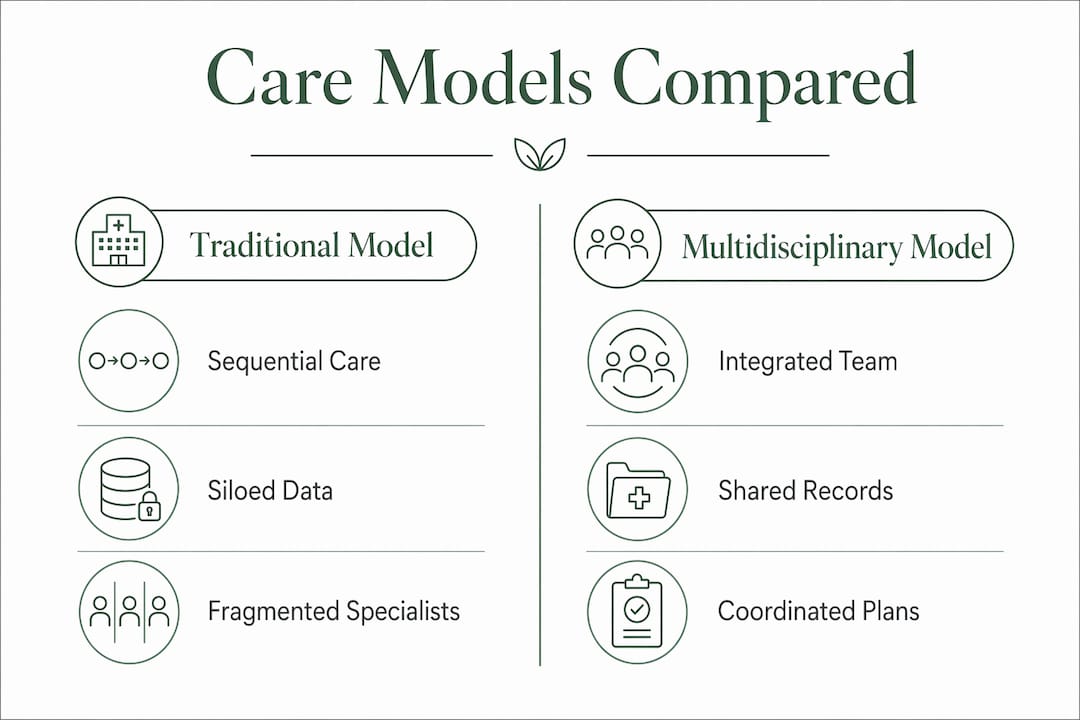
Multidisciplinary primary care teams demonstrate stronger chronic condition management and better integration with social services compared to traditional general practitioner models. That finding matters because chronic diseases like diabetes, hypertension, and chronic obstructive pulmonary disease require ongoing, multi-layered management that no single provider can deliver alone.
The table below summarizes the core differences between the two models.
| Feature | Traditional Model | Multidisciplinary Model |
|---|---|---|
| Care coordination | Sequential, provider to provider | Simultaneous, shared care plan |
| Communication | Referral letters, delayed updates | Shared electronic health records |
| Chronic disease management | Single-provider focused | Team-based, integrated |
| Social service integration | Rare or informal | Built into care structure |
| Patient experience | Repeat history at each visit | One unified record, less repetition |
Siloed data systems hinder coordinated care, and unified scheduling with shared electronic health records is the clearest sign that a medical group is truly integrated rather than simply co-located. You can ask your provider directly whether all specialists in the group share the same records system. That single question tells you a great deal about how your care will actually be managed.
Pro Tip: Before joining a medical group, ask: “Do all your specialists share one electronic health record?” If the answer is no, your care coordination may be more limited than it appears.
What makes a multidisciplinary medical group actually effective?
Not every group that calls itself multidisciplinary delivers genuine integrated care. The difference between a high-performing team and a loosely connected group of specialists comes down to three operational factors: trust, shared language, and collaborative decision-making.
Integrated teamwork requires trust and a shared medical language among professionals from different backgrounds. A cardiologist and a social worker, for instance, use entirely different vocabularies to describe patient risk. Without deliberate effort to align those perspectives, communication breaks down and patients fall through the gaps.

Bridging semantic gaps between diverse specialists is one of the most underappreciated challenges in building effective teams. Healthcare team diversity requires intentional communication structures, not just good intentions.
Collaborative decision-making is the clearest test of whether a team is truly functioning as one. In genuine multidisciplinary practice, specialists make shared patient care decisions rather than acting in sequence. One provider does not simply hand off to the next. The team reviews the full picture together and agrees on a unified direction.
Psychological safety is equally critical. When team members feel safe enough to admit uncertainty or challenge a colleague’s recommendation, patient outcomes improve. A culture where no one questions the senior physician is not a safe team. It is a hierarchy that puts patients at risk.
One common misconception is worth addressing directly. Many patients assume that multidisciplinary care means all their specialists meet in the same room at the same time. In reality, true MDT integration often relies on asynchronous communication, including shared electronic records and structured team reviews, rather than simultaneous face-to-face meetings. The coordination is real. It just happens behind the scenes.
How do patients directly benefit from multidisciplinary care?
The practical advantages of multidisciplinary care advantages show up in your daily experience as a patient. The most immediate benefit is that you stop repeating yourself. When your medical group uses a shared record system, every provider already knows your history before you walk into the room.
Patient satisfaction scores increased from 3.6 to 4.3 on a 5-point scale when care was delivered under a multidisciplinary model. That jump reflects a real shift in how patients feel about their care, not just how clinicians measure it. Patients report feeling heard, understood, and supported across multiple dimensions of their health.
Multidisciplinary teams provide faster referrals and more efficient access to diverse healthcare resources. If your primary care physician identifies a cardiac concern during a routine visit, a coordinated group can connect you with a cardiologist the same week rather than the same quarter.
Consider a patient managing Type 2 diabetes with early signs of kidney disease and anxiety. In a traditional model, that person sees an endocrinologist, a nephrologist, and a mental health provider separately, with no communication between them. In a multidisciplinary group, those three specialists review the case together. The treatment plan accounts for how each condition affects the others. The patient receives one coherent plan instead of three separate ones that may conflict.
The role of diverse medical expertise also extends to preventive care. When a team includes pharmacists, nutritionists, and behavioral health specialists alongside physicians, patients receive guidance that addresses the full picture of their health, not just the presenting symptom.
Key takeaways
Multidisciplinary medical groups deliver measurably better outcomes because coordinated teams reduce errors, shorten hospital stays, and improve patient satisfaction in ways that single-provider models cannot replicate.
| Point | Details |
|---|---|
| Readmission reduction | MDT approaches cut 30-day readmission rates by 12.4% and reduced hospital stays from 8.9 to 6.2 days. |
| Medication safety | Coordinated teams reduced medication errors by 56%, a direct result of shared care planning. |
| Patient satisfaction | Satisfaction scores rose from 3.6 to 4.3 on a 5-point scale under multidisciplinary management. |
| Effective integration markers | Shared electronic health records and unified scheduling are the clearest signs of genuine MDT coordination. |
| Psychological safety | Teams where specialists can admit uncertainty and challenge decisions produce consistently better patient outcomes. |
What i’ve learned from watching patients navigate healthcare silos
Most patients I speak with have experienced fragmented care at some point. They describe seeing four different specialists, carrying paper records from office to office, and receiving advice that contradicts itself. That experience is not a failure of individual providers. It is a structural problem, and multidisciplinary medical groups exist specifically to solve it.
What I find most telling is how rarely patients think to ask about team communication. They ask about wait times and insurance. They rarely ask whether their cardiologist and their primary care physician share the same records or speak to each other before adjusting a treatment plan. That question matters more than almost any other.
The importance of care coordination becomes most visible when something goes wrong. A missed medication interaction, a delayed referral, a discharge without a follow-up plan. These failures are far more common in siloed systems than in coordinated ones.
My honest advice: if you manage a chronic condition or have multiple health concerns, the type of medical group you choose is one of the most consequential healthcare decisions you will make. Ask about shared records. Ask about team rounds. Ask who coordinates your care when you are not in the office. The answers will tell you everything.
— Krunal
Experience multidisciplinary care at Gardenstatemedicalgroup
Gardenstatemedicalgroup brings together primary care, cardiopulmonary services, radiology, and specialized chronic disease programs under one coordinated structure in North Bergen and Secaucus, New Jersey. Every specialty shares records and communicates across disciplines so your care plan reflects your full health picture, not just one piece of it.
Whether you are managing a chronic condition or looking for a medical home that keeps all your providers connected, Gardenstatemedicalgroup offers the coordinated approach the evidence supports. Explore primary care services designed around your long-term health, or learn more about the chronic care management programs built specifically for patients with complex, ongoing needs. Schedule your appointment today and experience what coordinated care actually feels like.
FAQ
What is a multidisciplinary medical group?
A multidisciplinary medical group is a team of healthcare professionals from different specialties, such as primary care, cardiology, pharmacy, and social work, who coordinate care for the same patient using shared records and joint decision-making.
How do multidisciplinary teams reduce hospital readmissions?
Coordinated teams conduct structured care reviews, catch medication conflicts early, and create unified discharge plans. A 2026 study found this approach reduced 30-day readmission rates by 12.4%.
Do all my specialists meet together in multidisciplinary care?
Not necessarily. True multidisciplinary integration often relies on asynchronous communication through shared electronic health records and team reviews rather than simultaneous in-person meetings.
How can i tell if a medical group is truly multidisciplinary?
Ask whether all specialists share one electronic health record system and whether the group conducts regular interdisciplinary case reviews. Unified scheduling and shared records are the clearest indicators of genuine coordination.
Are multidisciplinary teams better for chronic disease management?
Yes. Research shows multidisciplinary primary care teams deliver stronger management of chronic conditions and better social service integration compared to traditional single-provider models.