
Building a family health plan for lasting wellness

TL;DR:
- Effective family health management requires integrating preventive care, insurance coverage, and community resources into a cohesive plan. Gathering records, setting clear goals, scheduling routine checkups, and reviewing insurance are essential steps for long-term wellness. Regular quarterly reviews and utilizing local clinics ensure sustainable health habits and minimized costs.
Managing the health of an entire household is one of the most rewarding things you can do for your family, but it can also feel like a moving target. Between school physicals, adult screenings, insurance renewals, and the daily habits that quietly shape long-term health, it is easy to let important steps slip through the cracks. Families in North Bergen and Secaucus have access to excellent local resources, yet many have never connected those resources into a single, workable plan. This guide walks you through every stage of building one, from gathering records to scheduling preventive care to making the most of what your insurance actually covers.
Table of Contents
- What you need before starting your family health plan
- Step-by-step: Creating your comprehensive family health plan
- Scheduling and tracking preventive care for your family
- Reviewing insurance and leveraging local resources in North Bergen and Secaucus
- Why most family health plans fall short—and what actually works
- Get support for your family health plan in North Bergen and Secaucus
- Frequently asked questions
Key Takeaways
| Point | Details |
|---|---|
| Gather family health data | Start by organizing health records, immunization history, and insurance details for every family member. |
| Follow proven planning steps | Use a step-by-step approach for goals, nutrition, exercise, mental health, and scheduled preventive care. |
| Track and update regularly | Quarterly reviews help catch gaps early and keep your family on track for wellness goals. |
| Combine insurance with prevention | The most effective family health plans connect daily habits with adequate insurance and community resources. |
What you need before starting your family health plan
Before you can build a plan, you need a clear picture of where your family stands today. Think of this as taking inventory. You would not renovate a house without knowing what is already there, and the same logic applies to your family’s health.
Start by gathering health records for every member of your household. This means recent checkup summaries, vaccination records, prescription lists, any diagnoses of chronic conditions such as diabetes, high blood pressure, or asthma, and your current insurance information including your plan’s Summary of Benefits and Explanation of Coverage documents. If you have children in school, their vaccination history is especially important because New Jersey requires certain immunizations for enrollment.
It is equally important to involve everyone in your household in this process, not just the adults. Teenagers are old enough to understand their own health status and benefit greatly from being included in conversations about screenings, nutrition, and mental wellness. Younger children can participate in age-appropriate ways, such as helping to plan healthy meals or understanding why they visit the doctor each year.
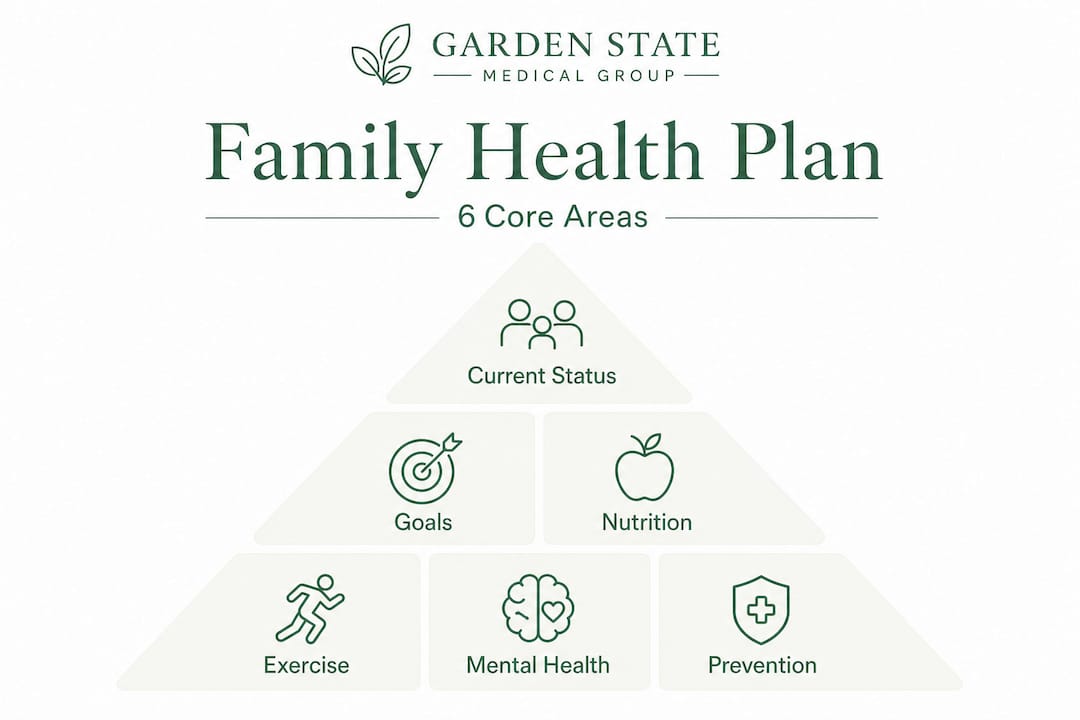
The six core areas you will address in your plan are current health status, specific wellness goals, nutrition, physical activity, mental health and sleep, and preventive care. Step-by-step mechanics to create a family wellness plan include assessing current health status, setting specific goals, planning nutrition and exercise, prioritizing mental health and sleep, scheduling preventive checkups, and reviewing insurance coverage. Knowing these categories upfront helps you stay organized and ensures nothing gets overlooked.
You may also want to review the local health programs available in your area, since many community offerings can support your plan at little or no cost.
| Record type | Why you need it | Where to find it |
|---|---|---|
| Vaccination history | Confirms what boosters are due | Pediatrician or school health office |
| Chronic condition notes | Tracks ongoing management needs | Primary care provider |
| Insurance summary | Shows what is covered and at what cost | Insurance company’s member portal |
| Recent lab results | Establishes baseline health markers | Lab or primary care provider |
| Prescription list | Prevents dangerous drug interactions | Pharmacy or patient portal |
Pro Tip: Create a single family health folder, either a physical binder or a secure digital folder, where every member’s records are stored together. Update it after every appointment so you are never hunting for information when you need it most.
Step-by-step: Creating your comprehensive family health plan
Once you have your materials together, here is exactly how to build your plan in a logical sequence that covers every important dimension of your family’s wellness.
Step 1: Assess current health status. Review the records you gathered and note any gaps. Who has not had a physical in over a year? Is anyone overdue for a dental checkup or eye exam? Write down the current health status of each family member honestly.
Step 2: Set specific, measurable goals. Vague goals like “eat better” rarely lead to change. Instead, aim for something concrete: “Walk 30 minutes four times a week” or “Reduce sugary drinks to one per day.” Goals should be realistic for your household’s schedule and budget.
Step 3: Plan your nutrition strategy. You do not need a strict diet to improve your family’s nutrition. Focus on gradual upgrades: more vegetables at dinner, whole grain bread instead of white, water as the default drink. Meal planning one day per week can reduce fast food reliance significantly.
Step 4: Establish exercise routines. The CDC recommends that children get at least 60 minutes of physical activity daily, while adults should aim for 150 minutes of moderate activity per week. Family walks, bike rides, or weekend sports can meet these targets while also strengthening relationships.
Step 5: Address mental health and sleep. Mental health is just as important as physical health. Make sure everyone in your household is getting adequate sleep, which means 8 to 10 hours for school-age children and 7 to 9 hours for adults. Build in downtime, and check in regularly with each family member about how they are feeling emotionally.
Step 6: Schedule preventive appointments. Use the benchmarks in the next section to identify which screenings and immunizations are due for each person. Schedule them in advance so they do not get pushed aside.
Step 7: Review your insurance coverage. Understanding what your plan covers prevents unwanted surprises. Look at your deductible, copays for specialist visits, and whether your preferred providers are in-network.
Step 8: Commit to quarterly reviews. A plan that is never revisited stops working. Creating a family wellness plan only pays off when families treat it as a living document, not a one-time task.
Check out this preventive care guide to understand which screenings are most important for your age group, and download the family wellness checklist to track your progress.
| Plan type | Strengths | Limitations |
|---|---|---|
| Insurance-focused plan | Protects against financial risk, guides network choices | May ignore daily habits and lifestyle factors |
| Wellness-focused plan | Promotes lasting behavioral change and prevention | May not account for coverage gaps or cost barriers |
| Integrated plan (both) | Balances prevention with financial protection | Requires more time and coordination upfront |
Pro Tip: Set a recurring calendar reminder for the first week of every quarter. Use that time to check in on each family member’s goals, confirm upcoming appointments, and update your health folder with any new records.
Scheduling and tracking preventive care for your family
Once your plan is written, making sure your family’s preventive care is actually happening is the most critical execution step. Many families intend to schedule screenings but never get around to it. Building a concrete timeline solves that problem.

The CDC immunization schedule is the authoritative source for both children and adults. Children need a series of vaccines beginning at birth and continuing through adolescence, covering diseases like measles, whooping cough, and hepatitis B. Adults need annual flu shots, a COVID-19 vaccine and updated boosters, and a Tdap booster every 10 years. Adults 65 and older should also receive pneumococcal vaccines.
Cancer screenings follow guidelines set by the U.S. Preventive Services Task Force, commonly abbreviated as USPSTF. Colorectal cancer screening is recommended for adults ages 45 to 75. Breast cancer screening via mammogram is recommended biennially for women ages 50 to 74. Adults with a 10 percent or higher cardiovascular disease risk may be prescribed statins, which are cholesterol-lowering medications, as a preventive measure. Understanding these benchmarks helps your family stay ahead of conditions that are far easier to treat when caught early.
The benefits of preventive care extend well beyond avoiding illness. Early detection of chronic conditions, management of risk factors, and consistent relationship-building with a primary care provider all reduce long-term healthcare costs significantly.
| Age group | Key screenings and vaccines |
|---|---|
| Infants and toddlers (0 to 2) | Hepatitis B, DTaP, IPV, Hib, PCV, MMR, Varicella, flu (6 months+) |
| Children (3 to 11) | Annual flu, booster doses, vision and hearing checks |
| Adolescents (12 to 17) | HPV series, meningococcal vaccine, depression screening |
| Adults (18 to 49) | Annual flu, Td/Tdap booster, blood pressure, cholesterol, diabetes screening |
| Adults (50 to 64) | Colorectal cancer screening, mammogram (women), bone density baseline |
| Adults (65+) | Pneumococcal vaccines, shingles vaccine, annual wellness visits |
Here is a practical list of preventive care tasks with their recommended timing:
- Annual physical exam for every family member, regardless of current health status
- Flu shot every fall, ideally before October, for all household members 6 months and older
- Dental cleanings every six months for children and adults
- Eye exam every one to two years depending on age and existing vision needs
- Blood pressure check at least once a year for adults
- Blood glucose and cholesterol panel every three to five years for adults without known risk factors, more frequently for those with risk factors
- Colorectal cancer screening starting at age 45
- Mammogram every two years for women starting at age 50
Learn more about why regular checkups matter for both children and adults, and how consistent care reduces the likelihood of expensive emergency visits down the road.
Reviewing insurance and leveraging local resources in North Bergen and Secaucus
After your preventive care calendar is in place, it is essential to connect your health steps with the insurance coverage your family carries and the community resources available right in your area.
Start by reviewing your plan’s Summary of Benefits and Coverage, a standardized document your insurer is required to provide. Focus on four key elements: your annual deductible (the amount you pay before insurance kicks in), your family’s aggregate deductible (the combined amount all family members must reach together), copays for primary care versus specialist visits, and whether your preferred providers are in-network. Switching plans during open enrollment can save your family hundreds of dollars annually if your current plan no longer fits your health needs.
Here are practical tips for getting the most out of your insurance review:
- Compare your family’s actual usage from last year against what your current plan covers.
- Check whether any chronic condition medications are covered under your formulary (the list of drugs your insurer will pay for).
- Find out if your plan covers telehealth visits, which can save time and reduce barriers to routine care.
- Review your explanation of benefits statements monthly to catch billing errors early.
- Ask your insurer about preventive care services that are covered at no cost under the Affordable Care Act.
You can also find detailed NJ insurance coverage tips and guidance on checking your insurance in NJ through our blog resources.
For families who are uninsured or underinsured, North Bergen has a powerful option. A Federally Qualified Health Center, commonly called an FQHC, is a community clinic that receives federal funding and must serve all patients regardless of their ability to pay, insurance status, or immigration status. These centers offer sliding-scale fees based on income and provide primary care, preventive screenings, and chronic disease management.
“Free or low-cost care at a Federally Qualified Health Center in North Bergen is available to all community members, regardless of insurance or immigration status.” This is a critical resource for families navigating coverage gaps or those who have recently moved to the area.
Understanding NJ healthcare access essentials can help your family make full use of these community-based safety net services alongside any private coverage you carry.
Why most family health plans fall short—and what actually works
We see a consistent pattern in families who struggle with long-term wellness. The plan starts strong in January, gets derailed by a busy spring schedule, and is completely abandoned by summer. The problem is rarely motivation. It is structure.
Most family health plans fail because they focus on one dimension and ignore the others. Some families invest heavily in insurance and believe that having good coverage is the same as having a health plan. It is not. Coverage protects you financially when something goes wrong, but it does not prevent problems from developing in the first place. Other families focus only on diet and fitness goals and neglect the equally critical steps of scheduling screenings and reviewing what their insurance actually covers.
Research consistently shows that integrating both coverage and prevention reduces long-term costs far more effectively than either approach alone. Insurance-focused plans emphasize financial protection and provider networks, while wellness plans prioritize lifestyle changes. The families who see the most lasting improvement are those who combine both, treating prevention as a year-round practice and insurance as the safety net beneath it.
Simple habits consistently outperform grand resolutions. Quarterly plan reviews take less than an hour and keep your family on track. Involving your entire household, including teenagers who are old enough to manage portions of their own health checklists, creates accountability and builds lifelong habits. Digital reminders on your phone cost nothing and eliminate the single biggest barrier to preventive care, which is simply forgetting to schedule it.
We also believe in the power of understanding preventive care as a mindset shift, not just a checklist. When your family sees every annual physical, every flu shot, and every dental cleaning as an investment in future quality of life, the behavior change becomes sustainable.
Pro Tip: Let your teenager take ownership of their health checklist. Walk them through what vaccines they need, what screenings are age-appropriate, and how to schedule appointments. This single step builds a habit they will carry for decades.
Get support for your family health plan in North Bergen and Secaucus
Building a family health plan is a process, and you do not have to figure it out alone. Garden State Medical Group provides family-focused care in North Bergen and Secaucus that supports every step of your wellness journey, from initial health assessments to ongoing chronic care management.
Our primary care services are designed to serve as the foundation of your family’s health plan, connecting preventive visits, screenings, and referrals through a single, coordinated team. For families managing chronic conditions like diabetes, hypertension, or heart disease, our chronic care support programs provide structured, ongoing management so that conditions stay controlled and complications stay rare. We accept most major insurance plans and are committed to making quality care accessible for every family in our community.
Frequently asked questions
How often should our family review our health plan?
Quarterly wellness reviews are the recommended standard, giving your family time to track progress, update goals, and confirm that all upcoming preventive appointments are scheduled before they become overdue.
What immunizations are required for adults and children?
Follow the CDC immunization schedule for both age groups, which includes annual flu shots, COVID-19 vaccines, Tdap boosters for adults, and a full series of childhood vaccines covering measles, hepatitis B, and more.
What is the difference between an insurance-focused plan and a wellness plan?
An insurance plan primarily protects your family’s finances and ensures access to covered providers, while a wellness plan focuses on daily habits and preventive routines. Integrating both approaches gives your family the most complete protection against both immediate and long-term health risks.
Are there low-cost clinics for preventive care if we lack insurance?
Yes. The Federally Qualified Health Center in North Bergen provides free or low-cost preventive care to all community members regardless of insurance status or immigration status, making quality care accessible for every family in the area.