
Skip or Start Statins: Coronary Calcium Score for New Jersey Patients

A coronary calcium score measures calcified plaque in your heart’s arteries using a quick CT scan, and it comes back as an Agatston score. A score of zero suggests your near-term risk of a heart attack is low, while higher scores point to more plaque and more risk. The main job of this test is helping you and your doctor decide, with real evidence instead of guesswork, whether preventive treatment like a statin makes sense for you.
TL;DR:
- A calcium score above 100 or above the 75th percentile for age and sex often leads to starting statin therapy, regardless of current symptoms.
- A score of zero supports delaying medication, but it does not guarantee permanent protection, especially for high-risk individuals like heavy smokers or diabetics.
- The test exposes patients to low radiation comparable to a mammogram and typically costs between $100 and $150 out-of-pocket in the United States.
- The score reflects years of calcified plaque buildup, making it valuable for long-term risk prediction but not for acute diagnosis or soft plaque detection.
- Repeat scanning is generally unnecessary once calcified plaque is detected, as it does not regress significantly, shifting focus to risk factor management instead.
Table of Contents
- What Is a Coronary Calcium Score Test at a Glance?
- What Does the Coronary Calcium Score Actually Measure?
- Who Should Get a Calcium Score Test?
- How Is a Calcium Score Test Performed?
- How Do You Interpret a Calcium Score?
- How Does Your Score Change Your Treatment Plan?
- Are There Risks or Costs to Worry About?
- When Should You Repeat a Calcium Score Test?
- Our Take on Coronary Calcium Scores as a Preventive Tool
- Ready to Get Your Coronary Calcium Score Checked?
- Primary Sources and Guidelines
- Sources
- FAQ
What Is a Coronary Calcium Score Test at a Glance?
A coronary calcium score test uses a noncontrast CT scan to detect and measure calcium deposits in the walls of your coronary arteries, producing a number called the Agatston score. You don’t need an IV, you don’t need contrast dye, and you don’t need to change your routine much beforehand.
The scanning itself takes only seconds. Once you account for check in, positioning, and the actual imaging, the full appointment runs about 5 to 15 minutes. Radiation exposure is low, roughly in the same range as a mammogram, which is part of why this test has become a standard option for people trying to clarify their heart disease risk without an invasive procedure.
Quick facts:
- Noncontrast CT scan, no needles, no dye
- Scan time: seconds; total visit: 5 to 15 minutes
- Radiation dose: low, comparable to a mammogram
- Typical U.S. out-of-pocket cost: often in the $100 to $150 range, though this varies by provider and insurance coverage
Insurance coverage for a coronary calcium score test varies widely. Some plans cover it when a doctor documents intermediate cardiovascular risk, others treat it as an elective screening test you pay for directly. Ask your provider’s billing office before you schedule.
What Does the Coronary Calcium Score Actually Measure?
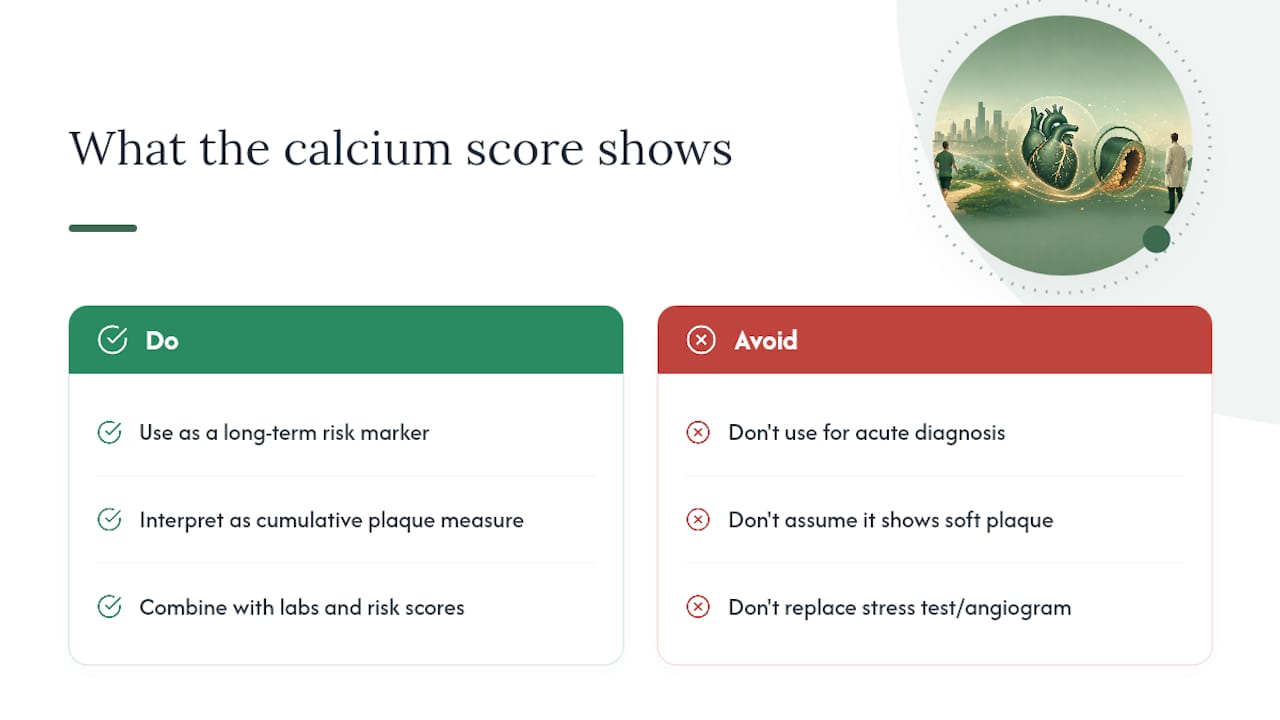
Calcified plaque builds up over years as fatty deposits in your artery walls harden. Your coronary calcium score reflects the cumulative amount of that hardened plaque, not a snapshot of a single moment, which is exactly why it works so well as a long-term risk marker rather than an acute diagnostic test.
That cumulative view is what makes coronary artery calcification so useful for predicting future cardiovascular events. Someone with a high score has spent years accumulating arterial damage, and that history tends to keep predicting risk going forward, independent of how someone feels on a given day.
The test does have real limits. It only detects calcified, or hardened, plaque. Soft, non-calcified plaque, which can also rupture and cause a heart attack, does not show up on a calcium scan. The test also does not measure how narrow your arteries have become, so it is not a substitute for a stress test or angiogram when someone already has symptoms. Think of a coronary calcium score as one strong data point among several, not a replacement for cholesterol testing, blood pressure readings, or a risk calculator like the Framingham score.
Who Should Get a Calcium Score Test?
This test earns its value in a specific window: adults roughly 40 to 75 years old whose 10 year risk of atherosclerotic cardiovascular disease sits in a gray zone. If your risk calculator puts you somewhere between borderline (5 to 7.5%) and intermediate (7.5 to 20%), and you and your doctor are not sure whether a statin makes sense, a coronary calcium score can settle the question with objective evidence instead of a coin flip.
- Good candidates: adults with uncertain intermediate or borderline risk, especially when statin therapy is being debated.
- Not typically needed: people who already have diagnosed coronary artery disease.
- Not typically needed: people already taking a statin for a clear, established indication, since the test won’t change that decision.
- Special consideration: a strong family history of early heart disease, diabetes, or heavy smoking history can shift the conversation even outside the standard risk bands.
If you already know you have heart disease, this test adds little. Its entire purpose is resolving uncertainty for people who don’t yet have a clear answer.
How Is a Calcium Score Test Performed?
Getting scanned for a coronary calcium score is about as low friction as diagnostic imaging gets. Here’s what the appointment typically looks like:
- You lie on the CT table, and the technologist attaches EKG leads to your chest so the machine can time the images with your heartbeat.
- You’ll be asked to hold your breath for a few seconds at a time while the scanner captures images of your heart, no contrast dye required.
- The actual image capture lasts only seconds; the whole visit, including setup, generally wraps up in 5 to 15 minutes.
- A cardiac imaging specialist reviews the scan and calculates your Agatston score, which your ordering physician then discusses with you.
Preparation is minimal. Some clinics ask you to skip caffeine for a few hours beforehand since it can raise your heart rate, and you’ll want to avoid heavy exercise right before the scan for the same reason. Your report will list your raw Agatston score, its category, and sometimes a percentile comparing you to others your age and sex.
How Do You Interpret a Calcium Score?
Coronary calcium scores fall into four broad categories, and knowing where you land tells you a lot about what happens next.
- 0: No detectable calcified plaque. This is the most reassuring result a coronary calcium score can deliver.
- 1 to 99: Mild plaque burden. Low but not zero risk.
- 100 to 399: Moderate plaque burden. This range often changes clinical decisions.
- 400 and above: Extensive plaque burden, associated with meaningfully higher cardiovascular risk.
Raw numbers don’t tell the whole story, though. A score of 50 means something very different for a 45 year old than it does for a 70 year old, which is where percentiles come in. Your percentile shows how your score compares to people your own age and sex, and a younger patient can land in a high percentile even with a moderate absolute score.
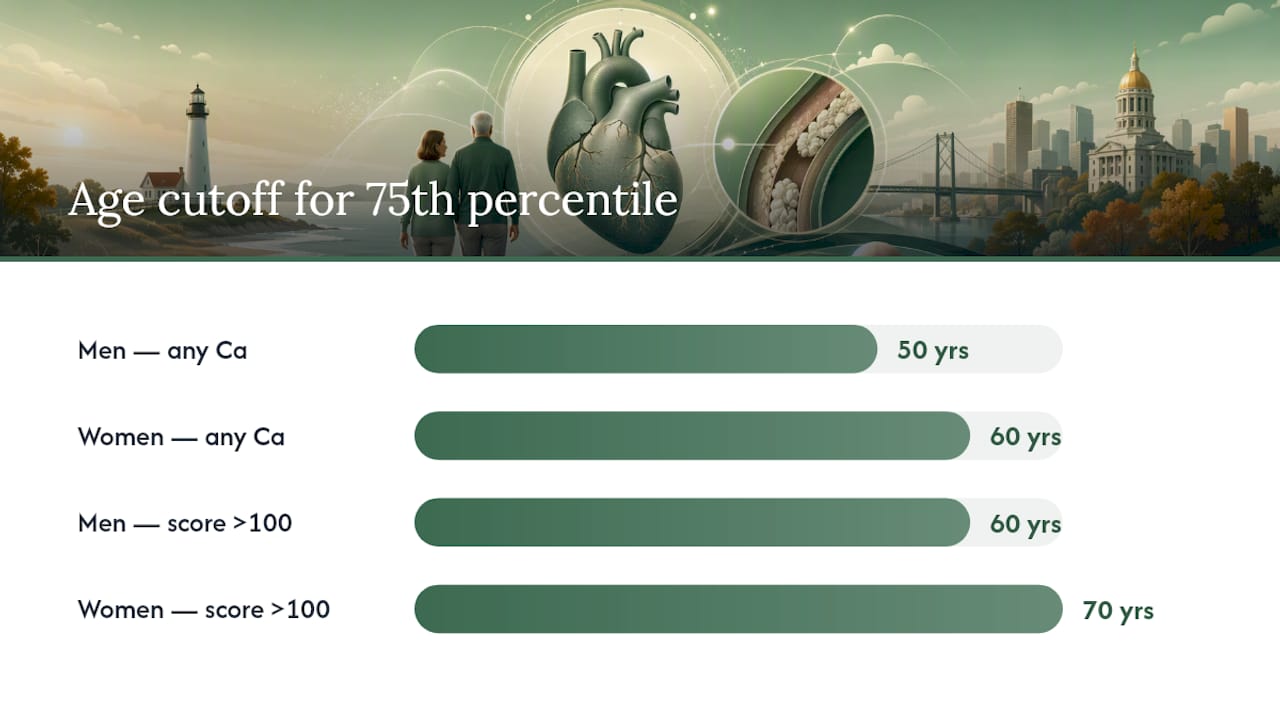
Research using the Multi-Ethnic Study of Atherosclerosis (MESA) gives clinicians a practical shortcut here. Any detectable calcium at all tends to place most men under 50 and women under 60 above the 75th percentile for their age group, and a score above 100 places nearly all men under 60 and women under 70 above that same threshold. That rule of thumb helps a doctor quickly flag a younger patient whose “moderate” number is actually a red flag for their age.
How Does Your Score Change Your Treatment Plan?
This is where a coronary calcium score earns its keep. Current guidance from the American College of Cardiology and American Heart Association treats CAC as a tiebreaker for statin decisions when risk is genuinely uncertain.
- A score of 100 or higher, or a result above the 75th percentile for your age and sex, frequently supports starting a statin, even in someone who felt on the fence beforehand.
- A score of zero often supports holding off on statin therapy in people with low to intermediate risk, at least for now.
- Your calcium score doesn’t override your preferences or your doctor’s judgment. It’s one more piece of evidence used in shared decision-making, alongside your cholesterol panel, blood pressure, and family history.
- Regardless of your score, lifestyle changes like better nutrition, regular activity, and quitting smoking remain part of the plan for improving cardiac health.
Pro Tip: Bring your calcium score results to your primary care visit rather than waiting for a separate follow-up. Your doctor can factor the number directly into your risk calculator and cholesterol treatment plan in the same conversation.
Are There Risks or Costs to Worry About?
The radiation dose from a coronary calcium score test is low, similar to a mammogram, and there’s no evidence of lasting harm from a single scan at that dose. Because there’s no contrast dye and no needle involved, immediate side effects are essentially nonexistent.
- Radiation exposure: low, comparable to a mammogram, with no known lasting effects at this dose.
- Incidental findings: occasionally the scan picks up something outside the heart, like a lung nodule, that needs a follow-up look.
- Typical out-of-pocket cost: often in the $100 to $150 range in the United States, though prices vary by facility.
- Insurance coverage: inconsistent. Some plans cover it for documented intermediate risk; others classify it as elective.
Call your insurer before scheduling if cost is a concern, and ask your provider’s office whether they can tell you the cash price upfront.
When Should You Repeat a Calcium Score Test?
A score of zero doesn’t mean permanent protection, but it does buy you time. Many adults with a zero score get what doctors sometimes call a warranty period of three to five years before rescanning is typically considered, and that window can stretch even longer for low-risk women.
Diabetes or continued smoking tends to shorten that interval, since both accelerate plaque formation. If your score comes back above zero, though, repeat scanning rarely changes anything. Calcified plaque doesn’t meaningfully regress once it’s there, so a follow-up scan a year or two later would likely just confirm what you already know. At that point, the focus shifts to controlling risk factors rather than remeasuring them. If new symptoms show up or your risk profile changes significantly, your doctor is more likely to order a stress test or CT angiogram than to repeat the calcium score.
Our Take on Coronary Calcium Scores as a Preventive Tool
We think coronary calcium scoring works best when it’s read alongside your full medical picture, not treated as a standalone verdict on your heart health. A number on a report means little without a clinician who can connect it to your cholesterol panel, your family history, and your day to day health.
A multidisciplinary structure spanning primary care, cardiopulmonary services, and on-site radiology supports integrated care without patients needing to visit separate offices. Clinician-led shared decision-making is favored over one-size-fits-all protocols, aiming to make scheduling diagnostic imaging straightforward and accessible.
— Garden State Medical Group
Ready to Get Your Coronary Calcium Score Checked?
If your risk feels uncertain and a statin conversation has stalled, a coronary calcium score can give you and your doctor something concrete to work from instead of another round of guessing. Some medical groups offer on-site radiology and diagnostic testing alongside cardiopulmonary follow-up care and health programs, enabling scans and follow-up care to occur under a coordinated plan rather than scattered across separate offices.
Start by talking to your primary care provider about whether you fall into the borderline or intermediate risk range where a calcium score adds real value. Bring your recent cholesterol results, your family history, and your insurance information to that visit. From there, you can request diagnostic imaging directly, or explore the full menu of diagnostic tests available on-site, including options that pair naturally with a calcium score like an echocardiogram or lipid panel. If your results point toward starting preventive therapy, our cardiopulmonary care team is positioned to take that conversation forward without a separate referral delay.
Primary Sources and Guidelines
- American Heart Association: Coronary Artery Calcium Test
- JAMA: Calcium Scoring Recommendations
- RadiologyInfo: Cardiac CT for Calcium Scoring
- Harvard Health: Should I Get a Calcium Score?
- MESA-Based CAC Percentile Study
- Understanding your CT report
Sources
- Should I get a calcium score? — Harvard Health
- JAMA article on calcium scoring recommendations
- Coronary Artery Calcium Test — American Heart Association
- MESA-based CAC percentile study — PMC
- Cardiac CT for Calcium Scoring — RadiologyInfo
FAQ
What Is a Good Calcium Score by Age?
There’s no single universal cutoff, since scores need to be read against age and sex. A score of zero is ideal at any age, and a MESA-based rule of thumb suggests any detectable calcium in men under 50 or women under 60 already places them above the 75th percentile for their peer group, worth discussing with your doctor even if the raw number seems small.
Which Is Worse, High Cholesterol or a High Calcium Score?
They measure different things and aren’t directly comparable. High cholesterol is a risk factor that can contribute to plaque formation over time, while a high coronary calcium score reflects plaque that has already formed, making it a more direct signal of existing cardiovascular disease.
Can You Lower Your Calcium Score?
Calcified plaque generally does not reverse once it forms, so the practical goal after a nonzero score shifts to slowing further plaque buildup through statin therapy when appropriate, blood pressure control, and lifestyle changes rather than trying to erase the existing score.
What Is an Alarming Calcium Score?
A score of 400 or higher falls into the extensive plaque category and is generally considered a strong signal for aggressive risk factor management and preventive therapy. Scores above 100, or above the 75th percentile for your age and sex, also frequently prompt a serious conversation about starting a statin.