
How to choose a primary care provider in North Bergen

TL;DR:
- Choosing a primary care provider who prioritizes prevention and continuity significantly improves long-term health outcomes.
- Evaluating credentials, accessibility, and practice philosophy helps you find a trusted partner for managing your health needs.
Finding the right person to manage your health is one of the most important decisions you will make, yet many adults in North Bergen and Secaucus approach it without a real plan. Knowing how to choose a primary care provider who genuinely prioritizes preventive health and chronic condition management can mean the difference between catching a problem early and dealing with a serious diagnosis that could have been avoided. This guide walks you through every step, from understanding what a PCP actually does to avoiding common mistakes that leave patients frustrated and underserved.
Table of Contents
- Understanding what a primary care provider does and why it matters
- Preparing your checklist: What to look for in a primary care provider
- Steps to evaluate and select your primary care provider
- Avoiding common pitfalls and ensuring ongoing satisfaction with your primary care provider
- Comparing types of primary care providers and practice models for your needs
- Why prioritizing continuity and a prevention-focused approach transforms your health
- Find your ideal primary care provider with Garden State Medical Group
- Frequently asked questions
Key Takeaways
| Point | Details |
|---|---|
| Know PCP roles | Primary care providers coordinate preventive care and manage chronic conditions to support your long-term health. |
| Check insurance network | Always confirm your PCP accepts your insurance and is in-network to avoid unexpected costs. |
| Prioritize continuity | Seeing the same provider consistently improves chronic disease outcomes and preventive care quality. |
| Evaluate practical factors | Consider location, availability, office hours, and telehealth options to fit your lifestyle and needs. |
| Interview before deciding | Meet or talk with your prospective PCP to ensure they listen, align with your health goals, and communicate clearly. |
Understanding what a primary care provider does and why it matters
To make the best choice, you first need to understand what your primary care provider can do for you. Many people think of their PCP only as the person they call when they are sick. The reality is much broader than that.
A PCP provides preventive care, manages common conditions, coordinates specialist referrals, and supports a long-term health relationship that evolves with you over time. That last part matters more than most people realize. A provider who knows your history, your lifestyle, and your health goals responds to changes in your condition much more accurately than one meeting you for the first time.
There are several types of primary care providers you may encounter:
- Family practitioners treat patients of all ages, including children and sometimes pregnant women.
- Internists specialize in adult medicine and are particularly well-suited to managing complex, overlapping conditions.
- Nurse practitioners (NPs) and physician assistants (PAs) provide many of the same services as physicians, often with shorter wait times and a strong focus on patient education.
- Geriatricians focus specifically on the health needs of older adults, including medication management and fall prevention.
Understanding why a primary care physician matters helps you see the role not just as a gatekeeper to specialists, but as a consistent advocate for your health. Continuity with the same PCP is also linked to better outcomes in preventive screenings and chronic disease management. Knowing this shapes how you evaluate your options from the start.
Preparing your checklist: What to look for in a primary care provider
With a clear understanding of what a PCP does, it is time to prepare your personalized checklist to find the right provider. Before you read a single review or make a single call, you need a few non-negotiables in place.
Start with insurance. Verifying insurance acceptance first, prioritizing offices within 15 to 20 minutes of travel, and confirming new patient availability with wait times under two to three weeks are your first filters. A provider who takes a month to see new patients is not a realistic option if you are managing a chronic condition like diabetes or hypertension.
Check credentials. Board certification and a prevention focus are two of the most important selection factors for quality care. Board certification means the provider has passed rigorous exams in their specialty and commits to ongoing education. Ask directly whether the office uses preventive care checklists or wellness visit frameworks.

Assess access options. Does the office offer telehealth for follow-up appointments? Are there extended hours on evenings or weekends? For working adults in Secaucus and North Bergen, this flexibility is not a luxury. It is often what determines whether you actually attend your appointments.
Here is a quick comparison of what to prioritize when finding the right primary care doctor for your needs:
| Factor | Why it matters | What to check |
|---|---|---|
| Insurance network | Avoids surprise costs | Your insurer’s online directory |
| Location and travel time | Improves appointment attendance | Under 15 to 20 minutes away |
| New patient wait time | Ensures timely access | Under 2 to 3 weeks ideally |
| Board certification | Confirms clinical standards | State medical board website |
| Preventive care focus | Supports early detection | Ask directly during intake |
| Telehealth availability | Improves ongoing access | Practice website or call ahead |
Pro Tip: Call the office before booking. How quickly they answer, whether staff can clearly explain insurance, and whether they actually confirm new patient availability tells you a great deal about how organized and patient-centered the practice is.
Reviewing what to look for when choosing a PCP in advance helps you ask better questions and avoid common oversights.
Steps to evaluate and select your primary care provider
Now that you have your checklist, follow these steps to thoroughly evaluate and select your PCP.
-
Verify insurance and new patient availability. Do not assume. Call the practice and confirm both. Insurance directories are frequently out of date.
-
Review board certification and credentials. You can check a physician’s certification status through the American Board of Medical Specialties. For nurse practitioners, confirm licensure through your state’s board of nursing.
-
Read verified patient reviews. Focus less on star ratings and more on patterns. Do multiple reviews mention that the provider listens carefully? Is there consistent feedback about long wait times in the exam room? Patterns reveal the real experience.
-
Schedule a meet-and-greet or an initial wellness visit. Many practices offer brief introductory visits. Use this time to assess whether the provider addresses your questions directly and whether the office environment feels organized and respectful.
-
Assess alignment with your health goals. Does the provider ask about your lifestyle, diet, or stress levels unprompted? Do they bring up preventive screenings you may be due for? These are signs of a provider who approaches care proactively.
-
Confirm coordination for chronic conditions. If you are managing diabetes, heart disease, or another ongoing condition, ask how the practice coordinates with specialists. Good primary care practices have clear referral pathways and follow up after specialist visits.
Seeing the same clinician consistently improves the quality of chronic and preventive services as well as patient satisfaction. This is not just a nice idea. Research backs it up firmly.
Pro Tip: When you ask questions during your first visit, pay attention to whether the provider seems curious about your answers or just moves through a checklist. Genuine curiosity about your health story is one of the best signs of a good long-term fit.
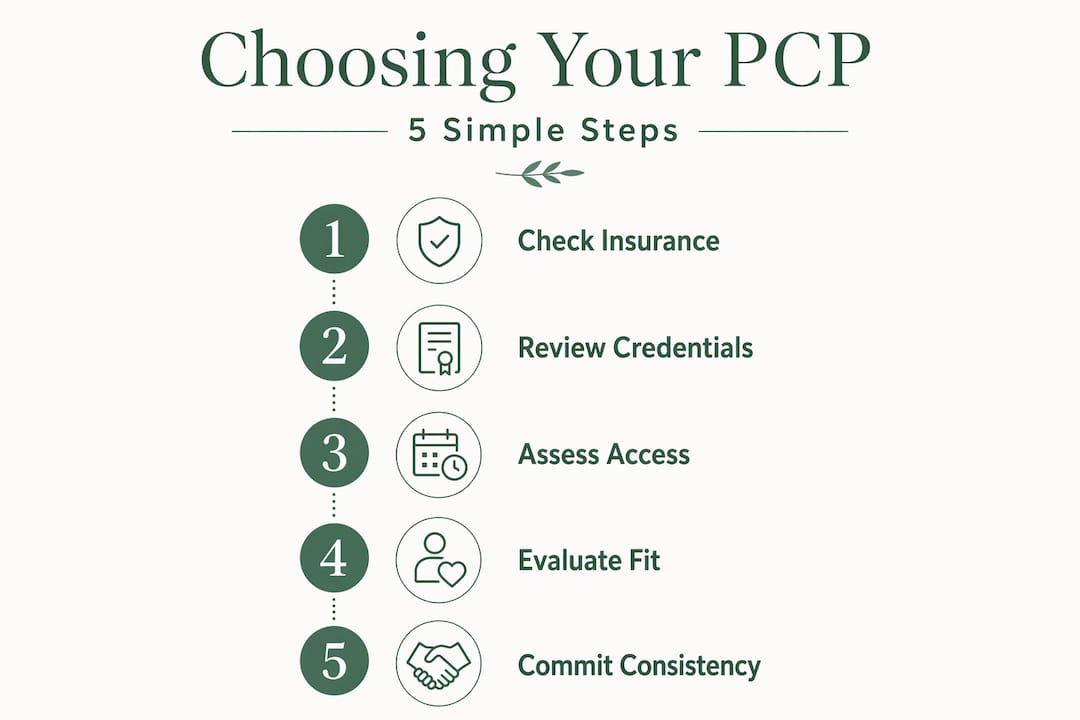
Learning how to find the right primary care doctor for you is a process, not a single decision. Give yourself permission to evaluate and choose carefully.
Avoiding common pitfalls and ensuring ongoing satisfaction with your primary care provider
Even after choosing your PCP, a few common pitfalls can undermine the relationship and your care quality over time.
Beware of overbooked practices. A provider who consistently runs 45 minutes late or who sees you for fewer than 10 minutes at every visit may not have the capacity to manage your preventive or chronic care needs thoroughly. Volume-heavy practices sometimes compromise the depth of each visit.
Do not trade continuity for convenience alone. It is tempting to prioritize whichever office can see you fastest. But for patients managing chronic conditions, emphasizing easy access can reduce continuity, and that reduced continuity can harm the quality of care you receive. Seeing a different provider at every visit means starting from scratch each time.
Trust your experience. If you consistently feel rushed, unheard, or dismissed, that is important information. It is completely appropriate to switch providers, and doing so does not need to be dramatic. Request your records, explain you are seeking care elsewhere, and move on.
Maintaining regular visits and keeping your provider updated on your health goals, new symptoms, or lifestyle changes builds the trust that makes long-term care genuinely effective. The relationship is a two-way investment.
Staying consistent with chronic disease management also depends on having a PCP you trust enough to be honest with. If you are not disclosing symptoms or skipping visits because you dread the appointment, that is a sign the relationship needs to change.
Comparing types of primary care providers and practice models for your needs
Understanding the provider types helps you narrow down who fits your preventive health and chronic management requirements best.
Family practitioners are trained to treat the whole family, including children, adults, and sometimes pregnant patients. If your household has multiple people who need care, a single family practitioner can manage everyone’s records and coordinate care across age groups.
Internists focus exclusively on adult medicine. They tend to have deeper training in managing complex, multi-system conditions like heart disease, diabetes, kidney disease, and autoimmune disorders. For adults in North Bergen and Secaucus with overlapping chronic conditions, an internist is often a strong fit.
Geriatricians specialize in the health needs of adults typically over 65, with training in managing multiple medications, cognitive health, and age-related conditions. If you or a family member are in this age group with complex health needs, a geriatrician offers targeted expertise.
Nurse practitioners and physician assistants provide patient-centered primary care with often shorter appointment wait times. They are an excellent option for generally healthy adults focused on preventive screenings, health education, and management of well-controlled chronic conditions.
Various PCP types have different training and scopes. Complex chronic cases usually benefit from physician-level care, while healthy adults may prefer advanced practice providers who offer timely visits and thorough health coaching.
| Provider type | Best suited for | Typical strengths |
|---|---|---|
| Family practitioner | All ages, families | Broad care across life stages |
| Internist | Adults with complex conditions | Multi-system chronic disease management |
| Geriatrician | Adults 65 and older | Medication management, cognitive health |
| Nurse practitioner | Healthy adults, preventive care | Patient education, quick access |
| Physician assistant | Preventive and routine care | Team-based care, flexible scheduling |
Choosing the right type of primary care physician for your health profile is just as important as any other factor on your checklist.
Why prioritizing continuity and a prevention-focused approach transforms your health
Now that you understand the practical steps, consider why focusing on continuity and prevention truly transforms your health experience.
Most people choose a PCP based on location, insurance, and whether they can get an appointment quickly. Those factors matter. But they address the surface of the decision, not the depth of it.
The PCP’s role as an advocate is something patients routinely underestimate when selecting a primary care provider. Advocacy, relationship building, and emotional support are as central to effective preventive and chronic care as any clinical skill. A provider who knows you well enough to notice that you seem more stressed than usual, or who remembers that you missed last year’s cholesterol screening, is doing something that no urgent care visit or specialist consult can replicate.
The data supports this clearly. Higher continuity with the same PCP correlates with fewer hospitalizations and emergency department visits among chronic disease patients. That is not a marginal benefit. Fewer hospitalizations means lower costs, less disruption to your life, and genuinely better health.
We also believe that patients underestimate their own role in making this relationship work. Showing up consistently, being honest about symptoms, and communicating your health goals directly are not optional extras. They are the foundation of care that actually improves your life. The right PCP, paired with an engaged patient, is one of the most effective tools in managing long-term health.
If you are in North Bergen or Secaucus and you are selecting a primary care doctor right now, let continuity and a prevention-first philosophy guide your decision. Tips for finding the right PCP that take those values seriously will serve you far better than a shorter commute alone ever will.
Find your ideal primary care provider with Garden State Medical Group
Ready to start your journey toward better health? Garden State Medical Group is here to help you find the right primary care provider in North Bergen and Secaucus.
At Garden State Medical Group, our primary care services are built around preventive health and chronic condition management. Our providers take the time to understand your full health picture and stay with you as a consistent partner in your care. We offer coordinated programs designed for specific conditions, including our chronic care management program and our diabetes prevention program. With offices conveniently located in both North Bergen and Secaucus, flexible scheduling, and telehealth options for ongoing follow-ups, we make it simple to build the kind of long-term care relationship that genuinely improves your health.
Frequently asked questions
Why is it important to have a primary care provider who focuses on prevention?
A PCP focusing on prevention helps detect health issues early, guiding lifestyle changes and screenings that reduce the risk of serious illness. Your PCP’s preventive care role includes teaching healthy lifestyle choices that protect your long-term health.
How can I check if a primary care provider accepts my insurance?
Contact your insurance provider directly or use your insurer’s online directory to confirm in-network status. Verifying insurance coverage first helps you avoid surprise bills and keeps your out-of-pocket costs predictable.
What should I ask during my first visit with a new primary care provider?
Ask about the provider’s approach to preventive screenings, chronic condition management, and how they communicate between visits. Asking about provider comfort with your goals and their care philosophy ensures you and your provider are aligned from day one.
How does continuity with the same physician benefit patients with chronic diseases?
Continuity leads to better care coordination, fewer hospital visits, and improved preventive screenings over time. Higher primary care clinician continuity correlates with lower hospitalization and emergency department use among chronic disease patients.
What types of primary care providers can I choose from?
You can choose among family practitioners, internists, geriatricians, nurse practitioners, and physician assistants based on your health complexity and personal preferences. Many types of PCPs exist, each with different training and practice scope suited to different patient needs.