
How to Find Nearby Medical Services: A Practical Guide

TL;DR:
- Finding nearby medical services involves using insurance directories, government health center locators, and direct verification. Calling providers directly ensures insurance acceptance and appointment availability, reducing surprises. Telehealth and urgent care options offer accessible, appropriate care for different situations.
Knowing how to find nearby medical services is the first step toward getting the right care at the right time. The process works best when you combine your insurance company’s directory with government health center locators and direct phone verification. Tools like findahealthcenter.hrsa.gov and the 211 helpline connect you to federally qualified health centers, sliding-scale clinics, and community resources you may not find through a standard web search. Whether you are a caregiver managing a family member’s health or an adult looking for a new primary care provider, this guide gives you a clear, practical path to locating accessible care near you.
What tools and resources do you need to locate nearby medical services?

Your insurance company’s online directory is the most reliable starting point for finding in-network providers. It filters results by your specific plan, which protects you from unexpected out-of-pocket costs. That said, directories often contain outdated information about provider availability and insurance acceptance. Treat the directory as a starting list, not a final answer.
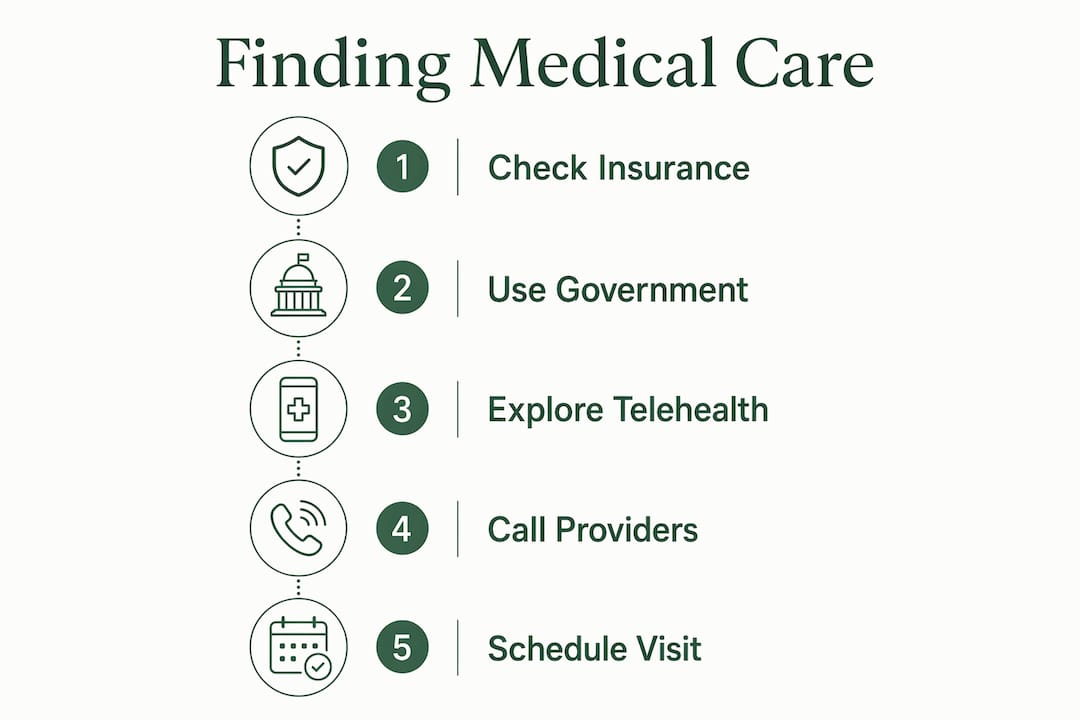
Government resources fill the gap when insurance coverage is limited or absent. The Health Resources and Services Administration operates findahealthcenter.hrsa.gov, which helps you locate federally qualified health centers that offer sliding-scale or free care regardless of insurance status. Calling 211 connects you to local health and social services coordinators who can point you toward community clinics, free screenings, and low-cost care programs in your area.
Online health provider platforms and telehealth portals add another layer of access. Many platforms let you filter by specialty, language, location, and accepted insurance. Telehealth options are worth checking early, especially for routine follow-ups or minor concerns that do not require an in-person visit.
| Tool Type | Source | Pros | Cons |
|---|---|---|---|
| Insurance directory | Your insurance company’s website | In-network filtering, cost protection | Frequently outdated |
| Federal health center locator | findahealthcenter.hrsa.gov | Free and sliding-scale options | Limited specialty care |
| Community helpline | 211 | Local referrals, social services | Availability varies by region |
| Online provider platforms | Health provider websites | Specialty filters, reviews | May not reflect real-time availability |
| Telehealth portals | Provider or insurer websites | No travel required, fast access | Not suitable for all conditions |
No tool replaces a direct phone call to the provider’s office. Confirm that the office is accepting new patients and that your specific insurance plan is accepted before you make any decisions.
How to verify insurance acceptance and provider availability
Insurance provider directories should never be solely relied upon when choosing a medical provider. Offices may be listed as in-network but may have stopped accepting new patients or dropped certain insurance plans without the directory being updated. That gap between listed and actual status is one of the most common reasons patients face surprise bills or wasted trips.
Calling the provider’s office directly takes less than five minutes and saves significant frustration. When you call, ask these specific questions:
- Do you accept [your insurance plan name and ID number]?
- Are you currently accepting new patients?
- What is the earliest available appointment for a new patient?
- Do you offer telehealth visits?
- What documents should I bring to my first appointment?
Board certification, hospital affiliations, and communication style matter as much as location. High patient ratings do not always equate to best clinical outcomes. A provider who is board certified, affiliated with a reputable hospital, and known for clear communication will serve you better over time than one who simply has a convenient address.
Pro Tip: Call both your insurance company and the provider’s office to cross-check network status. Insurers can confirm in-network status in real time, while the office confirms new patient availability.
What types of medical services are available nearby and how to choose?
The three most common types of nearby medical services are primary care providers, urgent care clinics, and emergency departments. Each serves a different level of medical need, and choosing the wrong one costs you time and money.
Non-life-threatening illnesses are best treated at primary care or urgent care clinics rather than emergency departments. Emergency departments prioritize life-threatening cases, which means a sprained ankle or sinus infection can result in a multi-hour wait and a significantly higher bill. Urgent care centers offer walk-in or same-day service for conditions that need prompt attention but are not emergencies.
Understanding the difference between urgent care and primary care helps you make faster, better decisions when symptoms appear. Primary care is your ongoing relationship with a provider who knows your full medical history. Urgent care fills the gap when your primary care office is closed or when you need same-day attention for an acute issue.
Telehealth has expanded access to routine care, allowing follow-ups and minor issues to be handled without travel. Virtual visits reduce barriers like scheduling conflicts and transportation. For caregivers managing multiple family members, telehealth can be a practical first step before deciding whether an in-person visit is necessary.
Before visiting any urgent care center, confirm that the facility matches your specific needs. Urgent care is not uniform; capabilities vary by location. Check for the following before you go:
- Pediatric care availability (if visiting with a child)
- On-site imaging such as X-ray or ultrasound
- Lab testing capabilities
- After-hours or weekend hours
- Ability to treat your specific condition
Pro Tip: Search for the specific urgent care center’s services page online before driving there. Many facilities list their capabilities and current wait times, saving you a wasted trip.
For more guidance on choosing the right urgent care facility for your situation, Gardenstatemedicalgroup has published a detailed breakdown of what to look for.
Step-by-step process to find and schedule an appointment
Finding and booking care near you follows a clear sequence. Skipping steps is where most people run into problems.
- Start with your insurance directory. Log into your insurer’s website and search for in-network providers by specialty and zip code. Save a shortlist of three to five options.
- Use government and community resources for low-cost options. Visit findahealthcenter.hrsa.gov or call 211 if you are uninsured or underinsured. These resources connect you to federally qualified health centers with income-based pricing.
- Call each office directly. Confirm insurance acceptance, new patient availability, and the earliest appointment date. Do not rely on online listings alone.
- Check for telehealth and same-day availability. Ask whether the provider offers virtual visits. This can be the fastest path to care for minor or routine concerns.
- Book through the patient portal when available. Many providers offer online scheduling through patient portals, which lets you select appointment times without waiting on hold.
- Confirm your appointment 24 hours in advance. Offices occasionally reschedule. A quick confirmation call or portal check prevents a wasted trip.
Common pitfalls to avoid:
| Pitfall | Why It Happens | How to Avoid It |
|---|---|---|
| Outdated directory listings | Directories update slowly | Always call the office directly |
| Booking out-of-network by mistake | Plan details not checked | Verify with insurer before booking |
| Arriving without documents | Skipping preparation | Bring insurance card, ID, and medication list |
| Choosing the wrong facility type | Misunderstanding care levels | Match your condition to the right service type |
For tips on finding the right primary care doctor, Gardenstatemedicalgroup offers practical guidance on what factors matter most.
How to prepare for your visit to a nearby medical provider
Preparation before your appointment directly affects the quality of care you receive. Providers spend less time gathering basic information and more time addressing your actual health concerns when you arrive ready.
Bring your insurance card, photo ID, and a current medication and allergy list to every appointment. These three items cover the core intake requirements at virtually every medical facility. If you are visiting a new provider, also bring records of recent lab work, imaging results, or specialist notes.
Patient portals and digital check-in tools reduce wait times significantly. Many providers now send pre-visit forms through their portal, which you can complete from home. Completing these forms in advance means you spend less time in the waiting room and more time with your provider.
Consider scheduling a meet-and-greet visit before committing to a new primary care provider. Meet-and-greet visits allow you to assess provider communication style and office environment without the pressure of a full medical appointment. These visits are typically shorter and lower in cost, making them a low-risk way to evaluate whether a provider is the right fit for your long-term care.
Pro Tip: Write down your top two or three health concerns before the appointment. Providers cover more ground when patients arrive with a clear, prioritized list rather than recalling concerns on the spot.
When choosing a new primary care physician, factors like board certification, hospital affiliation, and communication style carry more weight than online ratings alone. Gardenstatemedicalgroup’s guide on what to look for in a primary care physician covers these criteria in detail.
Key takeaways
Locating accessible medical care requires combining insurance directories, government health center locators, and direct provider verification rather than relying on any single source.
| Point | Details |
|---|---|
| Start with your insurance directory | Use your insurer’s website to build a shortlist of in-network providers near you. |
| Always call the provider’s office | Confirm insurance acceptance and new patient availability directly, since directories are often outdated. |
| Match your condition to the right facility | Use urgent care for acute non-emergency needs and primary care for ongoing health management. |
| Use telehealth for routine concerns | Virtual visits remove travel barriers and are especially useful for caregivers managing multiple schedules. |
| Prepare documents before every visit | Bring your insurance card, photo ID, and medication list to speed up intake and improve care quality. |
Why I think most people make this harder than it needs to be
Most adults approach finding a nearby medical provider the same way they shop for a product online: they read reviews, pick the highest-rated option, and assume the rest will work out. That approach fails more often than people realize.
The single most underused step is the direct phone call. I have seen caregivers spend hours researching providers online, only to show up at an office that stopped accepting their insurance plan six months ago. The directory looked fine. The reviews were solid. But no one called. Two minutes on the phone would have prevented the entire problem.
The other mistake I see consistently is mismatching the condition to the facility. Urgent care is not a substitute for primary care, and an emergency department is not a substitute for urgent care. Each level of service exists for a reason. When you use the wrong one, you pay more, wait longer, and often receive less appropriate care for your specific situation.
Telehealth deserves more credit than it gets. For caregivers especially, a virtual visit at 7:00 PM is often the difference between getting care that day and waiting a week for an in-person slot. The technology is reliable, the access is real, and the convenience is significant. If your provider offers it, use it.
The readers who get the best outcomes are the ones who verify everything, prepare their documents, and show up knowing exactly what they need to discuss. That is not complicated. It just requires treating your healthcare search with the same attention you would give any other important decision.
— Krunal
Gardenstatemedicalgroup: trusted local healthcare in New Jersey
Patients in North Bergen and Secaucus, New Jersey, have a reliable option close to home.
Gardenstatemedicalgroup offers primary care services for adults and families, along with on-site diagnostic testing, cardiopulmonary care, and specialized health programs for conditions like diabetes, bone health, and weight management. The practice accepts new patients and makes appointment scheduling straightforward through its website. If you are managing a chronic condition, the chronic care management program provides structured, ongoing support from a multidisciplinary care team. Gardenstatemedicalgroup is built for local residents who want accessible, quality care without the complexity of navigating a large hospital system.
FAQ
How do I start searching for medical services near me?
Start with your insurance company’s online directory to find in-network providers by zip code and specialty. Follow up with a direct call to each office to confirm availability and insurance acceptance.
What is the difference between urgent care and an emergency department?
Urgent care treats non-life-threatening conditions like infections, minor injuries, and flu symptoms, typically with shorter wait times and lower costs. Emergency departments prioritize life-threatening cases and should be reserved for serious emergencies.
Can I use telehealth to access health services near me?
Telehealth connects you to licensed providers virtually, making it a practical option for routine care, follow-ups, and minor concerns. Many local providers and insurers now offer telehealth as a standard part of their services.
What documents should I bring to a new medical provider?
Bring your insurance card, a government-issued photo ID, and a current list of medications and allergies. Recent lab results or specialist notes are also helpful for new patient appointments.
How do I find low-cost or free medical care if I am uninsured?
Visit findahealthcenter.hrsa.gov to locate federally qualified health centers that offer sliding-scale fees based on income. Calling 211 also connects you to local health and social service resources in your area.