
The Role of Insurance Acceptance in Your Healthcare

TL;DR:
- Insurance acceptance is a contractual agreement that determines which providers can bill your insurer and affects your costs. Accepting insurance does not guarantee in-network status, balance billing, or lower prices, especially if the provider is out-of-network. Verifying coverage through a two-call process before appointments helps prevent surprise medical bills and ensures continuity of care.
Insurance acceptance is the formal agreement between a healthcare provider and an insurance company to bill and receive payment under specific contracted terms, and it directly determines which doctors you can see, what you pay, and whether your care is covered at all. For patients managing chronic conditions or families coordinating care across multiple providers, understanding this process is not optional. It is the foundation of every healthcare decision you make. The role of insurance acceptance shapes your access, your costs, and your continuity of care in ways that most patients do not fully recognize until a surprise bill arrives.
How insurance acceptance works and what it means for your costs
Insurance acceptance, known in the industry as provider eligibility and network participation, begins with a contract between a provider and an insurer. That contract sets the negotiated rates and terms under which the provider agrees to bill the insurer rather than the patient directly. Without that contract, you are exposed to full billed charges.

The most critical distinction every patient must understand is this: a provider who says they “accept your insurance” is not necessarily in-network with your plan. Accepting insurance often means only a willingness to bill, not a contractual guarantee of lower in-network rates. A provider can submit a claim to your insurer and still be classified as out-of-network, leaving you responsible for the difference between what the insurer pays and what the provider charges. This is called balance billing, and it catches patients off guard more often than any other billing issue.
Your financial exposure depends entirely on which side of that contract your provider sits on. In-network providers have agreed to accept the insurer’s negotiated rate as payment in full, which means your copays and deductibles are calculated at the lower contracted amount. Out-of-network providers have no such agreement, so your cost-sharing is calculated on a higher base, and balance billing may apply on top of that.
Here is what the insurance acceptance process affects directly:
- Copays and coinsurance: In-network rates are significantly lower, often by 30 to 50 percent compared to out-of-network rates.
- Deductible application: Out-of-network spending may apply to a separate, higher deductible that resets independently.
- Balance billing: Providers outside your network can bill you for the gap between their charge and your insurer’s payment.
- Surprise medical bills: These occur most often when a patient visits an in-network facility but receives care from an out-of-network specialist, such as an anesthesiologist or radiologist.
Pro Tip: Before any scheduled procedure at an in-network hospital, call your insurer and ask specifically whether every provider involved, including anesthesiologists, radiologists, and assistants, participates in your network. Facility acceptance and individual provider acceptance are separate agreements.
How to check insurance acceptance before your visit
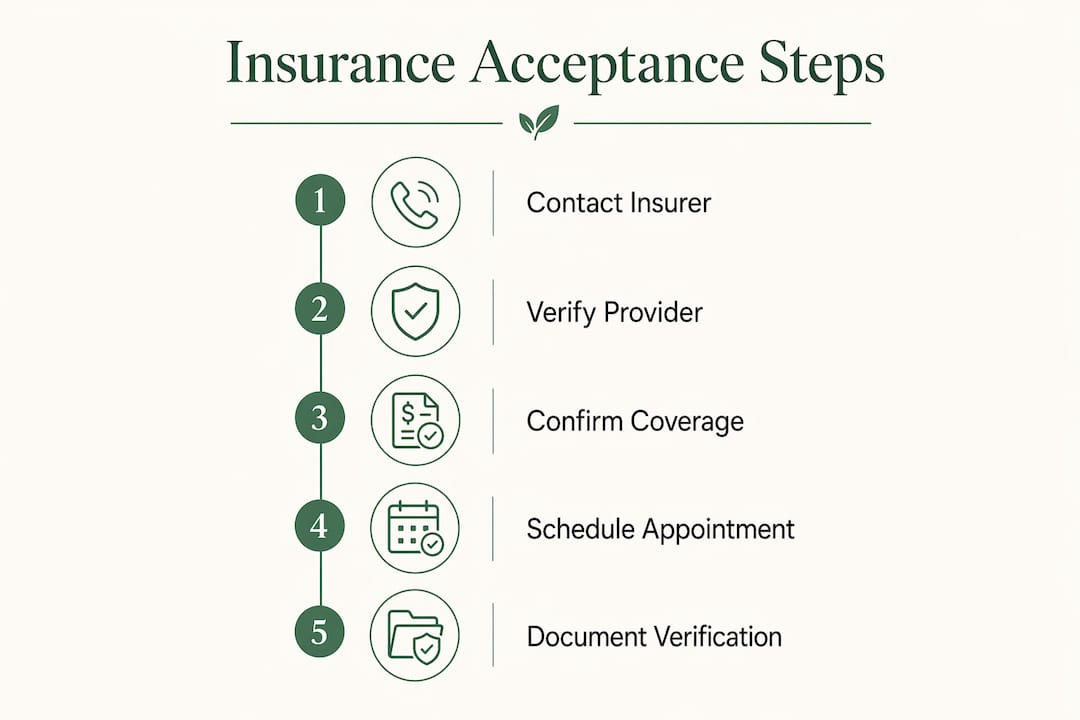
Verifying insurance acceptance before you receive care is the single most effective way to protect yourself from unexpected costs. The two-call verification method is the industry best practice as of 2026: call your insurer first, then call the provider’s office, and treat the insurer’s answer as the definitive one when the two conflict.
Follow these steps every time you schedule care with a new provider or after any change to your insurance plan:
- Call your insurer directly. Give them the provider’s full name, National Provider Identifier (NPI) number, practice address, and your exact plan name. Ask whether the provider is in-network for your specific plan, not just for the insurer’s network generally.
- Call the provider’s office. Confirm they accept your specific plan and ask whether any services you need, such as labs, imaging, or mental health visits, are handled in-house or referred out.
- Ask about carve-outs and prior authorizations. Some services, including behavioral health, physical therapy, and specialty drugs, are managed by separate vendors under your plan. Verification must include checks for carve-outs, prior authorizations, and remaining patient financial responsibilities to avoid denials.
- Verify again closer to your appointment. Automated eligibility systems can verify insurance in seconds, and verifying at scheduling, 24 to 48 hours before your visit, and at check-in reduces denials caused by coverage changes that happened between booking and arrival.
- Document every call. Write down the date, the representative’s name, and the reference number for each call. This documentation protects you if a claim is denied later.
Pro Tip: When you call your insurer, ask them to note in your account that you verified network status for this specific provider on this date. That record can be used to dispute a denial if the provider’s status changes without notice.
You can also check insurance coverage in NJ through your insurer’s online portal, but treat directory results as a starting point, not a final answer. Directories are updated periodically and may not reflect recent contract changes.
Common misconceptions about insurance acceptance
The most damaging misconception patients carry is that “accepting insurance” and “being in-network” mean the same thing. They do not. Many patients assume that a provider’s verbal acceptance of their insurance plan is a contractual guarantee of lower costs. It is not. That assumption leads directly to out-of-network bills that can reach thousands of dollars.
Provider directories compound this problem. Listings older than 90 days are especially unreliable for confirming network status, and experts recommend combining directory searches with direct calls to both the insurer and the provider. Directories are not updated in real time, and a provider who was in-network when you last checked may have renegotiated or ended their contract since then.
Here are the most common misconceptions patients encounter:
- “My doctor accepts my insurance, so I’m covered.” Acceptance means billing willingness. In-network status means contracted rates. These are different things.
- “The provider directory is accurate.” Directories lag behind actual contract changes. Always verify by phone.
- “My specialist is covered because my hospital is in-network.” Individual providers at in-network facilities may hold separate contracts or none at all.
- “My coverage is the same for all services.” Labs, imaging, mental health, and specialty pharmacy services often operate under separate network agreements, meaning your primary care provider being in-network does not guarantee the same status for associated services.
The table below clarifies the key differences patients most often confuse:
| Term | What it means | Patient cost impact |
|---|---|---|
| Accepts insurance | Provider will bill your insurer | May still be out-of-network; balance billing possible |
| In-network | Provider has a contract with your insurer | Lower copays, deductibles, and no balance billing |
| Out-of-network | No contract with your insurer | Higher cost-sharing, possible balance billing |
| Carve-out service | Managed by a separate vendor under your plan | Requires separate verification; different network rules apply |
Patients on Medicaid face a heightened version of this challenge. Frequent insurance changes in Medicaid populations require multiple eligibility verification checks to confirm accurate coverage at the time of care. A provider who accepted your Medicaid plan last month may not accept the managed care organization your coverage shifted to this month.
The role of insurance acceptance in managing chronic conditions
For patients managing diabetes, heart disease, COPD, or other long-term conditions, the role of insurance acceptance goes beyond a single visit. It determines whether you can maintain continuity with the specialists and care teams who know your history, and it directly affects your ability to access the full range of services your condition requires.
Chronic care patients typically see multiple providers: a primary care physician, one or more specialists, a lab for routine bloodwork, and possibly a physical therapist or behavioral health provider. Each of those relationships depends on its own insurance acceptance agreement. Confirming insurance acceptance affects access to specialists, continuity of care, and minimizing surprise costs for chronic patients. A change in your insurer or your employer’s plan can disrupt every one of those relationships simultaneously.
Patients with Medicare Advantage plans face a specific version of this challenge. Medicare Advantage networks are managed by private insurers and vary significantly by plan and geography. Checking specialist network status in a Medicare Advantage plan requires the same two-call verification process, with the added complexity that some plans require referrals from a primary care physician before specialist visits are covered at all.
Coordinating benefits across primary and secondary insurance adds another layer. When a patient carries both Medicare and a supplemental plan, or both employer coverage and a spouse’s plan, each provider must be verified against both plans. Secondary coverage does not automatically follow the primary plan’s network rules. Patients who skip this step often discover that their secondary insurer denies claims because the provider was not accepted under that plan’s terms.
Chronic care management programs, like those offered at Gardenstatemedicalgroup, are specifically designed to help patients navigate these complexities. They coordinate benefits, track prior authorization requirements, and flag network changes before they disrupt care.
Key takeaways
Insurance acceptance and in-network status are two distinct concepts, and confusing them is the leading cause of unexpected medical bills for patients with chronic conditions and families managing multiple providers.
| Point | Details |
|---|---|
| Acceptance does not equal in-network | A provider billing your insurer does not guarantee contracted rates or protection from balance billing. |
| Two-call verification is the standard | Call your insurer first, then the provider, and treat the insurer’s answer as authoritative when they conflict. |
| Directories are unreliable after 90 days | Always confirm network status by phone before any scheduled visit or procedure. |
| Chronic patients face compounded risk | Multiple providers, plan changes, and carve-out services each require independent verification. |
| Documentation protects you | Record every verification call with date, representative name, and reference number to dispute future denials. |
What I’ve learned about insurance acceptance after years of patient care
From where I sit, the single biggest gap in how patients approach insurance acceptance is the assumption that someone else is handling it. Patients assume the provider’s front desk verified everything. The front desk assumes the patient confirmed their plan. The insurer assumes both parties read the directory. Nobody is wrong, exactly, but the result is a surprise bill that lands in a patient’s mailbox weeks after a visit.
The patients who avoid this most consistently are the ones who treat insurance verification the way they treat locking their front door. They do it every time, without exception, even when nothing has changed. That habit matters most for patients managing chronic conditions, because their care involves more providers, more services, and more opportunities for a single verification gap to create a costly problem.
One thing I think gets overlooked: behavioral factors like trust and financial literacy significantly influence whether patients pursue and use their insurance coverage effectively. Patients who do not fully understand their plan are less likely to ask the right questions at verification, and that gap in confidence costs them money. The solution is not more paperwork. It is clearer communication between providers and patients before care begins.
I also want to be direct about provider directories. They are a useful starting point and a poor finishing point. Treating a directory result as a confirmed answer is one of the most common Medicare mistakes patients make, and it applies equally to commercial plans. The call takes five minutes. The bill it prevents can take months to resolve.
— Krunal
How Gardenstatemedicalgroup helps you navigate insurance acceptance
At Gardenstatemedicalgroup, serving patients in North Bergen and Secaucus, New Jersey, the team understands that insurance questions should not stand between you and the care you need.

Gardenstatemedicalgroup accepts a wide range of insurance plans and works directly with patients to confirm coverage before appointments. For patients managing chronic conditions, the Chronic Care Management program coordinates benefits, tracks authorization requirements, and helps patients maintain continuity with their care team through insurance changes. If you are ready to confirm your coverage and schedule care with a provider who accepts your insurance, visit the primary care services page to get started. You can also review the full list of accepted insurance plans before your first appointment.
FAQ
What does insurance acceptance mean for patients?
Insurance acceptance means a healthcare provider agrees to bill your insurance company and accept payment under the insurer’s terms. It does not automatically mean the provider is in-network, which is a separate contractual status that determines your actual cost-sharing.
How do I check if a provider accepts my insurance?
Call your insurer directly with the provider’s name, NPI number, and your exact plan name, then call the provider’s office to confirm. Treat the insurer’s answer as the definitive one if the two responses conflict.
What is the difference between accepting insurance and being in-network?
Accepting insurance means a provider will submit a claim to your insurer. Being in-network means the provider has a contract with your insurer that sets lower negotiated rates and protects you from balance billing. A provider can accept your insurance and still be out-of-network.
Why do claim denials happen even after a provider accepts my insurance?
More than half of claim denials stem from eligibility errors, often because intake data was inaccurate or coverage changed between scheduling and the date of service. Verifying eligibility at multiple points before your visit significantly reduces this risk.
How often should I verify insurance acceptance for ongoing care?
Verify at every new provider relationship, after any change to your insurance plan, and at least annually for established providers. Patients on Medicaid or Medicare Advantage should verify more frequently, as plan networks and provider contracts change throughout the year.