
The Role of Urgent Care in Modern Healthcare Access

TL;DR:
- Urgent care offers immediate treatment for non-life-threatening conditions and bridges the gap between primary care and emergency rooms. It is most suitable for issues like minor injuries, infections, and mild allergic reactions, while serious symptoms require urgent or emergency care. Proper use of urgent care improves healthcare efficiency and reduces costs when patients connect visits to ongoing primary care.
Urgent care is defined as immediate medical treatment for non-life-threatening conditions that require attention within hours, not days. It fills the gap between a primary care office and a hospital emergency room. Urgent care spending in the U.S. grew 50% from 2018 to 2022, driven by a 35% rise in utilization. That growth reflects how many patients now rely on urgent care as their first call when something goes wrong. Understanding the role of urgent care helps you make faster, smarter decisions when your health demands attention.
What is the role of urgent care centers?
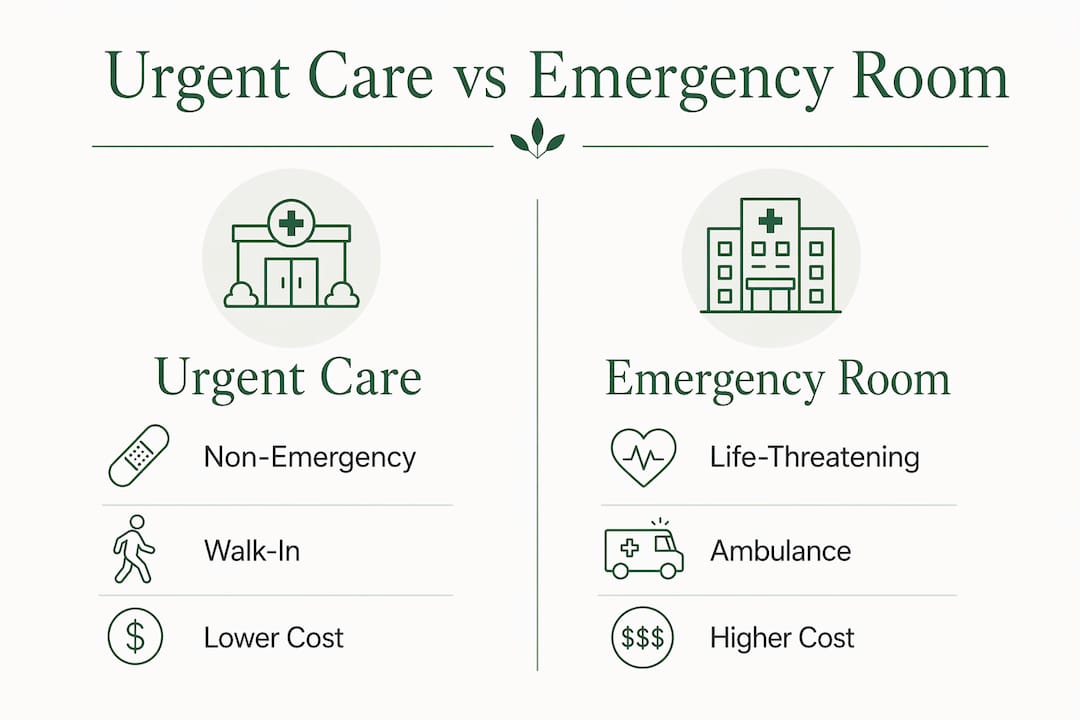
Urgent care centers serve as frontline medical facilities for conditions that are real and uncomfortable but not immediately life-threatening. The clinical term used across the industry is ambulatory urgent care, meaning care delivered outside a hospital on a walk-in basis. These centers exist because primary care offices often cannot see patients the same day, and emergency rooms are designed for crises, not sprains.
Urgent care centers have become a primary entry point for patients who lack an established relationship with a primary care physician. That is a significant portion of the adult population. For these patients, urgent care is not just convenient. It is often the only accessible option for timely treatment.

The importance of urgent care also shows up in cost. Treating a non-emergency condition at an urgent care center costs substantially less than the same visit at a hospital emergency department. That financial difference matters both to patients and to the broader healthcare system trying to manage resources efficiently.
What conditions are appropriate for urgent care?
Clinical guidelines define urgent care as the right setting for conditions that need prompt attention but carry low to moderate risk. Knowing which symptoms belong where saves you time, money, and unnecessary stress.
Conditions well-suited for urgent care:
- Cold and flu symptoms, including fever, body aches, and congestion
- Ear infections and sinus infections
- Minor sprains, strains, and small bone fractures
- Simple lacerations requiring stitches
- Urinary tract infections
- Mild allergic reactions
- Minor burns and skin rashes
- Pink eye and other common eye irritations
Conditions that require the emergency room immediately:
- Chest pain or pressure
- Signs of stroke (sudden facial drooping, arm weakness, slurred speech)
- Difficulty breathing
- Severe abdominal pain
- Head injuries with loss of consciousness
- Heavy, uncontrolled bleeding
- Suspected poisoning or overdose
Clinical guidelines confirm that urgent care is appropriate for non-life-threatening conditions such as cold or flu symptoms, ear infections, minor sprains, and simple lacerations. The ER is reserved for conditions where delayed treatment could cause permanent harm or death.
For very minor issues, such as a mild cold with no fever or a small cut that does not need stitches, a virtual care visit or a scheduled primary care appointment may be a better fit than an urgent care center. Knowing the right care setting for your specific situation prevents unnecessary visits and keeps urgent care available for patients who truly need it.
How does urgent care fit into the healthcare system?
Urgent care has moved from a convenience option to a structural component of how Americans access medical treatment. Urgent care increasingly functions as a front door to healthcare, especially for younger patients who often lack primary care relationships. That shift has changed how health systems think about care delivery.
“The urgent care industry must strive for better coordination with primary care to get the right patient to the right place at the right time.” — Journal of Urgent Care Medicine
This coordination gap is real. A patient who visits an urgent care center for recurring symptoms may receive treatment for the immediate issue but leave without a plan for the underlying cause. Without a connection to primary care, that patient returns to urgent care again and again. Care coordination between settings is what converts a one-time urgent care visit into a managed health outcome.
Hospital-affiliated urgent care centers address this problem more effectively than independent facilities. Hospital-affiliated centers often provide better clinical integration and faster referral pathways, which improves continuity of care for patients with complex needs. If you have ongoing health concerns, choosing a center with hospital or medical group affiliation gives you a clearer path to follow-up care.
Technology is also changing how patients navigate the system. Digital triage tools and nurse advice lines now help patients decide whether urgent care, the ER, or a telehealth visit is the right first step. These tools reduce unnecessary ER visits and direct patients to the most appropriate and cost-effective setting.
Pro Tip: If you visit an urgent care center, ask the provider to send a visit summary to your primary care physician. That one step keeps your medical history complete and prevents duplicate testing at your next appointment.
What services do urgent care centers offer?
Urgent care centers provide a defined set of diagnostic and treatment services. Understanding what they can and cannot do helps you arrive with realistic expectations.
| Service Category | Urgent Care Center | Emergency Room |
|---|---|---|
| On-site X-ray | Yes | Yes |
| Basic blood and urine labs | Yes | Yes |
| CT scan or MRI | No (referral required) | Yes |
| Specialty consultations | No | Yes |
| IV medications and fluids | Limited | Yes |
| Minor laceration repair | Yes | Yes |
| Fracture treatment (simple) | Yes | Yes |
| Cardiac monitoring | Limited | Yes |
| Typical visit cost | Lower | Significantly higher |
Urgent care centers typically offer on-site X-rays and basic labs but lack complex diagnostic imaging such as CT or MRI and specialty consultations. Complex cases are referred to the ER or a hospital setting. That limitation is not a flaw. It reflects the intended scope of urgent care, which is designed for speed and accessibility, not for managing multi-system emergencies.
Staffing also varies widely across urgent care centers. Staffing models range from emergency medicine physicians00374-9/abstract) to teams led primarily by nurse practitioners or physician assistants. That variability affects the acuity of cases a center can safely manage. A center staffed by an emergency medicine physician can handle more complex presentations than one staffed entirely by mid-level providers.
Insurance coverage adds another layer of complexity. Some insurance plans may deny ER visit coverage if the condition is classified as non-emergency, making urgent care the preferred and covered option for those situations. Checking your plan’s urgent care copay versus ER cost before you go can save you a significant out-of-pocket expense.
Pro Tip: Call your insurance’s member services line before visiting an urgent care center after hours. Some plans require a triage call or pre-authorization to guarantee coverage for the visit.
How do you decide between urgent care, the ER, or primary care?
Choosing the right care site comes down to three factors: how severe your symptoms are, how quickly they developed, and your personal health history. A structured approach removes the guesswork.
-
Assess symptom severity. If your symptoms are severe, sudden, or involve the heart, brain, or breathing, go to the ER. If they are uncomfortable but stable, urgent care is likely appropriate.
-
Consider your age and medical history. Age and medical history significantly affect risk and determine whether urgent care or the ER is most appropriate for similar conditions. A fever of 102°F in a healthy adult may be manageable at urgent care. The same fever in an infant or an immunocompromised patient warrants an ER visit.
-
Check timing and availability. If your primary care office is open and can see you the same day, that is often the best option for ongoing or chronic issues. After hours or on weekends, urgent care fills that gap effectively.
-
Review your insurance coverage. Confirm whether your plan covers urgent care visits and at what cost. Some plans require a referral or triage call for after-hours visits to maintain coverage.
-
Use a nurse advice line if unsure. Most major insurance plans offer 24-hour nurse hotlines. A two-minute call can confirm whether your symptoms need the ER, urgent care, or a scheduled appointment.
For parents deciding between urgent care and the ER for a child, the decision carries additional weight. After-hours pediatric care decisions depend on specific symptoms and risk factors that differ from adult presentations. When in doubt with a child, err toward the ER.
The difference between urgent care and primary care is also worth understanding. Primary care manages your health over time. Urgent care handles the unexpected. Both play distinct and complementary roles in keeping you healthy.
Key takeaways
Urgent care centers deliver the most value when patients use them for the right conditions and connect those visits back to ongoing primary care.
| Point | Details |
|---|---|
| Defined scope of care | Urgent care treats non-life-threatening conditions; ER handles emergencies requiring immediate intervention. |
| Rapid growth in use | U.S. urgent care spending grew 50% from 2018 to 2022, reflecting strong and rising patient demand. |
| Service limitations | On-site X-ray and basic labs are standard; CT, MRI, and specialty consultations require ER or hospital referral. |
| Staffing variability | Centers staffed by emergency physicians handle higher-acuity cases than those led by mid-level providers. |
| Insurance and cost | Urgent care typically costs less than the ER; some plans require pre-authorization for after-hours visits. |
Why urgent care’s real value is still misunderstood
I have spent years watching patients make the wrong call, not because they were careless, but because no one clearly explained what urgent care is actually for. The public tends to see it as a cheaper ER, and that misunderstanding creates two problems. Patients with genuine emergencies delay care because they think urgent care will do. And patients with minor issues flood ERs because they do not trust urgent care to handle their concern.
The clinical reality is more nuanced. Urgent care works best as part of a connected care system, not as a standalone fix. A visit that ends with a prescription but no follow-up plan leaves the patient exactly where they started. The centers that do this well are the ones with real ties to primary care and specialty services. They treat the immediate issue and hand the patient off to someone who can manage the bigger picture.
The lack of a shared clinical definition for urgent care also creates confusion. Patients walk into facilities with wildly different staffing, capabilities, and affiliations, all operating under the same label. That inconsistency is the industry’s biggest unsolved problem. Until patients can reliably know what they are walking into, the best protection is choosing a center affiliated with a medical group you already trust.
Urgent care is genuinely valuable. It reduces ER overcrowding, provides accessible care for patients without primary care, and delivers fast treatment at lower cost. But its value depends entirely on using it correctly and connecting it to the rest of your healthcare.
— Krunal
Gardenstatemedicalgroup: primary and urgent care in one place
When you need care quickly, knowing where to go matters. Gardenstatemedicalgroup serves patients in North Bergen and Secaucus, New Jersey, with a multidisciplinary team that covers both immediate needs and long-term health management.
The practice integrates primary care services with on-site radiology, cardiopulmonary care, and specialized health programs. That means a visit for an acute issue can connect directly to follow-up care, chronic disease management, or diagnostic testing without sending you to a separate facility. Gardenstatemedicalgroup also accepts a wide range of insurance plans and offers convenient scheduling at both locations. If you are looking for a care team that handles the urgent and the ongoing, Gardenstatemedicalgroup is built for exactly that.
FAQ
What is the role of urgent care in healthcare?
Urgent care provides immediate treatment for non-life-threatening conditions, filling the gap between primary care and the emergency room. It serves as a cost-effective, accessible option for patients who need same-day medical attention.
What conditions should I treat at urgent care vs the ER?
Urgent care is appropriate for conditions like ear infections, minor sprains, flu symptoms, and simple lacerations. Chest pain, stroke symptoms, severe injuries, and breathing difficulties require an emergency room visit.
Is urgent care cheaper than the emergency room?
Urgent care visits consistently cost less than ER visits for equivalent non-emergency conditions. Some insurance plans actively direct patients to urgent care for non-emergent issues to reduce costs.
Can urgent care replace my primary care doctor?
Urgent care treats immediate issues but does not manage ongoing health conditions or preventive care. A primary care physician provides continuity, chronic disease management, and long-term health planning that urgent care cannot replicate.
Does insurance cover urgent care visits?
Most insurance plans cover urgent care visits, often at a lower copay than ER visits. Some plans require a triage call or pre-authorization for after-hours urgent care visits to confirm coverage.