Why Community Healthcare Matters for Your Health
TL;DR:
- Community healthcare centers serve over 32 million low-income and underserved Americans annually through comprehensive services. Trust, social support, and addressing social determinants are vital for improving health outcomes and reducing hospitalizations. Community involvement and stable funding are essential for sustaining these front-line, integrative care systems.
Most people think of a hospital as the center of healthcare. When something goes wrong, you go to the ER. That assumption misses something critical. Understanding why community healthcare matters means recognizing that the vast majority of health outcomes are shaped long before anyone walks into a hospital. Community health centers, local clinics, and neighborhood wellness programs handle conditions earlier, more affordably, and often more effectively than acute care settings. The numbers behind this system are striking, and the implications for your family and neighborhood are real.
Table of Contents
- Key takeaways
- Why community healthcare matters: scope and reach
- Impact on health equity and outcomes
- Addressing social determinants of health
- Challenges keeping these systems afloat
- How you can support local healthcare
- My perspective on why this work goes underappreciated
- Local healthcare that puts community first
- FAQ
Key takeaways
| Point | Details |
|---|---|
| Community health centers reach millions | Over 32 million patients are served annually, primarily from low-income backgrounds. |
| Trust improves care outcomes | 81% of patients in community-based models report higher trust in providers, leading to fewer hospital admissions. |
| Social needs are part of healthcare | Effective community care addresses housing, food security, and transportation, not just clinical symptoms. |
| Funding instability is a real threat | Short-term federal funding cycles create gaps that threaten clinic operations and workforce stability. |
| You can make a difference locally | Attending board meetings, using local services, and advocating for funding all strengthen your community health system. |
Why community healthcare matters: scope and reach
The role of community healthcare starts with understanding what these centers actually are. Federally Qualified Health Centers (FQHCs) and community health centers are nonprofit, patient-governed clinics that exist specifically to serve populations who would otherwise go without care. That includes low-income families, uninsured adults, undocumented immigrants, rural residents, and people experiencing homelessness.
These are not stripped-down clinics offering bare-minimum services. Community health centers provided 139 million visits in 2024 alone, covering medical care, behavioral health, dental services, and enabling services like transportation assistance and translation support. That breadth of service is intentional. A patient who cannot get to an appointment, or who cannot understand their diagnosis in their own language, is not receiving real healthcare.
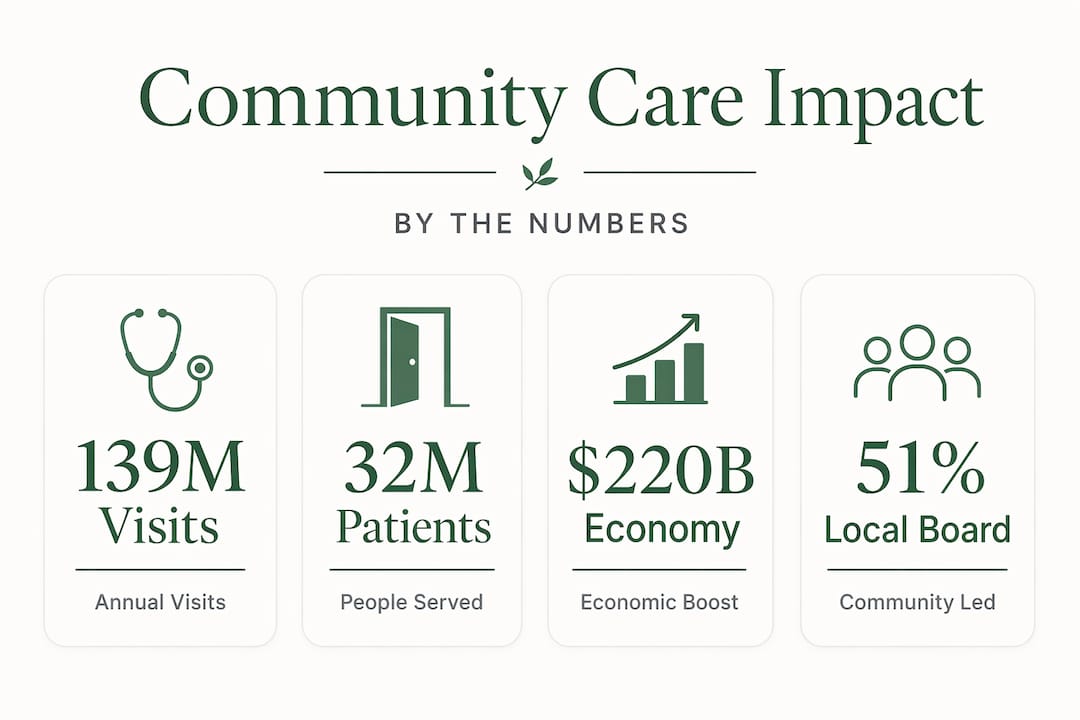
The economic contribution of these centers extends well beyond clinical care. Rural healthcare systems generate $220 billion in economic activity and support one in every twelve rural jobs, which means local clinics are not just health resources. They are economic anchors for entire communities.
One governance detail that often surprises people: at least 51% of a community health center’s governing board must be patients who are actively served by the center. That requirement exists to keep the organization accountable to the people it serves, not to outside funders or administrators. It is a structural form of community trust built directly into how these institutions operate.
Impact on health equity and outcomes
The importance of community healthcare becomes clearest when you look at what actually changes for patients who use these services consistently. The data on health equity and outcomes is strong, and it covers multiple dimensions of care.
Patients in community-based settings gain regular access to preventive screenings, chronic disease monitoring, and early treatment for conditions that would otherwise progress unchecked. This is where preventive care pays its biggest dividends. Catching elevated blood pressure or pre-diabetes early costs far less, medically and financially, than managing a heart attack or full diabetes complications later.

The trust factor matters more than most people expect. A 2025 meta-analysis found that 81% of patients in community-based care models reported trusting their providers more, and this higher trust translated into fewer hospital admissions and measurable improvements in mental health and mood. Trust is not a soft metric. It is the difference between a patient who follows a treatment plan and one who avoids care altogether.
Centers that employ multilingual staff and community health workers see tangible results. Research shows these approaches lead to lower mortality rates of 3.5% and a 2.5% reduction in preventable hospitalizations compared to populations without community health access. For chronic disease management, community models show particular effectiveness when they integrate primary care with digital tools and supportive supervision. The diabetes care research published in 2025 demonstrates that linking community-based programs to health financing and digital augmentation meaningfully improves disease control and long-term self-management.
These outcomes are not accidents. They result from continuity of care, relationships built over time, and a system designed to meet patients where they are.
Addressing social determinants of health
Clinical care alone does not determine how healthy you are. Where you live, what you eat, how you get around, and whether you feel safe at home all shape your health in ways that a prescription cannot fix. This is why the role of community healthcare extends into territory that traditional hospital systems rarely touch.
The most effective community health programs address these factors through structured interventions. Consider what that looks like in practice:
- Housing instability programs connect patients experiencing housing insecurity with legal aid and shelter resources before homelessness leads to a health crisis.
- Food access initiatives work with local food banks and nutrition programs to reduce diet-related chronic conditions in neighborhoods with limited grocery access.
- Transportation support covers ride assistance and transit vouchers so that patients actually arrive at their appointments instead of canceling for logistical reasons.
- Language and cultural services provide interpreters, culturally specific health education, and community health workers who share lived experience with the patients they serve.
Experts studying health equity consistently stress that sustainable community care must address structural factors, not just clinical symptoms. That means building systems where empathy is not a personal trait of individual providers but a designed feature of how care is delivered and governed.
Pro Tip: If you are a stakeholder in a local health organization, ask your leadership team how social needs are screened and addressed during patient visits. Many community health tools, like PRAPARE (Protocol for Responding to and Assessing Patients’ Assets, Risks, and Experiences), exist specifically to standardize this process.
Community health workers are central to this work. They bridge cultural and language barriers through outreach, education, and accompaniment, which increases treatment adherence in populations that have historically experienced distrust of medical institutions. This is not supplemental work. It is foundational to why community-based care works where other models fall short.
Challenges keeping these systems afloat
Understanding why local healthcare is important also means being honest about the threats it faces. Community health centers operate in a funding environment that is anything but stable.
| Challenge | Current reality |
|---|---|
| Federal funding cycles | 2026 funding extends only through December, creating year-end uncertainty for clinic operations |
| Medicaid reimbursement | Proposed Medicaid cuts would reduce payment rates that community centers depend on for a majority of their revenue |
| Workforce shortages | Burnout and policy uncertainty drive staff turnover, particularly among nurses and behavioral health providers |
| Governance stability | Centers with weak community board engagement struggle to maintain mission alignment during political shifts |
Workforce retention deserves specific attention. Community health clinics frequently serve the hardest cases in the most under-resourced settings, which makes burnout a persistent problem. Some centers are addressing this with team-based care models where nurses, community health workers, and social workers share patient loads. That approach reduces individual burden while keeping care coordination intact.
Pro Tip: If your organization is evaluating community health partnerships, look for clinics that have maintained consistent board leadership over multiple years. Governance stability is one of the strongest predictors of long-term program quality.
The reality is that these funding vulnerabilities are not inevitable. They reflect political choices. When community members and local stakeholders understand the impact of community medicine and advocate accordingly, the policy conversation changes.
How you can support local healthcare
You do not need to be a physician or a policymaker to strengthen community healthcare access. There are concrete ways any community member or organization can contribute.
- Use the services. The most direct way to support a community health center is to become a patient or refer people you know. Utilization data drives funding decisions.
- Attend public board meetings. Community health center boards are open to the public and actively seek community input. Your voice shapes how services are structured.
- Advocate at the local and state level. Contact your elected representatives about Medicaid funding protections and community health center appropriations. Letters and calls from constituents move policy.
- Volunteer or partner professionally. Clinics welcome volunteers for non-clinical roles including outreach, health education, and administrative support. Healthcare professionals can also explore loan repayment programs tied to service in underserved settings.
- Donate or fundraise. While grants fund most operations, unrestricted donations give clinic leadership flexibility to fill gaps that categorical funding does not cover.
The patient-provider relationship is at the heart of this system. When community members actively engage with local health services, they are not just receiving care. They are participating in a model that improves outcomes for everyone around them.
My perspective on why this work goes underappreciated
I have spent enough time watching how community health plays out at the neighborhood level to have strong opinions about what gets missed in the public conversation.
The clinical outcomes data is important. But what I have found is that the harder, less visible work is the relationship-building that happens before a patient ever makes an appointment. Community health workers who show up at a family’s door, who speak the same language, who understand the same cultural context, are doing something that no specialist appointment can replicate. They are making healthcare feel like something that belongs to the people receiving it.
What I have learned from watching this up close is that empathy must be institutionalized to scale. It cannot live only in the hearts of individual providers who are already stretched thin. It has to be written into governance structures, staffing models, and funding priorities.
The uncomfortable truth is that community healthcare is often treated as a backup system for people who cannot access “real” care. That framing gets it exactly backward. Community health centers ARE the care system for tens of millions of Americans. They are where chronic disease gets managed, where trust gets built over years of consistent contact, and where the social factors driving poor health outcomes actually get addressed. Treating them as secondary is not just unfair. It is medically counterproductive.
My take: every healthcare stakeholder, whether you are a physician, a city council member, a hospital administrator, or a parent, should understand what integrated healthcare looks like at the community level and advocate for the funding and policy stability it requires.
— Krunal
Local healthcare that puts community first
If the evidence in this article resonates with you, the next practical step is finding a local provider that actually practices this approach rather than just describing it.
Gardenstatemedicalgroup offers exactly that for residents of North Bergen and Secaucus, New Jersey. The practice integrates primary care services with specialized programs for chronic conditions, preventive health, and patient education, all under one coordinated care model. For patients managing ongoing conditions, the chronic care management program provides structured support designed to reduce hospitalizations and improve daily quality of life. Explore the full range of health programs offered to find the services that fit your needs. Good community healthcare is not just a concept. It is available to you right now.
FAQ
What is community healthcare and who does it serve?
Community healthcare refers to health services delivered locally through clinics, health centers, and neighborhood programs, primarily serving low-income, uninsured, rural, and immigrant populations. In 2024, community health centers served over 32 million patients across medical, dental, and behavioral health visits.
How does community healthcare improve health outcomes?
Research shows that patients in community-based models experience lower hospitalization rates, better chronic disease control, and stronger engagement with preventive care. A 2025 meta-analysis found that 81% of patients in these settings reported higher trust in their providers, which directly improves adherence and outcomes.
Why does funding matter so much for community health centers?
Community health centers rely heavily on federal grants and Medicaid reimbursements to operate. When funding lapses occur, clinics may reduce services, lose staff, or close entirely, directly cutting off care for millions of vulnerable patients.
How do community health centers address social determinants of health?
These centers go beyond treating symptoms by connecting patients with housing resources, food assistance, transportation support, and language services. Experts consistently find that addressing structural factors alongside clinical care is what produces lasting improvements in community health equity.
How can I get involved in supporting local healthcare?
You can attend community health center board meetings, advocate for local funding at the state and federal level, use or refer others to local services, and volunteer in non-clinical support roles. Community engagement is not optional for these systems. It is built into how they are governed and sustained.