Understanding health news: make informed choices locally
TL;DR:
- Health news covers complex science, policies, and wellness updates that directly impact your healthcare decisions.
- Reliable reporting relies on peer-reviewed research, expert consensus, balanced language, and transparency to ensure trustworthiness.
- Residents should verify local healthcare changes through trusted sources and consult providers before making significant health adjustments.
Every week, new health stories flood your phone, your TV, and your social feeds. Some of them feel urgent. Others contradict what you read just last month. For residents of North Bergen and Secaucus, sorting through that noise is not just an intellectual exercise. It directly shapes the healthcare decisions you make for yourself and your family. Knowing how to read, evaluate, and apply health news is one of the most practical skills you can build for your long-term well-being.
Table of Contents
- What is health news? Core purpose and characteristics
- How reliable health news is reported: Standards you should know
- Evaluating trustworthiness: How to spot solid health news
- Local relevance: The impact of health news in North Bergen and Secaucus
- Common pitfalls: Misinformation and media hype in health news
- Our perspective: What most people get wrong about health news
- Get local health support you can trust
- Frequently asked questions
Key Takeaways
| Point | Details |
|---|---|
| Health news defined | Health news translates complex science and policy into actionable public insights. |
| Judge reliability | Use credentials, evidence hierarchy, and expert consensus to spot trustworthy stories. |
| Beware misinformation | Avoid hype by verifying headlines with multiple sources and expert review. |
| Local impact matters | Hospital policies and local developments in North Bergen and Secaucus can affect your care. |
| Empower your choices | Apply evaluation techniques to make safer, more informed health decisions for you and your family. |
What is health news? Core purpose and characteristics
Now that we’ve highlighted the importance of trustworthy health news, it’s crucial to break down what defines this type of reporting.
Health news is not simply news about being sick. Health journalism covers medicine, public health policies, wellness trends, and scientific research, requiring specialized skills to translate complex science into language everyday people can actually use. That definition matters because it sets health news apart from general reporting. A story about a local election requires different skills than a story about a new diabetes treatment. Health reporters must understand research methodology, read scientific studies, and represent statistical findings accurately without sensationalizing them.
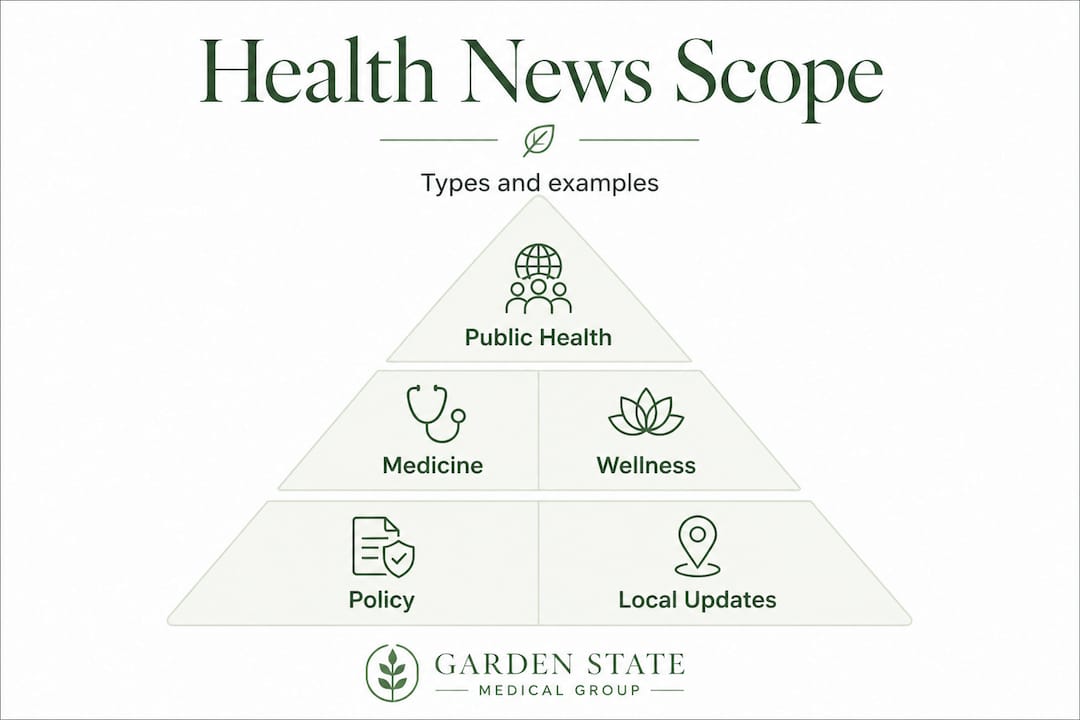
The scope of health news is broad. It includes vaccine updates and public health announcements, hospital openings and closures, changes in insurance coverage and policy, new treatment guidelines, and wellness recommendations from public health agencies. Each of these categories can affect you in a direct, practical way. If a nearby hospital closes a service line, that affects where you go for care. If a new vaccine recommendation comes out, that affects what you discuss at your next checkup.
For residents here, finding local health programs that respond to the latest health guidance is a core part of staying well. Local health news is not just background noise. It describes the actual landscape of services available to you.
Reliable health news has a few key characteristics:
- It cites peer-reviewed research or expert sources rather than anecdotal stories.
- It distinguishes between correlation (two things occurring together) and causation (one thing directly causing another).
- It represents the consensus of the scientific or medical community rather than highlighting outlier opinions.
- It avoids alarmist language and provides context for risk.
- It is transparent about what is still unknown or under study.
When you see these qualities in a health story, you can have more confidence in what it’s telling you.
“Health news is journalism focused on health, medicine, public health, policies, and wellness, requiring specialized skills to translate complex science for the public.” — Simply Global Media
How reliable health news is reported: Standards you should know
Understanding what health news is leads to the next step: recognizing how reliable reporting is actually produced.
Good health journalism follows a set of professional and ethical standards that separate credible coverage from poorly researched content. Key methodologies include evidence-based reporting drawn from peer-reviewed studies, consulting with multiple independent experts, disclosing any conflicts of interest, and using clear, accessible language that does not mislead readers.
Here is what that looks like in practice:
-
Evidence first. A responsible health story builds its argument around published, peer-reviewed research. Not a press release from a pharmaceutical company. Not a blog post. Actual scientific literature that has been reviewed by independent experts before publication.
-
Expert consultation. Solid health reporting seeks input from physicians, researchers, and public health officials who have relevant training. One quote from one doctor is not sufficient. Multiple experts with different viewpoints create a more complete and accurate picture.
-
Conflict of interest disclosure. Reporters and news organizations should tell you when a study was funded by a company that profits from the results. This transparency helps you weigh the information properly.
-
Proportionate language. Good health news avoids words like “breakthrough,” “miracle,” or “cure” unless those words are specifically and carefully justified. Overstated language is a signal that the story may be more focused on attention than accuracy.
-
Contextual statistics. A story that says “risk doubles” without telling you the baseline risk can mislead you. Reliable reporting puts numbers in context so you understand actual impact.
How healthcare providers’ influence shapes the news you consume is also worth noting. When hospitals or clinics release statements or studies, those communications enter the health news stream. Quality journalism filters and verifies this information rather than just republishing it.
| Standard | What reliable reporting does | What poor reporting does |
|---|---|---|
| Evidence source | Peer-reviewed studies | Press releases or social posts |
| Expert input | Multiple independent experts | One source or unnamed experts |
| Conflict of interest | Clearly disclosed | Ignored or hidden |
| Language | Measured and proportionate | Sensational or alarming |
| Statistics | Contextualized with baselines | Presented without context |
Pro Tip: When you read a health story, look for the source of the study and who was quoted. If neither is clearly identified, treat the story with extra skepticism.
Evaluating trustworthiness: How to spot solid health news
Knowing the standards journalists use, let’s learn how to evaluate these stories for yourself with a few proven techniques.
Checking source credibility is the foundation of any reliability check. That means looking at the author’s credentials, the publication’s track record, where the evidence comes from, and whether the study behind the story has been replicated. Randomized controlled trials (RCTs) are considered a higher standard of evidence than observational studies or anecdotal accounts. Studies involving thousands of participants carry more weight than small pilot studies.
One practical framework is the CRAAP test, which stands for Currency, Relevance, Authority, Accuracy, and Purpose. It was developed for academic research but applies equally well to health news.
- Currency: Is the story recent? Health science evolves. A study from 2015 may have been updated or overturned.
- Relevance: Does it actually apply to your situation? A study conducted on elderly men in Finland may not be relevant to a 35-year-old woman in Secaucus.
- Authority: Who published it and who wrote it? Organizations like the NIH, the CDC, and Johns Hopkins School of Public Health carry established credibility.
- Accuracy: Are claims backed by evidence? Are there links to the original study?
- Purpose: Why was this story written? To inform, or to sell something?
Another important skill is recognizing when a story is based on a single study. One study is a starting point, not a conclusion. Prioritizing consensus over single studies is one of the most important habits you can build for your well-being. Science works through repetition and verification, not one-time findings.

Dramatic headlines are another warning sign. “This common food kills cancer cells” and “New pill eliminates anxiety forever” are written to generate clicks, not to accurately represent research. The actual study behind such a headline is almost always much more limited in scope.
Checking your coverage also matters when local health news reports on policy changes. If a story says a treatment is newly covered by insurance, verifying that claim with your actual provider is a smart next step before counting on that coverage.
Pro Tip: Use lateral reading when you’re unsure about a health story. Open several additional tabs and search for the same topic across multiple trusted news sources. If the finding is real and significant, multiple reputable outlets will cover it independently.
Local relevance: The impact of health news in North Bergen and Secaucus
After covering ways to spot solid health news nationally, let’s see how these skills apply to your local landscape.
The healthcare environment in Hudson County is not static. Hospitals expand, contract, and sometimes face real financial pressure. 12 New Jersey hospitals face higher risk of closing following federal Medicaid funding changes, and Palisades Medical Center is among those named as vulnerable. For residents of North Bergen and Secaucus, that kind of news is not abstract. It describes where you might or might not be able to receive emergency care in the future.
Staying informed about local healthcare changes is genuinely important. But staying informed means using verified, trustworthy sources rather than relying on secondhand social media posts or alarming headlines that may not reflect the current situation accurately.
Here are reliable places to check for local health news:
- NJ Department of Health: Offers updates on hospital licensing, public health alerts, and policy changes across the state.
- Patch.com New Jersey: Covers community-level stories including hospital operations and local healthcare service changes.
- KFF Health News: Provides national and state-level health policy reporting with strong ethical standards.
- NIH and CDC: Authoritative sources for national health guidelines, disease updates, and research summaries.
- Your local medical group: Practices like ours publish updates that directly affect the services available to patients in North Bergen and Secaucus.
“Reliable sources for local residents include national institutions like the NIH and KFF Health News alongside local coverage of hospital risks and closures affecting community access.” — Patch NJ
If you’re trying to locate current services or understand what is available near you, finding healthcare services locally is a direct way to cut through the noise. You can also contact our North Bergen office or our Secaucus office directly for information about current services and availability.
Common pitfalls: Misinformation and media hype in health news
While local news matters, not all information is created equal. Let’s address the risks and realities of misinformation directly.
Social media and AI-generated content have made misinformation faster to spread and harder to identify. A false health claim can reach thousands of people before any correction is published. Algorithms on major social platforms are designed to prioritize content that gets strong reactions, and alarming or sensational health claims tend to generate exactly that kind of engagement.
Misinformation spreads rapidly through social media and AI tools, and single studies that have not been replicated are a common source of premature health claims. The SIFT method (Stop, Investigate the source, Find better coverage, and Trace claims to the original context) is a structured way to slow down before you share or act on something you read online.
One underappreciated cognitive trap is anchoring bias. This occurs when the first story you read about a health topic becomes your fixed reference point, even if later, more accurate reporting tells a different story. Early reports on a new disease, a drug’s effectiveness, or a hospital situation are often incomplete. Waiting for follow-up coverage and verified reporting protects you from acting on premature information.
- Stop before sharing. Ask yourself whether you’ve read beyond the headline.
- Investigate the source. Who published this? What is their track record?
- Find better coverage. Search for the same claim from multiple independent outlets.
- Trace the original claim. Go back to the primary source, whether that is a published study, a government report, or an official press release.
Official sources like the NIH and WHO stand apart from media coverage because they apply strict review processes before publishing guidance. That does not mean official sources are always ahead of the news cycle, but their statements carry far more accountability than a viral social media post.
When you’re managing a chronic condition, the stakes of misinformation are especially high. Learning to apply these critical thinking habits consistently is part of managing chronic care steps in a way that actually supports your health rather than creating confusion.
Our perspective: What most people get wrong about health news
Having explored the mechanics and challenges of health news, it’s worth sharing some often-missed truths we’ve seen play out again and again with patients and the community we serve.
The single biggest mistake people make is treating early research findings as settled conclusions. When a study gets published and picked up by major outlets, it feels authoritative. But science is a process, not a verdict. Most early studies are later revised, refined, or contradicted by larger follow-up research. Acting on preliminary findings, whether by changing medications, starting new supplements, or avoiding established treatments, can cause real harm.
The second mistake is assuming that dramatic headlines reflect dramatic facts. A “200 percent increase in risk” can mean moving from 1 in 10,000 to 3 in 10,000. That is still a very small absolute risk. Percentage changes sound alarming but mean very little without the baseline context.
For residents of North Bergen and Secaucus specifically, we’ve seen how hospital and service-related news can create what we call “information fatigue.” When you hear repeated, alarming stories about hospital closures or policy changes, it can become tempting to either panic and change your care plans abruptly or tune everything out entirely. Neither response serves you well. The right response is to verify key facts through reliable channels, hold steady on established care routines, and talk to your provider before making significant changes.
At our health insights blog, we work to give you context-rich information that reflects what is actually relevant to your life here. Our perspective is that health literacy, meaning the ability to find, evaluate, and apply health information, is one of the most practical investments you can make in your own well-being. It is not about becoming an expert. It is about building enough confidence to ask the right questions and wait for the right answers.
Get local health support you can trust
Putting these strategies to work is easier with local support, and that is exactly what we are here for.
At Garden State Medical Group, we serve patients across North Bergen and Secaucus with services that match the complexity of your health needs. Whether you are establishing care through local primary care, getting answers through radiology and diagnostics, or staying on top of a long-term condition through our chronic care management program, you have a team of experienced providers who are connected to the latest, verified health guidance.
When health news raises questions, your provider should be your first call, not your last resort. We welcome those conversations. Contact us today to schedule an appointment at either of our convenient locations and get the clarity you deserve.
Frequently asked questions
What distinguishes health news from regular news?
Health news explains scientific findings, medical policies, and public health topics, requiring specialized expertise and evidence review that general reporting does not always apply.
How do I verify a health news story is reliable?
Check the source and author credentials, look for expert consensus across multiple outlets, and confirm that the evidence comes from peer-reviewed research rather than anecdotal or preliminary findings.
What should I do if different health news sources give conflicting advice?
Prioritize consensus among multiple independent experts and wait for findings to be confirmed by follow-up studies before making any changes to your health routine.
Why is local health news important for North Bergen and Secaucus?
Local health news directly affects hospital access, available services, and the decisions you make about your care. Changes like NJ hospital closures can have immediate consequences for where you receive treatment.