Preventive healthcare: How adults can stay healthier

TL;DR:
- Preventive healthcare involves proactive measures to detect and prevent diseases before symptoms appear.
- Personalized prevention considers individual risk factors like age, family history, and lifestyle for effective care.
- Routine screenings, vaccinations, and checkups are essential services recommended for adults to maintain health.
Most serious health conditions don’t appear without warning. They develop quietly over years, shaped by risk factors that are often manageable with the right care. Yet many adults in North Bergen and Secaucus put off checkups, skip screenings, or simply feel unsure about what preventive healthcare actually means for them. The result is that conditions like high blood pressure, diabetes, and certain cancers go undetected until they’re far harder to treat. Understanding preventive healthcare isn’t just useful knowledge. It’s one of the most practical steps you can take to protect your long-term health and reduce unnecessary medical costs.
Table of Contents
- What is preventive healthcare? Key concepts explained
- The four levels of prevention: From policy to personal care
- Essential preventive healthcare services for adults
- Impact and limitations: What prevention can (and can’t) achieve
- Personalizing prevention: Precision, risk, and local access
- What most guides get wrong about preventive healthcare
- Connect with expert preventive healthcare locally
- Frequently asked questions
Key Takeaways
| Point | Details |
|---|---|
| Prevention starts with knowledge | Understanding what preventive healthcare is helps you make smarter health decisions. |
| Routine care reduces risk | Regular screenings, lifestyle counseling, and vaccinations can prevent major health issues. |
| Personalization boosts effectiveness | Tailoring prevention to your age, risk factors, and local access ensures better outcomes. |
| Benefits outweigh limits | Preventive care can decrease avoidable deaths, though expert guidance is crucial to avoid overdiagnosis. |
| Local resources make prevention easier | Primary care, health programs, and clinics in North Bergen and Secaucus support accessible prevention. |
What is preventive healthcare? Key concepts explained
Preventive healthcare is medical care focused on preventing health problems from occurring or diagnosing them early before symptoms develop, contrasting with traditional care that treats existing issues. That distinction matters more than most people realize. Traditional medicine is reactive. You feel sick, you see a doctor, you get treated. Preventive healthcare is proactive. It asks: what can we do before symptoms appear?
This approach is especially important when you consider how many diseases develop silently. High blood pressure, prediabetes, and high cholesterol rarely cause noticeable symptoms in their early stages. By the time you feel something, the condition may have already caused damage. Preventive care catches these issues early, when they’re most treatable and least costly.
There are several factors that raise your personal risk and make preventive care more urgent. These include:
- Age: Risk for many conditions increases after 40
- Family history: Genetic predisposition to heart disease, cancer, or diabetes
- Lifestyle habits: Smoking, poor diet, physical inactivity, and alcohol use
- Environmental factors: Exposure to pollutants or occupational hazards
- Existing conditions: Managing one chronic condition can prevent others from developing
Understanding the types of preventive care available helps you make more informed decisions at every stage of life.
| Feature | Preventive care | Traditional care |
|---|---|---|
| Timing | Before symptoms appear | After symptoms develop |
| Goal | Prevention and early detection | Treatment and recovery |
| Cost impact | Lower long-term costs | Often higher due to late-stage treatment |
| Examples | Screenings, vaccines, counseling | Surgery, medication for illness |
| Patient role | Active and ongoing | Reactive when needed |
“Preventive care is not about treating disease. It’s about giving people the information and support they need to stay well before illness takes hold.”
Connecting with primary care essentials is often the first and most effective step toward building a preventive care routine that works for your life.
The four levels of prevention: From policy to personal care
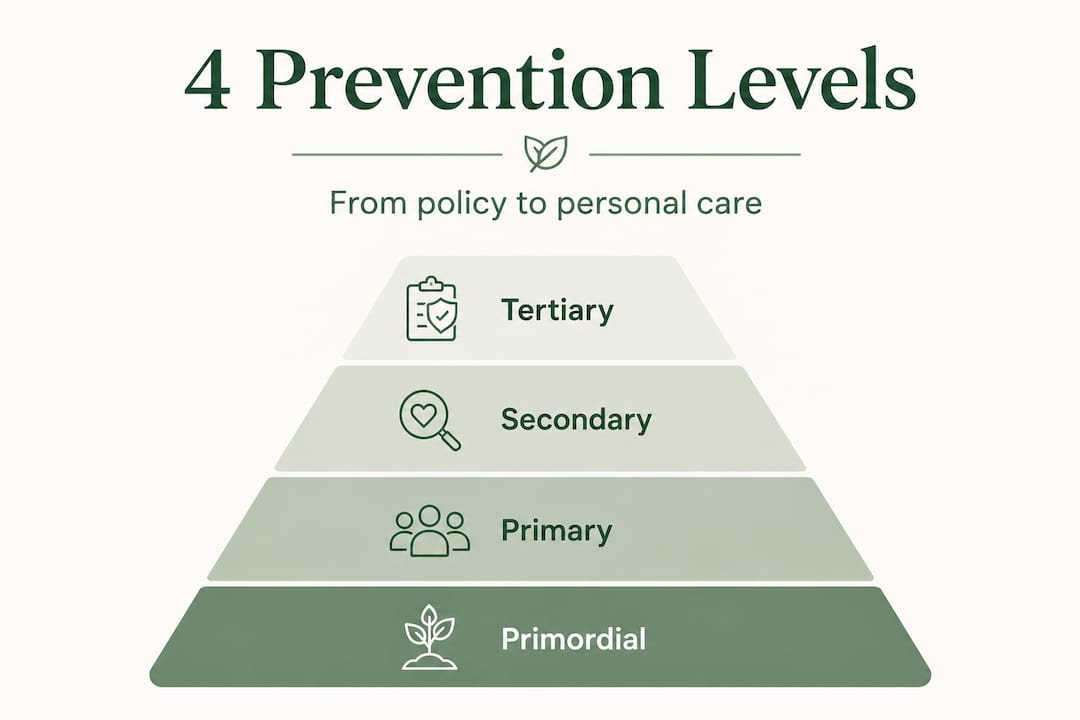
Now that you know what preventive healthcare is, let’s explore how prevention works at different levels, from broad policies to individual care. Preventive healthcare operates at four levels: primordial, primary, secondary, and tertiary. Each level addresses health at a different stage and scale.
Primordial prevention targets the social and environmental conditions that create disease risk in the first place. Think of local policies that reduce air pollution, improve access to healthy food, or support safe exercise spaces in Hudson County neighborhoods. These efforts shape the health of entire communities before any individual risk factor even develops.
Primary prevention focuses on stopping disease before it starts in individuals. Vaccinations are the clearest example. Getting your flu shot, staying current on your tetanus booster, or receiving the shingles vaccine all fall into this category. Lifestyle changes like quitting smoking or adopting a heart-healthy diet are also primary prevention strategies.
Secondary prevention involves early detection and intervention. This is where screenings become critical. A colonoscopy at age 45, a mammogram, or a routine blood pressure check can catch problems early enough to treat them effectively, before they progress into serious disease.
Tertiary prevention focuses on managing existing conditions to prevent complications. If you’ve already been diagnosed with diabetes, for example, working with your care team to control blood sugar and prevent nerve damage or kidney disease is tertiary prevention in action.
Here’s how these levels look in real life for adults in North Bergen and Secaucus:
- Primordial: Advocating for smoke-free public spaces and walkable neighborhoods in Hudson County
- Primary: Getting vaccinated against pneumonia or HPV based on age and risk
- Secondary: Scheduling a colorectal cancer screening at age 45 or a cholesterol check at your annual exam
- Tertiary: Attending a diabetes management program to prevent long-term complications
Understanding the full range of preventive care types helps you see where you fit and what action makes the most sense right now.
Pro Tip: If you’re not sure where to start, primary prevention is usually the most impactful first step. Talk to your doctor about vaccines, lifestyle changes, and routine screenings that match your age and health profile.
Essential preventive healthcare services for adults
Understanding the four levels of prevention helps clarify which services and tests are most relevant for adults today. The CDC recommends that key preventive services for adults include routine checkups, screenings for colorectal cancer between ages 45 and 75, blood pressure monitoring, cholesterol checks, vaccinations, lifestyle counseling, and regular dental visits.
These aren’t optional extras. They’re the foundation of staying healthy as you age. Here’s a closer look at what each involves:
Routine checkups give your doctor a baseline picture of your health. They’re the opportunity to catch changes in weight, blood pressure, or blood sugar before they become serious problems. Annual physicals also open the door to honest conversations about stress, sleep, and mental health.
Cancer screenings are among the most powerful tools in preventive care. Colorectal cancer screening is recommended starting at age 45 for average-risk adults. Breast cancer screening, lung cancer screening for long-term smokers, and cervical cancer screening are also recommended based on age and risk factors.

Vaccinations for adults are often underused. Many people think vaccines are only for children, but adults need them too. The flu vaccine annually, the shingles vaccine for adults over 50, the pneumococcal vaccine for those over 65, and COVID-19 boosters are all recommended depending on your age and health status.
Lifestyle counseling addresses the behaviors that drive most chronic disease. Diet, physical activity, tobacco use, and alcohol consumption all directly affect your long-term health. Your primary care doctor can connect you with resources, programs, and referrals to help you make sustainable changes.
Dental visits are a surprisingly important part of preventive health. Oral health is connected to heart disease, diabetes, and other systemic conditions. Yet dental visit rates among adults remain lower than recommended, with many skipping care due to cost or access barriers.
Key preventive services to prioritize:
- Blood pressure screening at every visit
- Cholesterol check every 4 to 6 years (more often if at risk)
- Colorectal cancer screening starting at age 45
- Annual flu vaccine
- Diabetes screening for adults with risk factors
- Vision and hearing checks as you age
- Skin cancer screening if you have high sun exposure history
Exploring the preventive care benefits in detail can help you understand just how much these services protect your quality of life and your wallet over time. If you’re unsure which services are available near you, learning how to access preventive services locally in North Bergen and Secaucus is a great next step.
Pro Tip: Don’t wait until something feels wrong to schedule your annual exam. Staying current with routine checkups is the single most consistent habit that supports long-term health.
Impact and limitations: What prevention can (and can’t) achieve
While preventive healthcare services are beneficial, it’s important to recognize both their strengths and limitations. The evidence for prevention is strong. Across OECD countries, 222 avoidable deaths per 100,000 people under age 75 could be prevented through better prevention and healthcare delivery. The World Health Organization estimates that 80% of heart disease and type 2 diabetes cases are preventable through lifestyle changes and early intervention.
Those numbers represent real people. They represent conditions caught in time, treatments that worked because they started early, and years of healthy life that wouldn’t have been possible without preventive care.
“Prevention is not just a medical strategy. It is a public health imperative that saves lives, reduces suffering, and lowers the cost of care for individuals and systems alike.”
But prevention has real limitations, and it’s important to be honest about them. Screening risks include false positives in 13 to 29 percent of low-dose CT lung cancer screenings, overdiagnosis of slow-growing tumors that may never have caused harm, and overtreatment that carries its own risks and side effects.
Other limitations worth knowing:
- False positives can lead to anxiety, additional testing, and sometimes unnecessary procedures
- Overdiagnosis occurs when screenings detect conditions that would never have caused symptoms or shortened life
- Resource diversion means that heavy investment in screening can sometimes pull resources away from treatment for those already ill
- Access barriers mean that not everyone benefits equally, particularly uninsured adults or those in underserved communities
This is why shared decision-making with your doctor matters so much. Understanding the cost and benefits of prevention in your specific situation helps you make choices that are right for you, not just for the average patient in a clinical study. Working through a shared decision-making process with your provider ensures that your values, preferences, and risk profile are all part of the conversation.
Personalizing prevention: Precision, risk, and local access
To maximize benefits and minimize drawbacks, prevention needs to be personalized, especially in diverse communities like North Bergen and Secaucus. Prevention is not one-size-fits-all. Guidelines that apply to the general population may not be the best fit for your individual risk profile, and fragmented guidelines across different organizations can make it hard to know what to follow.
Your provider can help you prioritize based on your specific risk factors. For example, the coronary artery calcium (CAC) score is an imaging test that measures calcium buildup in the arteries of the heart. For adults in a gray zone of cardiovascular risk, where it’s unclear whether medication is needed, precision approaches like CAC scoring can guide more targeted decisions rather than applying a blanket treatment recommendation.
Key factors that shape your personal prevention plan:
- Age and sex: Screening recommendations shift significantly across decades
- Family history: A parent or sibling with heart disease or certain cancers raises your baseline risk
- Genetics: Some genetic markers increase risk for conditions like breast cancer or colon cancer
- Lifestyle: Current smoking, physical inactivity, and diet directly influence which screenings and counseling you need most
- Existing conditions: Managing one condition often requires monitoring for related risks
Personalizing your care doesn’t mean navigating it alone. A workflow for personalized care built around your specific needs makes the process manageable and consistent. You can also explore health program benefits designed for specific conditions like diabetes, bone health, or lung health that may be highly relevant to your situation.
Pro Tip: Before your next appointment, write down your family health history and any symptoms or concerns you’ve noticed. Bringing that information to your doctor makes personalized prevention much easier to plan.
What most guides get wrong about preventive healthcare
Having explored how to personalize prevention, let’s address a common flaw in mainstream health advice. Most preventive healthcare guides present prevention as a simple checklist. Get this screening at this age. Take this vaccine. Follow these diet tips. Check the boxes and you’re done.
That framing misses something important. Prevention is not a checklist. It’s an ongoing, evolving conversation between you and your care team. The evidence behind specific screenings changes over time. Guidelines from different organizations sometimes conflict. And the barriers that prevent people from accessing care, including insurance gaps, language differences, transportation, and work schedules, rarely appear in those tidy lists.
In communities like North Bergen and Secaucus, where residents come from diverse backgrounds and face real-world access challenges, a checklist approach can actually create harm. It can make people feel like they’ve failed if they haven’t completed every recommended screening, or it can create false confidence in those who have checked every box without understanding what those results actually mean.
The most effective prevention we’ve seen is practical, personalized, and connected to the community. It’s not about doing everything. It’s about doing the right things for your specific situation, with a provider who knows your history and your life. Understanding how to access local preventive services in your area is often the most important first step, far more important than memorizing a national guideline.
Don’t let uncertainty or confusion delay care you actually need. If you’re unsure whether a screening is right for you, ask. That conversation with your doctor is itself a form of preventive care.
Connect with expert preventive healthcare locally
Taking action on preventive healthcare is easier when you have the right support close to home.
At Garden State Medical Group, we work with adults in North Bergen and Secaucus to build prevention plans that fit their real lives, not just their age group. Whether you need a primary care provider to guide your annual exams, or you’re looking for structured support through our diabetes education program or lung health program, we offer the services and expertise to help you stay ahead of serious health risks. Our primary care services are designed to be accessible, personalized, and rooted in the community you live in. Schedule your appointment today and take the first step toward prevention that actually works for you.
Frequently asked questions
What are the most important preventive screenings for adults over 40?
Top screenings include colorectal cancer testing between ages 45 and 75, blood pressure monitoring, cholesterol checks, and annual physical exams for early detection of developing conditions.
How often should adults get preventive healthcare checkups?
Annual checkups are generally recommended, with the frequency of specific screenings depending on your age, risk factors, and personal health history, following CDC and USPSTF guidelines.
Is preventive healthcare covered by insurance in North Bergen and Secaucus?
Most insurance plans cover preventive services, but uninsured adults are significantly less likely to receive these services, which increases their long-term disease risk.
What are the risks of preventive screenings like cancer tests?
Screening risks include false positives, overdiagnosis of conditions that may never have caused harm, and potential overtreatment. Always discuss the benefits and risks with your doctor before proceeding.
How can I personalize preventive healthcare for my situation?
Work with your provider to assess your age, genetics, family history, and lifestyle. Personalized prevention based on your individual risk profile is far more effective than following a generic checklist.