The Role of Medical Explainer Guides in Patient Care

TL;DR:
- Medical explainer guides help patients understand complex medical information, improving adherence and safety. They should be written at a sixth-grade level, using clear language and multimedia to meet diverse needs. Effective implementation and standardization across healthcare improve communication, trust, and patient outcomes.
Medical explainer guides are tools designed to translate complex medical concepts into clear, understandable information for patients and caregivers. The role of medical explainer guides goes well beyond handing out a pamphlet. These guides, also called patient education materials in clinical settings, directly affect whether patients follow treatment plans, ask the right questions, and manage their conditions safely. Research shows that patients following FDA-mandated guides experience 32% fewer adverse events. That single number makes the case for taking patient education seriously.
How do medical explainer guides improve patient understanding?
Patient education materials produce measurable gains in knowledge, not just general awareness. A study on dyslipidemia education found that providing validated, simplified patient leaflets combined with counseling improved mean knowledge scores by 43.59 points initially, with gains still holding at 20.57 points after three months. That kind of sustained improvement shows that well-designed guides do not just inform patients in the moment. They change how patients think about their conditions over time.

Anxiety is another area where these materials make a real difference. Pre-procedure animated explainer videos reduce patient anxiety by 20–30% and significantly decrease last-minute procedure cancellations. Fewer cancellations mean better care continuity and fewer wasted clinical resources. For caregivers managing a family member’s care, reduced anxiety also means more confident decision-making at home.
Compliance improves when patients actually understand what they are supposed to do. Guides that use plain language, clear dosing instructions, and simple visuals give patients the confidence to follow through. The benefits of medical explainer materials extend to safety as well. When patients know what side effects to watch for and when to call their provider, adverse events drop.
“Effective patient education is not about giving patients more information. It is about giving them the right information in a form they can actually use.”
Providers who communicate effectively with patients report stronger treatment adherence and fewer follow-up complications. The guide is the tool that makes that communication repeatable and consistent across every patient interaction.
What design principles make patient education materials effective?
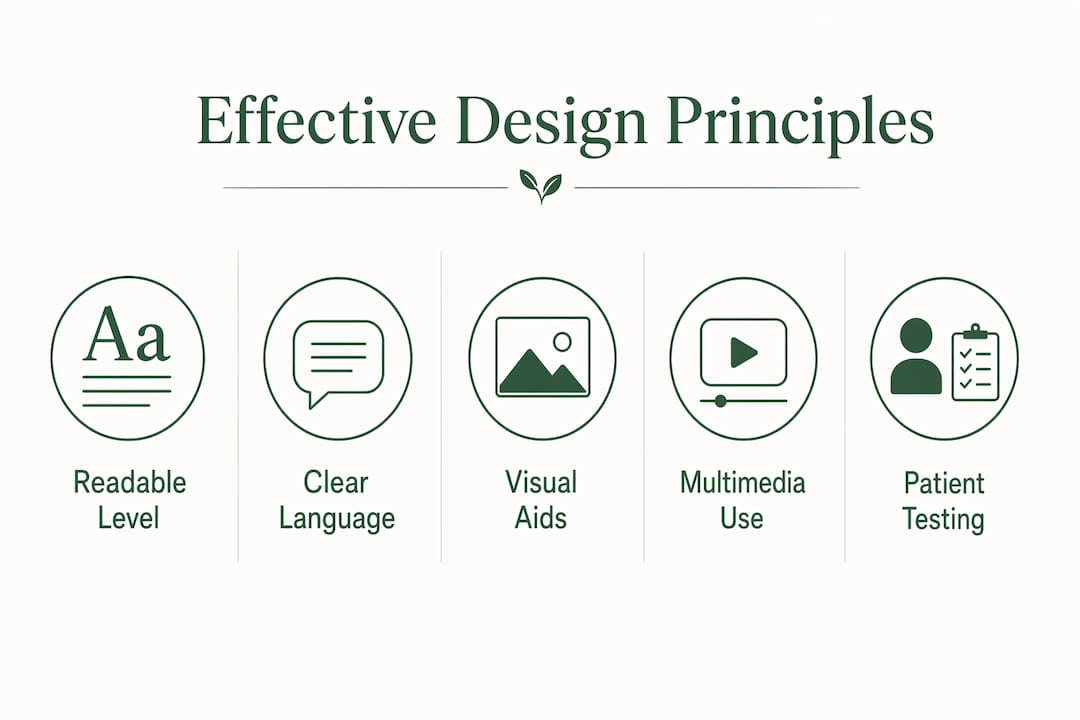
The most common failure in patient education materials is writing them at the wrong reading level. Most patient-facing documents are written at a 14th-grade reading level. The NIH recommends a 6th-grade reading level for all patient materials. That gap is not a minor stylistic issue. It is the primary reason patients leave appointments confused and non-compliant.
This problem has a name in cognitive science: the “curse of knowledge.” Healthcare professionals unconsciously overestimate how much patients already know. The result is materials written too complex for the average patient to use. Fixing it requires deliberate effort, including patient-centered writing reviews and health literacy expertise at the drafting stage.
Effective guides also use a three-tier information hierarchy. Research shows that healthcare professionals and patients prioritize different information: professionals focus on procedural accuracy, while patients focus on safety and clarity. A well-structured guide addresses both by organizing content into three layers.
- Basic Treatment and Safety: What the patient needs to know to stay safe and take action
- Professional Medication Support: Clinical details for providers and pharmacists
- Additional Attribute Reference: Supplementary information for those who want deeper context
Multimedia elements add another layer of effectiveness. Animation, short video clips, and audio narration help patients who struggle with written text. QR codes on medicine packaging now link to digital leaflets with video and audio support, multilingual translations, and adjustable font sizes. These features serve patients with low literacy, visual impairments, or limited English proficiency.
| Design Element | Why It Matters |
|---|---|
| 6th-grade reading level | Matches NIH standards and improves compliance |
| Three-tier content hierarchy | Serves both patient and provider needs in one document |
| Multimedia and QR links | Increases accessibility for diverse patient populations |
| Relatable analogies | Counters the curse of knowledge bias in clinical writing |
Pro Tip: Have a patient or caregiver with no clinical background read your draft before finalizing it. If they cannot explain the key points back to you, the guide needs revision.
What formats do medical explainer guides come in?
Medical explainer guides exist across a wide range of formats, and the right choice depends on the audience and the complexity of the information. Static printed leaflets work well for straightforward instructions, such as pre-appointment preparation or post-procedure wound care. They are low cost, easy to distribute, and do not require any technology to use.
Dynamic digital formats serve more complex needs. Medical 3D animation videos improve clarity and trust by visualizing biological processes that are impossible to show with text alone. A 3D animation of how a blood clot forms, for example, gives patients a concrete mental model that a written description rarely achieves. These videos also standardize communication, so every patient receives the same accurate explanation regardless of which provider they see.
AI-generated video explainers represent the newest category. These tools can produce multilingual content quickly, update automatically when clinical guidelines change, and be distributed through patient portals or QR codes. For healthcare organizations managing large patient populations, this scalability matters. A single updated video can reach thousands of patients overnight.
Different formats also serve different audiences within the same care episode.
- Patients benefit most from plain-language leaflets, short animated videos, and QR-linked audio guides
- Caregivers need the same clarity as patients, plus practical guidance on monitoring and when to seek help
- Clinicians use reference-level guides with procedural detail and clinical decision support
Knowing which format to use for which audience is a design decision, not an afterthought. The importance of medical guides increases when the format matches the audience’s actual needs and abilities.
How can healthcare settings implement explainer guides effectively?
Implementation is where most patient education programs fall short. A well-designed guide sitting in a storage room does nothing. Getting guides into clinical workflows requires a deliberate process.
- Standardize content across departments. Conflicting instructions from different providers are a leading source of patient confusion. Standardized explainer content across an organization eliminates contradictory messaging and builds patient trust.
- Involve health literacy specialists in script development. Clinical accuracy and plain language are both required. A clinician alone rarely achieves both. Health literacy specialists close that gap.
- Use digital tools for multilingual distribution. Patient portals, QR codes, and text message links make it possible to deliver guides in a patient’s preferred language without printing costs.
- Apply the teach-back method at every appointment. After giving a patient a guide, ask them to explain the key points back to you. This confirms comprehension and identifies gaps before the patient leaves the office.
Gardenstatemedicalgroup integrates patient education into its primary care and chronic care programs, recognizing that guides are most effective when they are part of a structured care conversation, not a standalone handout. Providers who treat guides as a conversation starter, rather than a replacement for conversation, see the strongest results. Learning proven ways to improve patient outcomes starts with consistent, accessible communication at every touchpoint.
Pro Tip: Build a quarterly review cycle for all patient-facing materials. Clinical guidelines change, and outdated guides can cause as much harm as no guide at all.
What challenges and trends are shaping medical guide development?
The biggest barriers to effective patient education materials are cost, organizational inertia, and health literacy gaps. Producing high-quality animated or multilingual content requires upfront investment that many smaller practices cannot easily absorb. Organizational inertia keeps outdated printed materials in circulation long after guidelines have changed.
Health literacy remains a persistent challenge. A significant portion of American adults read below a 6th-grade level, which means even well-designed guides can miss a large segment of the patient population. Information overload is a related problem. Guides that try to cover everything often communicate nothing clearly.
Emerging trends are addressing these barriers directly.
- AI content generation tools now produce draft patient education scripts in minutes, reducing production costs
- Electronic health record integration allows guides to be automatically assigned based on a patient’s diagnosis
- Adaptive video platforms adjust content complexity based on patient responses
- Audio narration and font scaling features make digital guides accessible to patients with visual or cognitive impairments
“The future of patient education lies in content that updates itself, reaches patients in their own language, and meets them at their actual reading level.”
Regulatory momentum is also building. Digital leaflets linked via QR codes are gaining acceptance as a supplement or replacement for printed inserts, enabling real-time content updates without reprinting costs. The impact of medical explainer tools will only grow as these technologies become standard in clinical practice.
Key Takeaways
Medical explainer guides are the most direct tool healthcare providers have for improving patient safety, compliance, and communication quality.
| Point | Details |
|---|---|
| Reading level determines compliance | NIH recommends a 6th-grade reading level; most materials are written at a 14th-grade level. |
| Anxiety drops with video explainers | Pre-procedure animated videos reduce patient anxiety by 20–30% and lower cancellation rates. |
| Three-tier hierarchy serves everyone | Structuring content for patients, providers, and reference users improves guide effectiveness. |
| Standardization reduces confusion | Consistent messaging across departments prevents conflicting instructions from undermining care. |
| Teach-back confirms real understanding | Asking patients to restate key points identifies comprehension gaps before they cause harm. |
What I have learned from watching patient education fail in real time
Working closely with healthcare communication over the years, the pattern I see most often is not a lack of effort. Providers genuinely want patients to understand their conditions. The failure is almost always a mismatch between how the guide was written and how the patient actually reads.
The curse of knowledge is real, and it is stubborn. Clinicians who have spent years mastering a subject genuinely cannot see how confusing their explanations are to someone hearing the terminology for the first time. I have watched patients nod through an explanation, take the printed guide home, and call back the next day with the same questions. The guide did not fail because the information was wrong. It failed because the information was inaccessible.
The fix is not complicated, but it requires humility. You have to let someone outside the clinical world read your materials before they go to patients. You have to accept that a simpler sentence is almost always a better sentence. And you have to treat patient-centered care as the organizing principle of every guide you produce, not just a value statement on a wall.
The providers who get this right do not just hand out better pamphlets. They build patients who show up prepared, ask better questions, and follow through on their treatment plans. That is the real return on investing in quality patient education materials.
— Krunal
Patient education at Gardenstatemedicalgroup
Gardenstatemedicalgroup brings together primary care, cardiopulmonary care, and chronic disease management under one roof in North Bergen and Secaucus, New Jersey. Patient education is built into every service line, from preventive screenings to long-term condition management.
Whether you are managing a chronic condition or supporting a family member through a new diagnosis, Gardenstatemedicalgroup’s care teams use clear, accessible communication at every appointment. Explore primary care services designed to keep you informed and in control of your health. For patients managing heart or lung conditions, cardiopulmonary care at Gardenstatemedicalgroup includes structured education as part of every care plan. Contact the team today to schedule an appointment and experience care that puts your understanding first.
FAQ
What is the role of medical explainer guides in patient care?
Medical explainer guides translate complex clinical information into clear, accessible content that patients and caregivers can act on. They improve treatment adherence, reduce anxiety, and lower the rate of adverse events.
What reading level should patient education materials use?
NIH standards recommend a 6th-grade reading level for all patient-facing materials. Most current materials are written at a 14th-grade level, creating a significant comprehension gap.
How do animated explainer videos help patients?
Pre-procedure animated videos reduce patient anxiety by 20–30% and decrease last-minute procedure cancellations, improving both patient experience and care continuity.
What is the three-tier information hierarchy in medical guides?
The three-tier hierarchy organizes content into basic treatment and safety information for patients, professional medication support for clinicians, and additional reference details for those who need deeper context.
How does standardizing explainer content benefit healthcare organizations?
Standardized patient education materials eliminate conflicting instructions across departments, reduce patient confusion, and create a consistent communication experience regardless of which provider a patient sees.