
What integrated healthcare means for your health

TL;DR:
- Integrated healthcare connects care providers with shared records and coordinated plans, improving patient outcomes.
- Patients can proactively ask about care coordination to ensure mechanisms are in place for truly integrated, patient-centered services.
You see three different doctors, take four medications prescribed by separate providers, and somehow no one seems to have the full picture. That experience is more common than it should be, and it’s not a reflection of poor care from any single provider. It’s what happens when the system itself isn’t designed to connect the dots. Integrated healthcare exists to solve exactly that problem. This article breaks down what integrated healthcare actually means, how it supports people managing chronic conditions, why preventive care is central to it, and what barriers exist when systems try to put it into practice.
Table of Contents
- What is integrated healthcare?
- How integrated healthcare addresses chronic conditions
- The role of preventive care in integrated healthcare
- Overcoming barriers in integrated healthcare implementation
- A fresh perspective: What most articles miss about integrated healthcare
- Explore integrated healthcare solutions in North Bergen and Secaucus
- Frequently asked questions
Key Takeaways
| Point | Details |
|---|---|
| Definition clarified | Integrated healthcare coordinates all aspects of care for a seamless patient experience. |
| Chronic care benefits | Integrated models lead to better management and outcomes for chronic conditions. |
| Prevention prioritized | Preventive care is central, with regular screenings and counseling made accessible. |
| Barriers exist | Financial and operational hurdles can limit true integration but are being addressed by innovative solutions. |
| Local access | Residents in North Bergen and Secaucus can find integrated care solutions close to home. |
What is integrated healthcare?
Many people assume that better healthcare means more specialists, more tests, or more appointments. In reality, quantity alone doesn’t improve outcomes if those services aren’t working together. Integrated healthcare coordinates the design and delivery of care across fragmented parts of the health system so people receive a continuum of services aligned to their needs. That’s the core idea: connection over volume.
Think about what this looks like in practice. Your primary care doctor, cardiologist, and nutritionist all have access to the same health record. Your lab results are shared automatically. Your care plan is updated in one place, and every provider who touches your case knows what the others have done. That’s integrated healthcare working as intended.
There are a few key components that make it function:
- Care coordination: A clear process for how providers communicate and transfer information about your care.
- Aligned administration: Billing, scheduling, and records systems that support rather than block communication.
- Comprehensive services: Access to primary care, specialty care, mental health, and preventive services within one framework.
- Shared accountability: Providers are measured on outcomes for the whole patient, not just their individual department.
One important nuance worth understanding: not all “integrated” programs are the same. Integration can mean different things depending on the context, ranging from coordination without unified financing or administration to deeper system-level integration of clinical teams, payment structures, and governance. So when a healthcare system says it offers integrated care, it’s worth asking what exactly is being integrated.
“Integrated people-centered health services shift systems away from being organized around diseases or institutions and toward systems organized around people, with services coordinated across the continuum of care.” — World Health Organization
That shift in orientation matters. It changes who the system is built for. Instead of optimizing around departments, procedures, or institutional efficiency, integrated systems are built around your experience as a patient. For residents in North Bergen and Secaucus navigating multiple chronic conditions or simply trying to stay healthy, that design difference is significant. You can also explore integrative health benefits to see how evidence-based approaches are reshaping what coordinated care looks like in real settings.
How integrated healthcare addresses chronic conditions
Managing a chronic condition like diabetes, hypertension, or heart disease is rarely simple. It typically involves multiple providers, ongoing monitoring, medication adjustments, and lifestyle changes. When those elements aren’t coordinated, patients fall through the gaps. Appointments get duplicated, critical information gets lost, and prevention opportunities are missed.
Integrated care for chronic disease can be implemented at scale by shifting care from hospitals to communities, with proactive prevention and timely specialist input closer to where patients live. This is a meaningful change. Instead of managing your condition primarily through emergency visits or reactive hospital care, the work happens in the community, earlier, and more consistently.

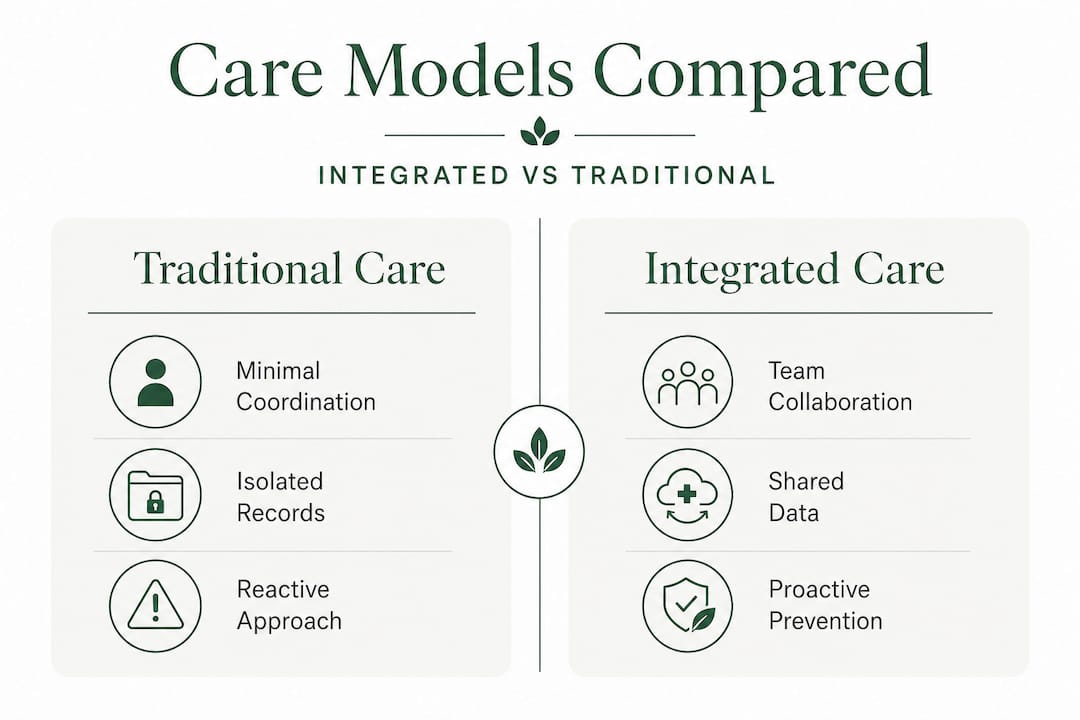
Here’s how traditional care compares to integrated chronic care:
| Feature | Traditional care | Integrated chronic care |
|---|---|---|
| Care coordination | Minimal, provider-dependent | Systematic and team-based |
| Patient records | Siloed by provider or system | Shared across care team |
| Specialist involvement | Referral-based, often delayed | Timely and coordinated |
| Prevention focus | Reactive | Proactive and ongoing |
| Patient communication | Fragmented, inconsistent | Centralized, clear |
| Accountability | Per-provider | Shared across the care team |
The benefits are clear on paper, but making this work in practice requires more than good intentions. Integrated care for chronic conditions requires operational capabilities including care coordination workflows and information sharing, as well as alignment of incentives and payment structures. Without those operational foundations, fragmentation tends to persist even when the clinical intent is there.
For patients, this means it’s worth being proactive. Review these chronic management tips to understand how you can actively participate in your care plan. You can also explore what care coordination benefits look like in a functioning integrated model, and use this chronic disease management guide to understand what questions to ask your care team.
Common barriers that can undermine integrated chronic care include:
- Resistance to change from providers or departments accustomed to working independently.
- Information system gaps where electronic health records don’t communicate across platforms.
- Unequal access in communities where integration is inconsistently applied.
- Incentive misalignment where providers are still rewarded for volume rather than coordinated outcomes.
Pro Tip: Ask your care team directly whether there is a coordinated management plan in place for your chronic condition. If different providers aren’t sure what the others have prescribed or recommended, that’s a signal to request better coordination.
The chronic care management program at Garden State Medical Group is one example of how structured, team-based approaches to chronic care can make a real difference for patients in this region.
The role of preventive care in integrated healthcare
Chronic conditions are only one part of the story. Integrated healthcare also places heavy emphasis on prevention, and for good reason. Catching a problem early is almost always better than managing it after it’s advanced.
Preventive care is a core complement to integrated healthcare because it includes screenings, vaccines, check-ups, and counseling intended to prevent illness and limit the impact of chronic diseases. When these services are coordinated within an integrated system, they become far more effective than when they’re delivered in isolation.
Here’s a look at common preventive services and their specific benefits:
| Preventive service | What it detects or prevents | Why it matters |
|---|---|---|
| Blood pressure screening | Hypertension | Early detection prevents stroke and heart disease |
| Cholesterol testing | Cardiovascular risk | Guides medication and lifestyle decisions |
| Blood glucose screening | Prediabetes and diabetes | Early intervention can reverse prediabetes |
| Cancer screenings | Colon, breast, cervical cancers | Significantly improves survival rates |
| Vaccines | Flu, pneumonia, shingles, and more | Reduces severity of illness and hospitalization |
| Annual wellness check-ups | Overall health status | Establishes baseline and catches emerging issues |
| Lifestyle counseling | Weight, smoking, alcohol use | Supports behavior change before conditions develop |
When these services are delivered within an integrated framework, your providers can see which screenings are due, flag gaps in care, and follow up consistently. That’s a very different experience from receiving a screening in one location with results that never reach your primary care doctor.
To make preventive care a consistent part of your health routine, consider these steps:
- Schedule an annual wellness visit with your primary care provider and bring a list of any symptoms or concerns.
- Ask specifically which screenings are recommended for your age, sex, and personal health history.
- Make sure your providers have updated records so screenings aren’t unnecessarily repeated.
- Track your own results over time, including blood pressure readings, lab values, and vaccine history.
- Follow up on any abnormal results promptly instead of waiting for your next scheduled appointment.
Pro Tip: At every appointment, ask your provider, “What screenings am I due for this year?” Most people don’t ask, and as a result, important preventive services get missed. Understanding the preventive care benefits available to you is the first step toward using them consistently. You can also review types of preventive care to build a clearer picture of what belongs in your personal health plan.
Overcoming barriers in integrated healthcare implementation
Understanding the benefits and core concepts of integrated healthcare is one thing. But putting it into practice across a healthcare system is genuinely difficult. There are real operational, financial, and cultural obstacles that affect how well integration actually works.
One of the sharpest criticisms of integrated care reforms is that they can fail if the financial side isn’t aligned. Some critics argue that integrated care reforms may be undermined if financial accountability and incentives are not aligned. Without budget and performance accountability, moving care into the community can threaten organizational viability or create turf conflicts between institutions competing for the same patients or funding.
“Without accountability built into the structure, integration becomes a label rather than a practice.” — Integrated Care Journal
This matters for you as a patient because it explains why two systems that both claim to offer integrated care can produce very different experiences. One might have genuine information sharing, a coordinated care team, and shared accountability. Another might simply have co-located services with no real coordination behind the scenes.
Common barriers to watch for include:
- Turf conflicts where hospitals, specialist groups, and community providers compete rather than collaborate.
- Misaligned payment models that reward individual procedures rather than coordinated outcomes.
- Technology gaps where different electronic health record systems can’t share information.
- Cultural resistance from clinical staff who are used to working independently.
- Unclear accountability where no single person or team is responsible for overall patient outcomes.
Systems that overcome these barriers tend to invest in clearer performance metrics, patient-centered incentive models, and practical workflow redesign. Transparency also plays a significant role. You can learn more about transparency in wellness and how it informs better healthcare decisions. For providers, resources like a streamlined preventive workflow show how practical operational changes can make a measurable difference in patient care.
A fresh perspective: What most articles miss about integrated healthcare
Most discussions of integrated healthcare focus on structure: shared records, care teams, coordinated payments. Those elements matter. But they’re not what makes integration actually work for patients. What most articles miss is that the real test of integration is cultural, not structural.
You can build the most sophisticated electronic health record system, hire an entire care coordination team, and align payment incentives perfectly. If the clinicians involved don’t believe in shared accountability, if the teams don’t communicate proactively, and if the patient’s experience is still confusing and repetitive, then the system is integrated in name only.
Real integration shows up in subtle ways. It’s your doctor knowing what your cardiologist told you last month without you having to repeat it. It’s a care coordinator calling you before a follow-up falls through the cracks. It’s a care plan that actually reflects your priorities, not just your diagnoses. When those things happen consistently, that’s when integration delivers real value.
The uncomfortable truth is that the word “integrated” is used frequently and loosely in healthcare marketing. It doesn’t always mean what patients need it to mean. So rather than taking a system’s word for it, test it. When you receive care from multiple providers, ask directly: How does my information travel between your team and my other doctors? What happens if I miss an appointment? Who is responsible for following up with me?
If those answers are vague or inconsistent, that’s useful information. You can explore chronic care improvement steps to see what a genuinely coordinated care experience looks like in practice.
Pro Tip: Don’t hesitate to ask your provider, “How is my care coordinated across your team?” A confident, specific answer is a good sign. Vague reassurances are worth probing further.
The most important insight here is this: integration succeeds when the culture, incentives, and accountability structures support it. Technology and structure can enable it. But people and motivation sustain it.
Explore integrated healthcare solutions in North Bergen and Secaucus
If this article has clarified what integrated healthcare is and why it matters, the next step is finding it close to home.
At Garden State Medical Group, patients in North Bergen and Secaucus have access to a genuinely coordinated care experience designed around their health needs. From primary care specialties that serve as the foundation of your health management to structured programs like the chronic care management program and the diabetes prevention program, the services here are built to work together. Whether you are managing an existing condition, focused on prevention, or simply looking for a care team that communicates well, Garden State Medical Group offers a practical, community-based approach to integrated health.
Frequently asked questions
How does integrated healthcare differ from traditional healthcare?
Integrated healthcare aligns and coordinates services across providers so that your care feels connected and consistent, whereas traditional care often operates in siloed departments, leading to fragmented patient experiences where information doesn’t follow you between providers.
What makes preventive care a core part of integrated healthcare?
Preventive care fits naturally within integrated models because it includes screenings, vaccines, check-ups, and counseling that can be coordinated systematically across your care team, catching diseases early and reducing the long-term burden of chronic conditions.
Are there challenges to implementing integrated healthcare?
Yes, real challenges exist including misaligned financial incentives, resistance from providers accustomed to independent practice, and the risk of inequities if integrated programs are applied unevenly across communities or patient populations.
How can I access integrated healthcare services in North Bergen or Secaucus?
You can schedule an appointment with Garden State Medical Group, which offers integrated care programs in both North Bergen and Secaucus, including preventive services and structured chronic disease management for local residents.
What should I ask my provider to ensure my care is truly integrated?
Ask specifically how your health information, care plans, and treatments are coordinated across all providers involved in your care, and find out who is responsible for following up if something changes or a result needs attention.