
What Is Patient-Centered Care? A Clear Guide for Patients

TL;DR:
- Patient-centered care involves respecting individual preferences and values to guide clinical decisions. Healthcare systems are redesigning workflows to foster collaboration, coordination, and active patient involvement. This approach improves satisfaction, adherence, and overall health outcomes.
Patient-centered care is defined as medical care that respects and responds to individual patient preferences, needs, and values, ensuring those values guide every clinical decision. The Institute of Medicine established this definition in 2001, and it remains the standard framing used by healthcare systems across the United States. You are not a passive recipient in this model. You are an active partner. Organizations like the Picker Institute, the Centers for Medicare and Medicaid Services (CMS), and the Australian Commission on Safety and Quality in Health Care all build their care frameworks around this same core idea. Understanding what patient-centered care means helps you ask better questions, choose better providers, and get more from every appointment.
What is patient-centered care, and what are its core principles?
Patient-centered care organizes medical treatment around the whole person, not just the diagnosis. The Picker Institute identified eight domains that define this approach in practice. Each domain addresses a specific dimension of the patient experience.
Those eight domains are:
- Respect for patient preferences. Your cultural background, personal values, and stated wishes shape treatment decisions.
- Coordination and integration of care. Providers across specialties share information so your care does not fall through the gaps between appointments.
- Information, communication, and education. Explanations match your health literacy level, not a medical textbook.
- Physical comfort. Pain management and physical needs receive direct attention, not just the underlying condition.
- Emotional support. Anxiety and fear about illness are acknowledged and addressed.
- Involvement of family and friends. Your support network participates at the level you choose.
- Continuity and care transitions. Handoffs between providers, hospitals, and home care are planned and communicated clearly.
- Access and availability. Appointments, after-hours advice, and specialist referrals are reachable without unnecessary barriers.
The Australian Commission on Safety and Quality in Health Care describes this as seeking to understand what matters most to the patient and then setting goals together. That phrase, “what matters to you,” is the practical test of whether a provider is truly practicing patient-centered care.
Pro Tip: Before your next appointment, write down your top two concerns and your personal health goals. Sharing these at the start of the visit signals to your provider that you expect a collaborative conversation, not a one-way briefing.

How does patient-centered care differ from traditional care?
Traditional disease-centered care focuses on identifying a condition, treating it, and discharging the patient. Patient-centered care focuses on the person living with that condition. The difference sounds subtle, but it changes nearly every part of the clinical encounter.
| Dimension | Disease-centered care | Patient-centered care |
|---|---|---|
| Primary focus | Diagnosis and treatment | Whole person and context |
| Patient role | Passive recipient | Active partner |
| Decision-making | Physician-directed | Collaborative and shared |
| Success measure | Clinical test results | Patient goals and quality of life |
| Communication style | Provider explains, patient listens | Two-way dialogue with questions encouraged |
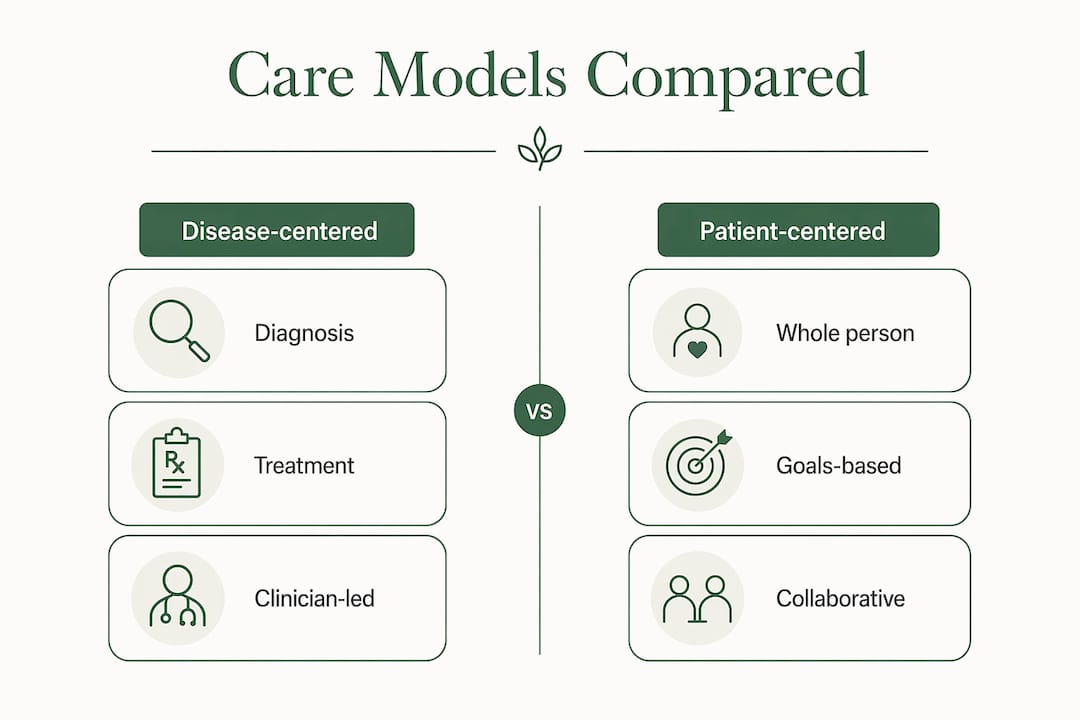
A partnership model treats patients and families as active participants who set goals, ask questions, and make informed choices. This shift matters most in chronic disease management. A patient managing Type 2 diabetes, for example, is far more likely to follow a treatment plan they helped design than one handed to them without discussion. Adherence improves when the plan reflects the patient’s daily life, food preferences, and work schedule.
The power shift from physician-directed to collaborative care also changes how providers communicate. In a disease-centered model, a doctor might say, “You need to take this medication.” In a patient-centered model, the same conversation becomes, “Here are your options. What fits your life best?” That distinction produces measurably different outcomes in long-term care.
Pro Tip: If a provider does not ask about your preferences or goals, ask directly: “What are my options here, and what are the trade-offs?” That question opens the door to a more collaborative conversation.
How do leading healthcare organizations implement patient-centered care?
Knowing the definition is one thing. Putting it into practice across a health system requires deliberate redesign. Research based on interviews with 15 successful Medicare accountable care organizations in 2026 found that leading organizations operationalize patient-centered care through three consistent strategies: patient partnership, proactive service orientation, and whole-person coordinated care.
Here is how those strategies translate into real operations:
-
Engage patients as partners in care planning. Providers invite patients to co-create treatment goals rather than simply prescribing them. This includes structured goal-setting conversations at every visit.
-
Build proactive service access. Same-day appointments, after-hours nurse lines, and patient portals reduce the friction between a patient’s need and the care they receive.
-
Coordinate care across settings. A patient moving from hospital to rehabilitation to home care needs a single coordinated plan, not three separate ones. Successful organizations assign care coordinators who manage these transitions directly. You can read more about why care coordination matters for long-term health outcomes.
-
Use decision-support tools. Decision-support tools and patient activation increase the likelihood that patients choose treatments aligned with their values and improve adherence. These tools include visual aids, question prompt lists, and shared decision-making guides.
-
Measure patient experience systematically. CMS mandates the use of HCAHPS surveys to measure hospital patient experience across dimensions like communication, coordination, and discharge information. Results affect quality ratings and Medicare reimbursement directly.
The critical insight from successful systems is that patient-centered care requires redesigning care workflows beyond isolated clinician behaviors. One empathetic doctor cannot carry the entire model alone. The scheduling system, the follow-up process, and the referral pathway all need to reflect the same patient-first values.
| Implementation area | What it looks like in practice |
|---|---|
| Care planning | Patients co-create goals at every visit |
| Access | Same-day slots and patient portal messaging |
| Transitions | Assigned care coordinators manage handoffs |
| Measurement | HCAHPS scores tracked and acted upon |
What are the benefits of patient-centered care?
The benefits of patient-centered care extend to both patients and the health systems that serve them. Patient-centered care leads to higher satisfaction, lower readmissions, stronger patient relationships, and better value for health systems. Each of those outcomes has a direct effect on your experience as a patient.
The specific benefits include:
- Higher satisfaction scores. Patients who feel heard and respected consistently report better experiences, which shows up in HCAHPS results and public quality ratings.
- Better treatment adherence. When your care plan reflects your values and daily life, you are more likely to follow it consistently.
- Fewer hospital readmissions. Coordinated discharge planning and clear follow-up instructions reduce the likelihood of returning to the hospital within 30 days.
- Stronger emotional well-being. Being treated with dignity and having your concerns acknowledged reduces anxiety and builds trust in your care team.
- Financial benefits for health systems. Lower readmission rates and better chronic disease management reduce costs. CMS ties reimbursement to HCAHPS performance, creating a direct financial incentive for hospitals to prioritize patient experience.
Proactive health management, which patient-centered care actively supports, also reduces the burden of preventable conditions over time. Patients who engage regularly with their care team and understand their treatment options tend to catch problems earlier and avoid costly interventions. Learning about proven ways to improve patient outcomes gives you a clearer picture of how this approach translates to real health gains.
The emotional dimension deserves specific attention. Feeling dismissed or unheard during a medical visit is not just frustrating. Research consistently links poor patient-provider communication to lower adherence and worse outcomes. Patient-centered care addresses this directly by treating your concerns as clinically relevant information, not background noise.
Key Takeaways
Patient-centered care, defined by the Institute of Medicine in 2001, produces better outcomes when it reshapes entire care workflows around patient values, not just individual provider behaviors.
| Point | Details |
|---|---|
| Core definition | Patient-centered care means clinical decisions are guided by your preferences, needs, and values. |
| Eight domains | The Picker Institute identified eight domains including respect, coordination, access, and emotional support. |
| Key difference from traditional care | Patients shift from passive recipients to active partners in goal-setting and decision-making. |
| Implementation requires system redesign | Successful organizations redesign workflows, access, and transitions, not just clinician communication styles. |
| Measurable benefits | Higher satisfaction, lower readmissions, better adherence, and stronger financial performance for health systems. |
Why patient-centered care is harder than it sounds
I have spent years watching healthcare organizations announce a commitment to patient-centered care and then change almost nothing about how they actually operate. The language shifts. The workflows do not. That gap is where patients get hurt.
The most common misconception is that patient-centered care is primarily about bedside manner. It is not. A warm, empathetic physician working inside a broken scheduling system, a fragmented referral process, and a discharge plan that no one explained clearly cannot deliver patient-centered care on their own. The system has to be redesigned, not just the conversation.
What I find genuinely encouraging in 2026 is that more organizations are treating patient-centered care as an operational standard, not a communication style. The use of HCAHPS scores tied to reimbursement has forced health systems to take patient experience seriously at the administrative level. That financial pressure is producing real structural change.
My advice to you as a patient is direct: ask your provider what your options are, not just what the plan is. Ask who coordinates your care if you see multiple specialists. Ask what happens after your visit. Those three questions reveal quickly whether a practice is operating a patient-centered model or just describing one.
— Krunal
Patient-centered care at Gardenstatemedicalgroup
Gardenstatemedicalgroup, serving patients in North Bergen and Secaucus, New Jersey, builds its care model around the principles described throughout this article.
The practice integrates primary care services with cardiopulmonary care, radiology, and specialized programs for diabetes, bone health, lung health, and weight management. Each program is designed around individual patient needs, with coordinated care across specialties and personalized treatment planning. Patients managing chronic conditions can access the chronic care management program, which applies whole-person coordination to long-term health goals. Gardenstatemedicalgroup accepts most major insurance plans and offers convenient scheduling at both locations. If you are looking for a provider who treats you as a partner in your own care, Gardenstatemedicalgroup is worth a closer look.
FAQ
What is the definition of patient-centered care?
Patient-centered care is medical care that respects and responds to individual patient preferences, needs, and values, ensuring those values guide all clinical decisions. The Institute of Medicine established this definition in 2001.
What are the eight domains of patient-centered care?
The Picker Institute identified eight domains: respect for preferences, care coordination, communication and education, physical comfort, emotional support, family involvement, care transitions, and access to care.
How does patient-centered care improve health outcomes?
Patient-centered care improves outcomes by increasing treatment adherence, reducing hospital readmissions, and strengthening the patient-provider relationship. Decision-support tools and patient activation further align treatment choices with patient values.
What is the difference between patient-centered and disease-centered care?
Disease-centered care focuses on diagnosing and treating a condition. Patient-centered care focuses on the whole person, shifting decision-making from physician-directed to collaborative and goal-oriented.
How is patient-centered care measured in hospitals?
CMS mandates the HCAHPS survey to measure patient experience across communication, coordination, and discharge information. Results are publicly reported and directly affect hospital reimbursement rates.